
Skip to Navigation Skip to Content
University of Otago, New Zealand
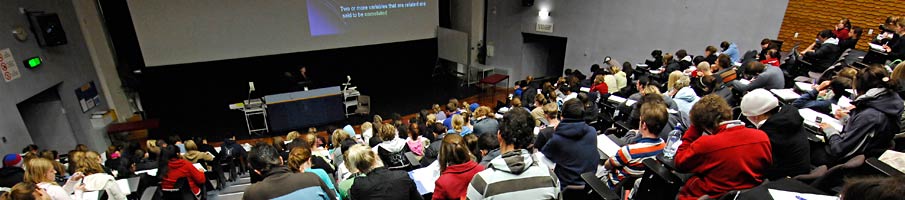
Students taking notes in a lecture

Sciences Lectures

Inaugural Professorial Lectures, public lectures and events from the Division of Sciences.

You can add this podcast to your feed reader or you can add it to iTunes.

IPL: Dave Prior - Mapping crystals to underestand gold, glaciers and earthquakes (60.53 MB)
Thursday, 10 May 2012
Inaugural Professorial Lecture from Dave Prior, head of Geology at University of Otago. The lecture was entitled "Mapping crystals to understand gold, glaciers and earthquakes" and was delivered on Thursday the 22nd of September, 2011

IPL: Dave Prior - Mapping crystals to underestand gold, glaciers and earthquakes (350.42 MB)
Thursday, 10 May 2012
Inaugural Professorial Lecture from Dave Prior, head of Geology at University of Otago. The lecture was entitled "Mapping crystals to understand gold, glaciers and earthquakes" and was delivered on Thursday the 22nd of September, 2011

IPL: Gary Wilson: Shall we lower the lifeboats? A marine ecological view of warming climates (262.16 MB)
Wednesday, 2 May 2012
Inaugural Professorial Lecture from Gary Wilson, head of Marine Science and researcher in Geology at University of Otago. The lecture was entitled "Shall we lower the lifeboats? A marine ecological view of warming climates." The lecture was delivered on Thursday the 1st of September, 2011

IPL: Gary Wilson: Shall we lower the lifeboats? A marine ecological view of warming climates - Audio (49.82 MB)
Wednesday, 2 May 2012
Inaugural Professorial Lecture from Gary Wilson, head of Marine Science and researcher in Geology at University of Otago. The lecture was entitled "Shall we lower the lifeboats? A marine ecological view of warming climates." The lecture was delivered on Thursday the 1st of September, 2011

IPL: Ken Hodge : Sports Psychology; its the thought that counts - Video (427.54 MB)
Tuesday, 1 May 2012
Inaugural Professorial Lecture from Ken Hodge of the School of Physical Education. The lecture was entitled "Sports Psychology: It's the thought that counts." The IPL was delivered on Tuesday 17th of April 2012.

IPL: Ken Hodge : Sports Psychology: its the thought that counts - Audio (72.12 MB)
Tuesday, 1 May 2012
Inaugural Professorial Lecture from Ken Hodge of the School of Physical Education. The lecture was entitled "Sports Psychology: It's the thought that counts." The IPL was delivered on Tuesday 17th of April 2012.

Geoff Baylis Lecture 2009 - Video (129.08 MB)
Friday, 27 April 2012
The Geoff Baylis lectures are a joint initiative between the Otago Botanical Society and the Department of Botany, University of Otago. This lecture was presented by Associate Professor Daphne Lee, a paleo-botanist. The title is "Palms, Podocarps, orchids and proteads: the contribution of new fossil plants from Otago and Southland to our understanding of NZ's vegetation history." The lecture was given on the 16th of September 2009.

Geoff Baylis Lecture 2009 (69.03 MB)
Friday, 27 April 2012
The Geoff Baylis lectures are a joint initiative between the Otago Botanical Society and the Department of Botany, University of Otago. This lecture was presented by Associate Professor Daphne Lee, a paleo-botanist. The title is "Palms, Podocarps, orchids and proteads: the contribution of new fossil plants from Otago and Southland to our understanding of NZ's vegetation history." The lecture was given on the 16th of September 2009.

Setting priorities for science - Sir Peter Gluckman Video (359.82 MB)
Friday, 27 April 2012
Professor Sir Peter Gluckman is Chief Science Advisor in the Office of the Prime Minister's Science and Advisory Committee. He delivered this special lecture at University of Otago, outlining priorities for science in New Zealand and in a broader context. The lecture is entitled "Setting Priorities for Science" and it was delivered on Tuesday 24th April 2012.

Setting priorities for science - special lecture by Sir Peter Gluckman (58.78 MB)
Friday, 27 April 2012
Professor Sir Peter Gluckman is Chief Science Advisor in the Office of the Prime Minister's Science and Advisory Committee. He delivered this special lecture at University of Otago, outlining priorities for science in New Zealand and in a broader context. The lecture is entitled " setting Priorities for Science" and it was delivered on Tuesday 24th April 2012.

Technologies in Sport Symposium - Session 5 (136.82 MB)
Friday, 30 March 2012
Disciplinary technologies, Andrew graduated from Queen's University in 1974. Currently Chief of the Division of Prevention and Rehabilitation at the University of Ottawa Heart Institute, he is a Professor in the Faculty of Medicine at the University of Ottawa. In addition to his clinical responsibilities, Andrew has been extensively involved in sports and sport medicine for many years. Currently he is the President of the Commonwealth Games Association of Canada, has served as a physician at eight Olympic Games and has been the Team Physician for Canada's National Men's Basketball Team since 1978. A member of the Canadian Olympic Hall of Fame, Andrew served as Chair of the Canadian Centre for Ethics in Sport from its inception until 2003. Enhancing Sport Performance: Character, Culture, Coaching or Chemistry? Attempts to enhance sport performance have traditionally reflected an accentuation of skill, a burnishing of sport-specific tactics, and an augmentation of ‘fitness’. A contemporary challenge in sport is to distinguish those enhancement strategies which are seen as in keeping with established norms of sport practice, and those which are viewed as transgressing a standard of ‘appropriate sporting behaviour’. The programmes designed to curb performance-enhancing drug use are intended to address such a challenge. Sport is practiced in accordance with rules and norms that are ultimately arbitrary. Those vested with responsibility for the preservation of ‘fair play’ apply rules that can also be seen as arbitrary – their approaches represent an application, in part, of the “disciplinary technologies” – but which seek to ensure safety, fair-play and enduring public support of sport. Held, September 2011.

Technologies in Sport Symposium - Session 3 (67.07 MB)
Friday, 30 March 2012
Technologies of the body, Gregor was a research scientist at the University of Calgary, Faculty of Medicine, for 16 years before, in 2008, becoming an Assistant Professor at the University of Calgary’s, Program in Community Rehabilitation and Disability Studies. Currently, he is also a part-time Professor in the Faculty of Law at the University of Ottawa in Canada. In addition, Gregor is a Distinguished Scholar in the Center for Nanotechnology in Society at Arizona State University, USA and Adjunct Faculty in the Critical Disability Studies at York University, Canada; the President of the Canadian Disability Studies Association and Chair of the Bioethics Taskforce of Disabled People's International. Un outil, une machine ce sont des organes, et des organes sont des outils ou des. Machines (1). (Tools and machines are kinds of organs, and organs are kinds of tools or machines; translation from (2)). Science and technology products and changing social concepts and values trigger continuously new sport and influence existing sport in general and the Olympics, Paralympics, and their relationship in particular by among others changing expectations of athletes, officials, spectators, sponsors and governments. Held, September 2011.

Technologies in Sport Symposium - Session 6 (71.29 MB)
Friday, 30 March 2012
Disciplinary technologies, Jim is an Associate Professor in the Faculty of Physical Education and Recreation, University of Alberta, Canada and Director of the Canadian Athletics Coaching Centre. A sport sociologist and coach educator, his research examines coach effectiveness and the social construction and historical formation of coaches’ practices through a Foucauldian lens. What Coaches Do: Problematizing Planning and Practice “Being a coach” largely revolves around the practice of planning what athletes need to do in training to improve and develop their potential. Three components of training that coaches control, and that greatly influence athletes’ capabilities, are the training spaces used, the monitoring of time, and the organization of exercises. The consideration of these elements, and their impact on athletes’ progression and capacity for performance, derive from Michel Foucault’s analysis of technologies of discipline. In this talk I will examine Foucault’s conceptualization of discipline and it effects on athletes’ bodies, as well as how coaches can enhance their understanding of planning and athlete development by problematizing what they have their athletes do. Held, September 2011.

Technologies in Sport Symposium - Session 5 (77.58 MB)
Friday, 30 March 2012
Disciplinary technologies, Andrew graduated from Queen's University in 1974. Currently Chief of the Division of Prevention and Rehabilitation at the University of Ottawa Heart Institute, he is a Professor in the Faculty of Medicine at the University of Ottawa. In addition to his clinical responsibilities, Andrew has been extensively involved in sports and sport medicine for many years. Currently he is the President of the Commonwealth Games Association of Canada, has served as a physician at eight Olympic Games and has been the Team Physician for Canada's National Men's Basketball Team since 1978. A member of the Canadian Olympic Hall of Fame, Andrew served as Chair of the Canadian Centre for Ethics in Sport from its inception until 2003. Enhancing Sport Performance: Character, Culture, Coaching or Chemistry? Attempts to enhance sport performance have traditionally reflected an accentuation of skill, a burnishing of sport-specific tactics, and an augmentation of ‘fitness’. A contemporary challenge in sport is to distinguish those enhancement strategies which are seen as in keeping with established norms of sport practice, and those which are viewed as transgressing a standard of ‘appropriate sporting behaviour’. The programmes designed to curb performance-enhancing drug use are intended to address such a challenge. Sport is practiced in accordance with rules and norms that are ultimately arbitrary. Those vested with responsibility for the preservation of ‘fair play’ apply rules that can also be seen as arbitrary – their approaches represent an application, in part, of the “disciplinary technologies” – but which seek to ensure safety, fair-play and enduring public support of sport. Held, September 2011.

Technologies in Sport Symposium - Session 1 (157.97 MB)
Friday, 30 March 2012
Technologies of the body, Grant Gillett is a Professor of biomedical ethics at the University of Otago. He is also a neurosurgeon and worked in clinical practice until 2006. He studied medicine at the Auckland Medical School and also completed a Masters degree in Psychology. He became an overseas fellow in Neurosurgery at The Radcliffe Infirmary and then completed a D.Phil at Oxford University and was appointed fellow of Magdalen College in 1985. Cyborgs are human-machine complexes with prosthetic abilities. Where the enhancements remediate a defect we are prepared to acknowledge their value but where they seem to create an unfair advantage over others we feel disturbed. How good can a person be before a compensation for their disability makes them differently abled being in quite another sense. We accept and even welcome enhancement of natural abilities in officials but direct advantaging of competitors is quite another thing. Why – when does good preparation and careful optimisation of ability cross a boundary and why do we care? A range of ethical arguments will be examined to see which, if any, give us a plausible and defensible line to take on this issue. Held, September 2011.

Technologies in Sport Symposium - Session 2 (182.40 MB)
Friday, 30 March 2012
Emerging technologies for performance enhancement, Damian holds a joint appointment within the School of Sport and Exercise Science / ISEAL Victoria University, and the Australian Institute of Sport (AIS) where he is responsible for the provision of quality research for both institutions. Damian was appointed as the inaugural AIS Skill Acquisition Specialist (2002) a role dedicated to providing Australian coaches with an evidence-based approach to skill development. Consistent with many other disciplines of sport and exercise science, Skill Acquisition practitioners now have more sophisticated technology at their disposal for both the measurement and development of skilled performance than ever before. Despite claims boasting refined measurement sensitivity, real-time feedback performance, and enhanced interactivity and fidelity, the relative efficacy of such tools is poorly understood. Held, September 2011.

Technologies in Sport Symposium - Session 3 (96.58 MB)
Friday, 30 March 2012
Technologies of the body, Gregor was a research scientist at the University of Calgary, Faculty of Medicine, for 16 years before, in 2008, becoming an Assistant Professor at the University of Calgary’s, Program in Community Rehabilitation and Disability Studies. Currently, he is also a part-time Professor in the Faculty of Law at the University of Ottawa in Canada. In addition, Gregor is a Distinguished Scholar in the Center for Nanotechnology in Society at Arizona State University, USA and Adjunct Faculty in the Critical Disability Studies at York University, Canada; the President of the Canadian Disability Studies Association and Chair of the Bioethics Taskforce of Disabled People's International. Un outil, une machine ce sont des organes, et des organes sont des outils ou des. Machines (1). (Tools and machines are kinds of organs, and organs are kinds of tools or machines; translation from (2)). Science and technology products and changing social concepts and values trigger continuously new sport and influence existing sport in general and the Olympics, Paralympics, and their relationship in particular by among others changing expectations of athletes, officials, spectators, sponsors and governments. Held, September 2011.

Technologies in Sport Symposium - Session 2 (67.66 MB)
Friday, 30 March 2012
Emerging technologies for performance enhancement, Damian holds a joint appointment within the School of Sport and Exercise Science / ISEAL Victoria University, and the Australian Institute of Sport (AIS) where he is responsible for the provision of quality research for both institutions. Damian was appointed as the inaugural AIS Skill Acquisition Specialist (2002) a role dedicated to providing Australian coaches with an evidence-based approach to skill development. Consistent with many other disciplines of sport and exercise science, Skill Acquisition practitioners now have more sophisticated technology at their disposal for both the measurement and development of skilled performance than ever before. Despite claims boasting refined measurement sensitivity, real-time feedback performance, and enhanced interactivity and fidelity, the relative efficacy of such tools is poorly understood. Held, September 2011.

Technologies in Sport Symposium - Session 4 (146.46 MB)
Friday, 30 March 2012
Emerging technologies for performance enhancement, Cathy is a Professor at the School of Psychology, Queen’s University Belfast. Having obtained her Ph.D. from the University of Edinburgh, she went on to take up a post-doc at the Sports Science Faculty, Marseille, France. It was here that she first encountered virtual reality. In a project funded by Adidas she was the first person to use this technology to simulate and understand the perception of curved free-kicks in soccer. Since joining QUB in 2005, she has built an immersive interactive VR lab where she is continuing to use this technology to study decision making in sport. Keynote abstract Virtual Reality Technology: How can it help us understand decision making in sport? Virtual reality provides the perfect adjunct to study perception/action and decision making in sport. It is in essence a sophisticated interactive and immersive human-computer interface where a sensory environment (visual, haptic and/or acoustic) is simulated by a computer and is controlled by the interactive behaviour of the user. It is a versatile methodological tool that gives the experimenter complete control over complex environmental conditions and allows for an in-depth analysis of the user’s behaviour. Held, September 2011.

Technologies in Sport Symposium - Session 6 (158.09 MB)
Friday, 30 March 2012
Disciplinary technologies, Jim is an Associate Professor in the Faculty of Physical Education and Recreation, University of Alberta, Canada and Director of the Canadian Athletics Coaching Centre. A sport sociologist and coach educator, his research examines coach effectiveness and the social construction and historical formation of coaches’ practices through a Foucauldian lens. What Coaches Do: Problematizing Planning and Practice “Being a coach” largely revolves around the practice of planning what athletes need to do in training to improve and develop their potential. Three components of training that coaches control, and that greatly influence athletes’ capabilities, are the training spaces used, the monitoring of time, and the organization of exercises. The consideration of these elements, and their impact on athletes’ progression and capacity for performance, derive from Michel Foucault’s analysis of technologies of discipline. In this talk I will examine Foucault’s conceptualization of discipline and it effects on athletes’ bodies, as well as how coaches can enhance their understanding of planning and athlete development by problematizing what they have their athletes do. Held, September 2011.

Technologies in Sport Symposium - Session 4 (69.30 MB)
Friday, 30 March 2012
Emerging technologies for performance enhancement, Cathy is a Professor at the School of Psychology, Queen’s University Belfast. Having obtained her Ph.D. from the University of Edinburgh, she went on to take up a post-doc at the Sports Science Faculty, Marseille, France. It was here that she first encountered virtual reality. In a project funded by Adidas she was the first person to use this technology to simulate and understand the perception of curved free-kicks in soccer. Since joining QUB in 2005, she has built an immersive interactive VR lab where she is continuing to use this technology to study decision making in sport. Keynote abstract Virtual Reality Technology: How can it help us understand decision making in sport? Virtual reality provides the perfect adjunct to study perception/action and decision making in sport. It is in essence a sophisticated interactive and immersive human-computer interface where a sensory environment (visual, haptic and/or acoustic) is simulated by a computer and is controlled by the interactive behaviour of the user. It is a versatile methodological tool that gives the experimenter complete control over complex environmental conditions and allows for an in-depth analysis of the user’s behaviour. Held, September 2011.

Technologies in Sport Symposium - Session 1 (75.40 MB)
Friday, 30 March 2012
Technologies of the body, Grant Gillett is a Professor of biomedical ethics at the University of Otago. He is also a neurosurgeon and worked in clinical practice until 2006. He studied medicine at the Auckland Medical School and also completed a Masters degree in Psychology. He became an overseas fellow in Neurosurgery at The Radcliffe Infirmary and then completed a D.Phil at Oxford University and was appointed fellow of Magdalen College in 1985. Cyborgs are human-machine complexes with prosthetic abilities. Where the enhancements remediate a defect we are prepared to acknowledge their value but where they seem to create an unfair advantage over others we feel disturbed. How good can a person be before a compensation for their disability makes them differently abled being in quite another sense. We accept and even welcome enhancement of natural abilities in officials but direct advantaging of competitors is quite another thing. Why – when does good preparation and careful optimisation of ability cross a boundary and why do we care? A range of ethical arguments will be examined to see which, if any, give us a plausible and defensible line to take on this issue. Held, September 2011.

Treasures of the Sea (126.68 MB)
Wednesday, 15 February 2012
Students and staff from Marine Science, University of Otago discuss their 'treasures of the sea'.

For the Public Good (218.69 MB)
Wednesday, 25 January 2012
2011 O-Zone groups members explain their research and its importance in bite sized presentations.

Winter Lecture Series - 2011: Experience trackers - How science uses mobile technology to understand us (104.38 MB)
Friday, 30 September 2011
Discover the Otago phenomenon for yourself and come along to free public lectures in Auckland and Wellington on a range of relevant and challenging issues that affect so many New Zealanders. Held July-August, 2011.

Winter Lecture Series - 2011: Experience trackers - How science uses mobile technology to understand us (51.50 MB)
Friday, 30 September 2011
Discover the Otago phenomenon for yourself and come along to free public lectures in Auckland and Wellington on a range of relevant and challenging issues that affect so many New Zealanders. Held July-August, 2011.

Patricia Coleman Lecture: Bringing it Home (148.88 MB)
Friday, 12 August 2011
One hundred years ago Lieutenant-Colonel John Studholme not only put up the money to establish a chair of Home Science at the University of Otago, he also wrote the following criteria for the first Professor. Winifred Lily Boys-Smith was the woman who measured up. Dr Noel Waite of the Applied Sciences Department will speaks of Professor Boys-Smith and other people and places that have made the Consumer and Applied Sciences Programme what it is today. Held February 06, 2011.

Patricia Coleman Lecture: Bringing it Home (57.17 MB)
Friday, 12 August 2011
One hundred years ago Lieutenant-Colonel John Studholme not only put up the money to establish a chair of Home Science at the University of Otago, he also wrote the following criteria for the first Professor. Winifred Lily Boys-Smith was the woman who measured up. Dr Noel Waite of the Applied Sciences Department will speaks of Professor Boys-Smith and other people and places that have made the Consumer and Applied Sciences Programme what it is today. Held February 06, 2011.

How many species will survive the 21st century? (106.30 MB)
Friday, 5 August 2011
Peter H. Raven President Emeritus, Missouri Botanical Gardens present the 2011 John Smaillie Tennant Lecture, Botany, Division of Sciences. Held July 21, 2011.

How many species will survive the 21st century? (64.75 MB)
Friday, 5 August 2011
Peter H. Raven President Emeritus, Missouri Botanical Gardens present the 2011 John Smaillie Tennant Lecture, Botany, Division of Sciences. Held July 21, 2011.

Sink or Swim: Sea Level Rise - Implications for Dunedin. Session 3 (49.67 MB)
Thursday, 21 July 2011
An information evening open to the public to discuss issues around sea level rise and how it might affect low lying suburbs and coastal communities in the Dunedin area. Learn what the DCC and ORC are planning as well as hearing about possible engineering solutions and the social aspects of sea level rise. It is being chaired by Professor John Hannah, member of the F.I.G. Task Force on Climate Change. Hosted by the NZ Institute of Surveyors. Held July 12, 2011.

Sink or Swim: Sea Level Rise - Implications for Dunedin. Session 4 (17.31 MB)
Thursday, 21 July 2011
An information evening open to the public to discuss issues around sea level rise and how it might affect low lying suburbs and coastal communities in the Dunedin area. Learn what the DCC and ORC are planning as well as hearing about possible engineering solutions and the social aspects of sea level rise. It is being chaired by Professor John Hannah, member of the F.I.G. Task Force on Climate Change. Hosted by the NZ Institute of Surveyors. Held July 12, 2011.

Sink or Swim: Sea Level Rise - Implications for Dunedin. Session 5 (14.14 MB)
Thursday, 21 July 2011
An information evening open to the public to discuss issues around sea level rise and how it might affect low lying suburbs and coastal communities in the Dunedin area. Learn what the DCC and ORC are planning as well as hearing about possible engineering solutions and the social aspects of sea level rise. It is being chaired by Professor John Hannah, member of the F.I.G. Task Force on Climate Change. Hosted by the NZ Institute of Surveyors. Held July 12, 2011.

Sink or Swim: Sea Level Rise - Implications for Dunedin. Session 4 (12.40 MB)
Thursday, 21 July 2011
An information evening open to the public to discuss issues around sea level rise and how it might affect low lying suburbs and coastal communities in the Dunedin area. Learn what the DCC and ORC are planning as well as hearing about possible engineering solutions and the social aspects of sea level rise. It is being chaired by Professor John Hannah, member of the F.I.G. Task Force on Climate Change. Hosted by the NZ Institute of Surveyors. Held July 12, 2011.

Sink or Swim: Sea Level Rise - Implications for Dunedin. Session 3 (19.52 MB)
Thursday, 21 July 2011
An information evening open to the public to discuss issues around sea level rise and how it might affect low lying suburbs and coastal communities in the Dunedin area. Learn what the DCC and ORC are planning as well as hearing about possible engineering solutions and the social aspects of sea level rise. It is being chaired by Professor John Hannah, member of the F.I.G. Task Force on Climate Change. Hosted by the NZ Institute of Surveyors. Held July 12, 2011.

Sink or Swim: Sea Level Rise - Implications for Dunedin. Session 1 (27.92 MB)
Thursday, 21 July 2011
An information evening open to the public to discuss issues around sea level rise and how it might affect low lying suburbs and coastal communities in the Dunedin area. Learn what the DCC and ORC are planning as well as hearing about possible engineering solutions and the social aspects of sea level rise. It is being chaired by Professor John Hannah, member of the F.I.G. Task Force on Climate Change. Hosted by the NZ Institute of Surveyors. Held July 12, 2011.

Sink or Swim: Sea Level Rise - Implications for Dunedin. Session 2 (47.28 MB)
Thursday, 21 July 2011
An information evening open to the public to discuss issues around sea level rise and how it might affect low lying suburbs and coastal communities in the Dunedin area. Learn what the DCC and ORC are planning as well as hearing about possible engineering solutions and the social aspects of sea level rise. It is being chaired by Professor John Hannah, member of the F.I.G. Task Force on Climate Change. Hosted by the NZ Institute of Surveyors. Held July 12, 2011.

Sink or Swim: Sea Level Rise - Implications for Dunedin. Session 6 (5.57 MB)
Thursday, 21 July 2011
An information evening open to the public to discuss issues around sea level rise and how it might affect low lying suburbs and coastal communities in the Dunedin area. Learn what the DCC and ORC are planning as well as hearing about possible engineering solutions and the social aspects of sea level rise. It is being chaired by Professor John Hannah, member of the F.I.G. Task Force on Climate Change. Hosted by the NZ Institute of Surveyors. Held July 12, 2011.

Sink or Swim: Sea Level Rise - Implications for Dunedin. Session 1 (66.55 MB)
Thursday, 21 July 2011
An information evening open to the public to discuss issues around sea level rise and how it might affect low lying suburbs and coastal communities in the Dunedin area. Learn what the DCC and ORC are planning as well as hearing about possible engineering solutions and the social aspects of sea level rise. It is being chaired by Professor John Hannah, member of the F.I.G. Task Force on Climate Change. Hosted by the NZ Institute of Surveyors. Held July 12, 2011.

Sink or Swim: Sea Level Rise - Implications for Dunedin. Session 5 (35.17 MB)
Thursday, 21 July 2011
An information evening open to the public to discuss issues around sea level rise and how it might affect low lying suburbs and coastal communities in the Dunedin area. Learn what the DCC and ORC are planning as well as hearing about possible engineering solutions and the social aspects of sea level rise. It is being chaired by Professor John Hannah, member of the F.I.G. Task Force on Climate Change. Hosted by the NZ Institute of Surveyors. Held July 12, 2011.

Sink or Swim: Sea Level Rise - Implications for Dunedin. Session 6 (12.93 MB)
Thursday, 21 July 2011
An information evening open to the public to discuss issues around sea level rise and how it might affect low lying suburbs and coastal communities in the Dunedin area. Learn what the DCC and ORC are planning as well as hearing about possible engineering solutions and the social aspects of sea level rise. It is being chaired by Professor John Hannah, member of the F.I.G. Task Force on Climate Change. Hosted by the NZ Institute of Surveyors. Held July 12, 2011.

Sink or Swim: Sea Level Rise - Implications for Dunedin. Session 2 (27.88 MB)
Thursday, 21 July 2011
An information evening open to the public to discuss issues around sea level rise and how it might affect low lying suburbs and coastal communities in the Dunedin area. Learn what the DCC and ORC are planning as well as hearing about possible engineering solutions and the social aspects of sea level rise. It is being chaired by Professor John Hannah, member of the F.I.G. Task Force on Climate Change. Hosted by the NZ Institute of Surveyors. Held July 12, 2011.

IPL: The Remarkable History of Whales and Dolphins (63.17 MB)
Thursday, 16 June 2011
Professor Ewan Fordyce, Department of Geology, Division of Science. Inaugural Professorial Lecture, given on May 19, 2011. Held November 24, 2010.

IPL: The Remarkable History of Whales and Dolphins (159.34 MB)
Thursday, 16 June 2011
Professor Ewan Fordyce, Department of Geology, Division of Science. Inaugural Professorial Lecture, given on May 19, 2011. Held November 24, 2010.

Human-Made Climate Change: A Scientific, Moral and Legal Issue (239.85 MB)
Friday, 27 May 2011
Dr. James Hansen is the director of the NASA Goddard Institute for Space Studies in New York, and Adjunct Professor at Columbia University?s Earth Institute. He is best known for bringing the urgency of the climate change issue to the world?s attention when he gave evidence to the US congress in 1988. Jeanette Fitzsimons, prominent NZ environmentalist, says: “Dr. Hansen is one of the best-known climate scientists in the world. He offers a recipe for how to achieve a stable climate that will be particularly relevant to New Zealand.” Held May 18, 2011.

Human-Made Climate Change: A Scientific, Moral and Legal Issue (96.90 MB)
Friday, 27 May 2011
Dr. James Hansen is the director of the NASA Goddard Institute for Space Studies in New York, and Adjunct Professor at Columbia University?s Earth Institute. He is best known for bringing the urgency of the climate change issue to the world?s attention when he gave evidence to the US congress in 1988. Jeanette Fitzsimons, prominent NZ environmentalist, says: “Dr. Hansen is one of the best-known climate scientists in the world. He offers a recipe for how to achieve a stable climate that will be particularly relevant to New Zealand.” Held May 18, 2011.

Effective Communication and Relationship Management in the Science-Policy Interface (67.61 MB)
Thursday, 26 May 2011
Nancy Dahl-Tacconi, National Environment Reporting, Australian Government, Department of the Environment, Water, Heritage and the Arts gives a seminar about the interface between science and policy. Held March, 2011.

Effective Communication and Relationship Management in the Science-Policy Interface (42.77 MB)
Thursday, 26 May 2011
Nancy Dahl-Tacconi, National Environment Reporting, Australian Government, Department of the Environment, Water, Heritage and the Arts gives a seminar about the interface between science and policy. Held March, 2011.

The crucial role of physical activity in the prevention and management of overweight and obesity (63.89 MB)
Friday, 20 May 2011
Steven Blair is a Professor in the Departments of Exercise Science and Epidemiology and Biostatistics at the Arnold School of Public Health, University of South Carolina. His research focuses on the associations between lifestyle and health, with a specific emphasis on exercise, physical fitness, body composition, and chronic disease. He has published over 400 papers and chapters in the scientific literature, and was the Senior Scientific Editor for the U.S. Surgeon General's Report on Physical Activity and Health. In this presentation, Steven will review the scientific evidence on the role of physical activity in the development of weight gain, overweight, and obesity. He will discuss current recommendations related to amount of activity required to prevent weight gain, to lose weight, and to prevent weight regain. There are numerous misconceptions regarding how much activity is required for these objectives, and these will be discussed. Held February 1, 2010.

The crucial role of physical activity in the prevention and management of overweight and obesity (177.07 MB)
Friday, 20 May 2011
Steven Blair is a Professor in the Departments of Exercise Science and Epidemiology and Biostatistics at the Arnold School of Public Health, University of South Carolina. His research focuses on the associations between lifestyle and health, with a specific emphasis on exercise, physical fitness, body composition, and chronic disease. He has published over 400 papers and chapters in the scientific literature, and was the Senior Scientific Editor for the U.S. Surgeon General's Report on Physical Activity and Health. In this presentation, Steven will review the scientific evidence on the role of physical activity in the development of weight gain, overweight, and obesity. He will discuss current recommendations related to amount of activity required to prevent weight gain, to lose weight, and to prevent weight regain. There are numerous misconceptions regarding how much activity is required for these objectives, and these will be discussed. Held February 1, 2010.

Brain Day 2011: Maintaining control over visual orienting - age-related changes and potential remedies (53.66 MB)
Monday, 9 May 2011
Brain Day 2011 is sponsored by the Neurological Foundation of NZ and the University of Otago. As part of Brain Awareness Week, we join this major international effort to communicate the wonders and achievements of brain research. Dr Liana Machado from the Department of Psychology speaks on “Maintaining control over visual orienting: Age related changes and potential remedies” Held March 19, 2011.

Brain Day 2011: Maintaining control over visual orienting - age-related changes and potential remedies (119.66 MB)
Monday, 9 May 2011
Brain Day 2011 is sponsored by the Neurological Foundation of NZ and the University of Otago. As part of Brain Awareness Week, we join this major international effort to communicate the wonders and achievements of brain research. Dr Liana Machado from the Department of Psychology speaks on “Maintaining control over visual orienting: Age related changes and potential remedies” Held March 19, 2011.

Brain Day 2011: Stimulating the brain with electricity - from electric rays to magnetic coils (57.06 MB)
Monday, 9 May 2011
Brain Day 2011 is sponsored by the Neurological Foundation of NZ and the University of Otago. As part of Brain Awareness Week, we join this major international effort to communicate the wonders and achievements of brain research. Dr Andrew Clarkson from the Departments of Psychology and Anatomy & Structural Biology speaks on “Understanding how the brain can be repaired after a stroke” Held March 19, 2011.

Brain Day 2011: Shedding light on Parkinson's Disease (63.42 MB)
Monday, 9 May 2011
Brain Day 2011 is sponsored by the Neurological Foundation of NZ and the University of Otago. As part of Brain Awareness Week, we join this major international effort to communicate the wonders and achievements of brain research. Dr Louise Parr-Brownlie, from the Department of Anatomy and Structural Biology, speaks on “Shedding light on Parkinson’s Disease” Held March 19, 2011.

Brain Day 2011: Stimulating the brain with electricity - from electric rays to magnetic coils (115.48 MB)
Monday, 9 May 2011
Brain Day 2011 is sponsored by the Neurological Foundation of NZ and the University of Otago. As part of Brain Awareness Week, we join this major international effort to communicate the wonders and achievements of brain research. Dr Andrew Clarkson from the Departments of Psychology and Anatomy & Structural Biology speaks on “Understanding how the brain can be repaired after a stroke” Held March 19, 2011.

Brain Day 2011: Understanding how the brain can be repaired after a stroke (60.57 MB)
Monday, 9 May 2011
Brain Day 2011 is sponsored by the Neurological Foundation of NZ and the University of Otago. As part of Brain Awareness Week, we join this major international effort to communicate the wonders and achievements of brain research. Dr Graeme Hammond-Tooke, from the Dunedin School of Medicine, speaks on “Stimulating the brain with electricity: From electric rays to magnetic coils” Held March 19, 2011.

Brain Day 2011: Shedding light on Parkinson's Disease (124.63 MB)
Monday, 9 May 2011
Brain Day 2011 is sponsored by the Neurological Foundation of NZ and the University of Otago. As part of Brain Awareness Week, we join this major international effort to communicate the wonders and achievements of brain research. Dr Louise Parr-Brownlie, from the Department of Anatomy and Structural Biology, speaks on “Shedding light on Parkinson’s Disease” Held March 19, 2011.

Special lecture: Sir Fraser Stoddart - "Mingling Art with Science" - part of the ISMSC-7 conference in February 2012 (399.42 MB)
Monday, 9 May 2011
Sir Fraser Stoddart lecture, delivered as part of the ISMSC-7 conference held at University of Otago in February 2012. The lecture traces sir Fraser's fascination with art forms within science, in particular the usefulness of Borromean rings as the structural framework of nano-particles. The lecture is entitled "Mingling Art with Science" and it was delivered on Wednesday the 1st of February 2012.

Brain Day 2011: Understanding how the brain can be repaired after a stroke (138.48 MB)
Monday, 9 May 2011
Brain Day 2011 is sponsored by the Neurological Foundation of NZ and the University of Otago. As part of Brain Awareness Week, we join this major international effort to communicate the wonders and achievements of brain research. Dr Graeme Hammond-Tooke, from the Dunedin School of Medicine, speaks on “Stimulating the brain with electricity: From electric rays to magnetic coils” Held March 19, 2011.

Special lecture: Sir Fraser Stoddart - "Mingling Art with Science" (90.62 MB)
Monday, 9 May 2011
Sir Fraser Stoddart lecture, delivered as part of the ISMSC-7 conference held at University of Otago in February 2012. The lecture traces sir Fraser's fascination with art forms within science, in particular the usefulness of Borromean rings as the structural framework of nano-particles. The lecture is entitled "Mingling Art with Science" and it was delivered on Wednesday the 1st of February 2012.

IPL: Mathematics in Plain English - some important problems in Graph Theory readily explained (101.01 MB)
Friday, 15 April 2011
Professor Robert Aldred, Department of Mathematics and Statistics, Division of Science. Inaugural Professorial Lecture, given on April 7, 2011. Held November 24, 2010.

IPL: Mathematics in Plain English - some important problems in Graph Theory readily explained (63.51 MB)
Friday, 15 April 2011
Professor Robert Aldred, Department of Mathematics and Statistics, Division of Science. Inaugural Professorial Lecture, given on April 7, 2011. Held November 24, 2010.

Science, Non-Science, and Nonsense: From Aliens to Creationism (87.47 MB)
Thursday, 7 April 2011
Lawrence M. Krauss Foundation Professor, School of Earth and Space Exploration and Department of Physics, Arizona State University gives a public lecture. The distinction between science and fiction and between sense and nonsense has become blurred in popular discourse, most recently manifesting itself around the teaching of intelligent design in public schools. In this lecture Professor Krauss uses examples from government and the media to explore what science is, and what it is not. The lecture is part “tour” through the fascinating world of modern science, part fun-filled examination of video clips, and part sober discussion of the various dangers facing modern society if we fail to learn the lessons science has taught us about the world. Given March 15, 2010.

Science, Non-Science, and Nonsense: From Aliens to Creationism (218.98 MB)
Thursday, 7 April 2011
Lawrence M. Krauss Foundation Professor, School of Earth and Space Exploration and Department of Physics, Arizona State University gives a public lecture. The distinction between science and fiction and between sense and nonsense has become blurred in popular discourse, most recently manifesting itself around the teaching of intelligent design in public schools. In this lecture Professor Krauss uses examples from government and the media to explore what science is, and what it is not. The lecture is part “tour” through the fascinating world of modern science, part fun-filled examination of video clips, and part sober discussion of the various dangers facing modern society if we fail to learn the lessons science has taught us about the world. Given March 15, 2010.

Winter Lecture Series - 2010: Busting the environmental myths; putting science into the mining debate (314.25 MB)
Tuesday, 29 March 2011
New Zealand is geologically favourable for gold, iron and coal deposits. As an experienced geologist and researcher on the environmental effects of mining, Professor Craw shows how assessing the damaging effects of past mining activity helps with prediction of the effects of modern mining. He argues that, whichever way the mining debate goes, it needs to be informed with real environmental science. Held 22 July, 2010.

Winter Lecture Series - 2010: Busting the environmental myths; putting science into the mining debate (80.27 MB)
Tuesday, 29 March 2011
New Zealand is geologically favourable for gold, iron and coal deposits. As an experienced geologist and researcher on the environmental effects of mining, Professor Craw shows how assessing the damaging effects of past mining activity helps with prediction of the effects of modern mining. He argues that, whichever way the mining debate goes, it needs to be informed with real environmental science. Held 22 July, 2010.

IPL: My Chemical Romance - Teaching, Functional Materials and Hazardous Substance (215.10 MB)
Monday, 7 March 2011
Professor Lyall Hanton, Department of Chemistry, Division of Science. Inaugural Professorial Lecture, given on October 1, 2009. Held November 24, 2010.

IPL: My Chemical Romance - Teaching, Functional Materials and Hazardous Substance (66.06 MB)
Monday, 7 March 2011
Professor Lyall Hanton, Department of Chemistry, Division of Science. Inaugural Professorial Lecture, given on October 1, 2009. Held November 24, 2010.

IPL: Research at the Interface - Food science, Microbiology, Marine Science and Chemistry (111.98 MB)
Monday, 28 February 2011
Professor Phil Bremer, Department of Food Science, Division of Science. Inaugural Professorial Lecture, given on November 18, 2010. Held November 24, 2010.

IPL: Research at the Interface - Food science, Microbiology, Marine Science and Chemistry (57.49 MB)
Monday, 28 February 2011
Professor Phil Bremer, Department of Food Science, Division of Science. Inaugural Professorial Lecture, given on November 18, 2010. Held November 24, 2010.

OERC Symposium 2010: The future of personal wind appliances (16.44 MB)
Thursday, 6 January 2011
Bill Currie speaks at the the 2010 Otago Energy Research Centre Symposium. Held November 24, 2010.

OERC Symposium 2010: Energy social practices, Communities and Reflexive Governance - an approach from socio-technical systems (40.79 MB)
Thursday, 6 January 2011
Heidi Pina-Gasca speaks at the the 2010 Otago Energy Research Centre Symposium. Held November 24, 2010.

OERC Symposium 2010: Acceptance of Renewable Electricity Generation in New Zealand (35.51 MB)
Thursday, 6 January 2011
Janet Stephenson speaks at the the 2010 Otago Energy Research Centre Symposium. Held November 24, 2010.

OERC Symposium 2010: Keynote address (38.10 MB)
Thursday, 6 January 2011
Paul Atkins gives the keynote address for the 2010 Otago Energy Research Centre Symposium. Held November 24, 2010.

OERC Symposium 2010: Realizing the potential of tidal current power (41.50 MB)
Thursday, 6 January 2011
Ross Vennell speaks at the the 2010 Otago Energy Research Centre Symposium. Held November 24, 2010.

OERC Symposium 2010: Energy Cultures - a framework for interdisciplinary research (38.76 MB)
Thursday, 6 January 2011
Rob Lawson speaks at the the 2010 Otago Energy Research Centre Symposium. Held November 24, 2010.

OERC Symposium 2010: The Transition to Renewables - can it be made in time? (18.32 MB)
Thursday, 6 January 2011
Bob Lloyd speaks at the the 2010 Otago Energy Research Centre Symposium. Held November 24, 2010.

OERC Symposium 2010: Energy social practices, Communities and Reflexive Governance - an approach from socio-technical systems (19.53 MB)
Thursday, 6 January 2011
Heidi Pina-Gasca speaks at the the 2010 Otago Energy Research Centre Symposium. Held November 24, 2010.

OERC Symposium 2010: Realizing the potential of tidal current power (21.23 MB)
Thursday, 6 January 2011
Ross Vennell speaks at the the 2010 Otago Energy Research Centre Symposium. Held November 24, 2010.

OERC Symposium 2010: Energy Cultures - a framework for interdisciplinary research (19.56 MB)
Thursday, 6 January 2011
Rob Lawson speaks at the the 2010 Otago Energy Research Centre Symposium. Held November 24, 2010.

OERC Symposium 2010: Acceptance of Renewable Electricity Generation in New Zealand (19.61 MB)
Thursday, 6 January 2011
Janet Stephenson speaks at the the 2010 Otago Energy Research Centre Symposium. Held November 24, 2010.

OERC Symposium 2010: Keynote address (187.33 MB)
Thursday, 6 January 2011
Paul Atkins gives the keynote address for the 2010 Otago Energy Research Centre Symposium. Held November 24, 2010.

OERC Symposium 2010: The future of personal wind appliances (24.33 MB)
Thursday, 6 January 2011
Bill Currie speaks at the the 2010 Otago Energy Research Centre Symposium. Held November 24, 2010.

OERC Symposium 2010: Identifying the roles of protein subunits in solar water-splitting (25.04 MB)
Thursday, 6 January 2011
Robert Fagerlund speaks at the the 2010 Otago Energy Research Centre Symposium. Held November 24, 2010.

OERC Symposium 2010: Cyanobacterial hydrogen production under low oxygen conditions (15.65 MB)
Thursday, 6 January 2011
Tim Crawford speaks at the the 2010 Otago Energy Research Centre Symposium. Held November 24, 2010.

OERC Symposium 2010: Cyanobacterial hydrogen production under low oxygen conditions (25.87 MB)
Thursday, 6 January 2011
Tim Crawford speaks at the the 2010 Otago Energy Research Centre Symposium. Held November 24, 2010.

OERC Symposium 2010: The Transition to Renewables - can it be made in time? (29.81 MB)
Thursday, 6 January 2011
Bob Lloyd speaks at the the 2010 Otago Energy Research Centre Symposium. Held November 24, 2010.

OERC Symposium 2010: Is the future green? Biological nanowires for harvesting solar energy (24.24 MB)
Thursday, 6 January 2011
Martin Hohmann-Marriott speaks at the the 2010 Otago Energy Research Centre Symposium. Held November 24, 2010.

OERC Symposium 2010: Is the future green? Biological nanowires for harvesting solar energy (19.31 MB)
Thursday, 6 January 2011
Martin Hohmann-Marriott speaks at the the 2010 Otago Energy Research Centre Symposium. Held November 24, 2010.

OERC Symposium 2010: At the coal face of energy action - Blueskin Power (17.49 MB)
Thursday, 6 January 2011
Scott Willis speaks at the the 2010 Otago Energy Research Centre Symposium. Held November 24, 2010.

OERC Symposium 2010: Identifying the roles of protein subunits in solar water-splitting (18.87 MB)
Thursday, 6 January 2011
Robert Fagerlund speaks at the the 2010 Otago Energy Research Centre Symposium. Held November 24, 2010.

OERC Symposium 2010: At the coal face of energy action - Blueskin Power (36.43 MB)
Thursday, 6 January 2011
Scott Willis speaks at the the 2010 Otago Energy Research Centre Symposium. Held November 24, 2010.

Distinguished Research Medal 2009: Synapses to Remember (184.32 MB)
Monday, 15 November 2010
Professor Cliff Abraham, Director Brain Health and Repair Research Centre, Department of Psychology, Division of Science. Recipient of the 2009 Distinguished Research Medal. November 24, 2009.

Distinguished Research Medal 2009: Synapses to Remember (83.93 MB)
Monday, 15 November 2010
Professor Cliff Abraham, Director Brain Health and Repair Research Centre, Department of Psychology, Division of Science. Recipient of the 2009 Distinguished Research Medal. November 24, 2009.

IPL: Does processing make your food healthy? (46.81 MB)
Friday, 5 November 2010
Professor Indrawati Oey, Department of Food Science, Division of Science. Inaugural Professorial Lecture, given on June 30, 2010.

IPL: Does processing make your food healthy? (127.62 MB)
Friday, 5 November 2010
Professor Indrawati Oey, Department of Food Science, Division of Science. Inaugural Professorial Lecture, given on June 30, 2010.

IPL: From sticky molecules to microbes: Reflections on wet surface chemistry (63.08 MB)
Thursday, 7 October 2010
Professor Jim McQuillan, Department of Chemistry, Division of Science. Inaugural Professorial Lecture, given on July 22, 2010.

IPL: From sticky molecules to microbes: Reflections on wet surface chemistry (117.14 MB)
Thursday, 7 October 2010
Professor Jim McQuillan, Department of Chemistry, Division of Science. Inaugural Professorial Lecture, given on July 22, 2010.

IPL: Memory, Gambling, and Planning for the Future: Explorations into the Mind of Another Species (178.74 MB)
Friday, 13 August 2010
Professor Mike Colombo, Department of Psychology, Division of Science. Inaugural Professorial Lecture, given on August 5, 2010.

IPL: Memory, Gambling, and Planning for the Future: Explorations into the Mind of Another Species (60.67 MB)
Friday, 13 August 2010
Professor Mike Colombo, Department of Psychology, Division of Science. Inaugural Professorial Lecture, given on August 5, 2010.

Winter Lecture Series - 2009: Diet detective: What's on the menu for our coastal marine animals? (141.90 MB)
Friday, 7 May 2010
Dr McLeod – the 2008 McDiarmid Young Scientist of the year – has a fascination with the slimy and disgusting that has seen her study hagfish in Fiordland and metre-long worms in Antarctica. She looks at the importance of rain forest and sea ice for the diets of these creatures. What if more forests are cut down, or if the sea ice disappears? Armed with these answers, it is becoming possible to predict the challenges ahead for these coastal creatures, and for coastal ecosystems in general. 2009 Winter Lecture Series.

Winter Lecture Series - 2009: Diet detective: What's on the menu for our coastal marine animals? (71.27 MB)
Friday, 7 May 2010
Dr McLeod – the 2008 McDiarmid Young Scientist of the year – has a fascination with the slimy and disgusting that has seen her study hagfish in Fiordland and metre-long worms in Antarctica. She looks at the importance of rain forest and sea ice for the diets of these creatures. What if more forests are cut down, or if the sea ice disappears? Armed with these answers, it is becoming possible to predict the challenges ahead for these coastal creatures, and for coastal ecosystems in general. 2009 Winter Lecture Series.

IPL: Talking with Barmaids - the importance of science communication in today's changing world (150.28 MB)
Friday, 30 April 2010
Professor Jean Fleming, Centre for Science Communication, Division of Science. Inaugural Professorial Lecture, given on October 22, 2008.

IPL: Talking with Barmaids - the importance of science communication in today's changing world (48.11 MB)
Friday, 30 April 2010
Professor Jean Fleming, Centre for Science Communication, Division of Science. Inaugural Professorial Lecture, given on October 22, 2008.

IPL: Diversity - The Spice of Life (202.76 MB)
Friday, 23 April 2010
Professor Kath Dickinson, Department of Botany. Inaugural Professorial Lecture, given on March 18, 2010.

IPL: Diversity - The Spice of Life (71.77 MB)
Friday, 23 April 2010
Professor Kath Dickinson, Department of Botany. Inaugural Professorial Lecture, given on March 18, 2010.

IPL: Hippocampal-cortical communication: from Amnesia to schiZophrenia (234.82 MB)
Tuesday, 15 December 2009
Professor David Bilkey, Department of Psychology, Inaugural Professorial Lecture, given on November 18, 2009.

IPL: Hippocampal-cortical communication: from Amnesia to schiZophrenia (65.02 MB)
Tuesday, 15 December 2009
Professor David Bilkey, Department of Psychology, Inaugural Professorial Lecture, given on November 18, 2009.

IPL: Of Drugs, Milk and Solar Cells; Spectroscopy Shines its Light (276.21 MB)
Tuesday, 8 September 2009
Professor Keith Gordon, Department of Chemistry, Inaugural Professorial Lecture, given on July 1, 2009.

IPL: Of Drugs, Milk and Solar Cells; Spectroscopy Shines its Light (74.58 MB)
Tuesday, 8 September 2009
Professor Keith Gordon, Department of Chemistry, Inaugural Professorial Lecture, given on July 1, 2009.

Cot Death and Toxic Gases - The History of a Myth (71.88 MB)
Thursday, 11 June 2009
Cot Death and Toxic Gases - The History of a Myth, A lecture given by Emeritus Professor William Cullen on August 13, 2008.

For the Public Good (51.63 MB)
Thursday, 11 June 2009
2011 O-Zone groups members explain their research and its importance in bite sized presentations.

Cot Death and Toxic Gases - The History of a Myth (303.19 MB)
Thursday, 11 June 2009
Cot Death and Toxic Gases - The History of a Myth, A lecture given by Emeritus Professor William Cullen on August 13, 2008.

Our People: Craig Rodger (34.67 MB)
Tuesday, 17 March 2009
An interview with Dr. Craig Rodger, Department of Physics.

The Paul Callaghan Interviews: Andrew Wilson (4.73 MB)
Friday, 15 August 2008
This interview is part of a series undertaken in 2007 and 2007 by Paul Callaghan of the MacDiarmid Institute, as part of a project entitled "beyond the Farm and the Theme Park". Andrew Wilson is a physicist at the University of Otago, an expert in lasers, optics and their application to the study of cold atoms. He leads a small spin-out company called Photonic Innovations.

The Paul Callaghan Interviews: Andrew Wilson (37.13 MB)
Friday, 15 August 2008
This interview is part of a series undertaken in 2007 and 2007 by Paul Callaghan of the MacDiarmid Institute, as part of a project entitled "beyond the Farm and the Theme Park". Andrew Wilson is a physicist at the University of Otago, an expert in lasers, optics and their application to the study of cold atoms. He leads a small spin-out company called Photonic Innovations.

Our People: Caroline Beck (42.63 MB)
Friday, 8 August 2008
An interview with Dr Caroline Beck, Department of Zoology.

Our People: Caroline Beck (5.00 MB)
Wednesday, 11 June 2008
An interview with Dr Caroline Beck, Department of Zoology.

Investigative Journalism and the Media (12.26 MB)
Wednesday, 30 April 2008
A lecture given by Nicky Hagar on April 30, 2008 in the "Distinguished Communicator Series", hosted by the Centre for Science Communication.

Investigative Journalism and the Media (210.64 MB)
Wednesday, 30 April 2008
A lecture given by Nicky Hagar on April 30, 2008 in the "Distinguished Communicator Series", hosted by the Centre for Science Communication.

The Audacity of Hype: John Key and the new National Socialism (8.05 MB)
Wednesday, 2 April 2008
A lecture given by Finlay MacDonald on April 2, 2008 in the "Distinguished Communicator Series", hosted by the Centre for Science Communication.

The Audacity of Hype: John Key and the new National Socialism (131.36 MB)
Wednesday, 2 April 2008
A lecture given by Finlay MacDonald on April 2, 2008 in the "Distinguished Communicator Series", hosted by the Centre for Science Communication.

Climate Change: An update to August 2007 (Special Lecture for School Students) (217.17 MB)
Tuesday, 7 August 2007
Consumer and Applied Sciences Patricia Coleman Lecture, Presenter: Tim Flannery, Author of "The Future Eaters" and "The Weather Makers", Tuesday 7 August, 5:30pm.

Climate Change: An update to August 2007 (Special Lecture for School Students) (25.96 MB)
Tuesday, 7 August 2007
Consumer and Applied Sciences Patricia Coleman Lecture, Presenter: Tim Flannery, Author of "The Future Eaters" and "The Weather Makers", Tuesday 7 August, 5:30pm.

Climate Change: An update to August 2007 (Patricia Coleman Lecture) (19.74 MB)
Saturday, 7 April 2007
Consumer and Applied Sciences Patricia Coleman Lecture, Presenter: Tim Flannery, Author of "The Future Eaters" and "The Weather Makers" Tuesday 7 August, 7:30pm.

Climate Change: An update to August 2007 (Patricia Coleman Lecture) (173.08 MB)
Saturday, 7 April 2007
Consumer and Applied Sciences Patricia Coleman Lecture, Presenter: Tim Flannery, Author of "The Future Eaters" and "The Weather Makers" Tuesday 7 August, 7:30pm.

You can add this podcast to your feed reader or you can add it to iTunes.

IPL: Dave Prior - Mapping crystals to underestand gold, glaciers and earthquakes (350.42 MB)
Thursday, 10 May 2012
Inaugural Professorial Lecture from Dave Prior, head of Geology at University of Otago. The lecture was entitled "Mapping crystals to understand gold, glaciers and earthquakes" and was delivered on Thursday the 22nd of September, 2011

IPL: Gary Wilson: Shall we lower the lifeboats? A marine ecological view of warming climates (262.16 MB)
Wednesday, 2 May 2012
Inaugural Professorial Lecture from Gary Wilson, head of Marine Science and researcher in Geology at University of Otago. The lecture was entitled "Shall we lower the lifeboats? A marine ecological view of warming climates." The lecture was delivered on Thursday the 1st of September, 2011

IPL: Ken Hodge : Sports Psychology; its the thought that counts - Video (427.54 MB)
Tuesday, 1 May 2012
Inaugural Professorial Lecture from Ken Hodge of the School of Physical Education. The lecture was entitled "Sports Psychology: It's the thought that counts." The IPL was delivered on Tuesday 17th of April 2012.

Geoff Baylis Lecture 2009 - Video (129.08 MB)
Friday, 27 April 2012
The Geoff Baylis lectures are a joint initiative between the Otago Botanical Society and the Department of Botany, University of Otago. This lecture was presented by Associate Professor Daphne Lee, a paleo-botanist. The title is "Palms, Podocarps, orchids and proteads: the contribution of new fossil plants from Otago and Southland to our understanding of NZ's vegetation history." The lecture was given on the 16th of September 2009.

Setting priorities for science - Sir Peter Gluckman Video (359.82 MB)
Friday, 27 April 2012
Professor Sir Peter Gluckman is Chief Science Advisor in the Office of the Prime Minister's Science and Advisory Committee. He delivered this special lecture at University of Otago, outlining priorities for science in New Zealand and in a broader context. The lecture is entitled "Setting Priorities for Science" and it was delivered on Tuesday 24th April 2012.

Technologies in Sport Symposium - Session 5 (136.82 MB)
Friday, 30 March 2012
Disciplinary technologies, Andrew graduated from Queen's University in 1974. Currently Chief of the Division of Prevention and Rehabilitation at the University of Ottawa Heart Institute, he is a Professor in the Faculty of Medicine at the University of Ottawa. In addition to his clinical responsibilities, Andrew has been extensively involved in sports and sport medicine for many years. Currently he is the President of the Commonwealth Games Association of Canada, has served as a physician at eight Olympic Games and has been the Team Physician for Canada's National Men's Basketball Team since 1978. A member of the Canadian Olympic Hall of Fame, Andrew served as Chair of the Canadian Centre for Ethics in Sport from its inception until 2003. Enhancing Sport Performance: Character, Culture, Coaching or Chemistry? Attempts to enhance sport performance have traditionally reflected an accentuation of skill, a burnishing of sport-specific tactics, and an augmentation of ‘fitness’. A contemporary challenge in sport is to distinguish those enhancement strategies which are seen as in keeping with established norms of sport practice, and those which are viewed as transgressing a standard of ‘appropriate sporting behaviour’. The programmes designed to curb performance-enhancing drug use are intended to address such a challenge. Sport is practiced in accordance with rules and norms that are ultimately arbitrary. Those vested with responsibility for the preservation of ‘fair play’ apply rules that can also be seen as arbitrary – their approaches represent an application, in part, of the “disciplinary technologies” – but which seek to ensure safety, fair-play and enduring public support of sport. Held, September 2011.

Technologies in Sport Symposium - Session 1 (157.97 MB)
Friday, 30 March 2012
Technologies of the body, Grant Gillett is a Professor of biomedical ethics at the University of Otago. He is also a neurosurgeon and worked in clinical practice until 2006. He studied medicine at the Auckland Medical School and also completed a Masters degree in Psychology. He became an overseas fellow in Neurosurgery at The Radcliffe Infirmary and then completed a D.Phil at Oxford University and was appointed fellow of Magdalen College in 1985. Cyborgs are human-machine complexes with prosthetic abilities. Where the enhancements remediate a defect we are prepared to acknowledge their value but where they seem to create an unfair advantage over others we feel disturbed. How good can a person be before a compensation for their disability makes them differently abled being in quite another sense. We accept and even welcome enhancement of natural abilities in officials but direct advantaging of competitors is quite another thing. Why – when does good preparation and careful optimisation of ability cross a boundary and why do we care? A range of ethical arguments will be examined to see which, if any, give us a plausible and defensible line to take on this issue. Held, September 2011.

Technologies in Sport Symposium - Session 2 (182.40 MB)
Friday, 30 March 2012
Emerging technologies for performance enhancement, Damian holds a joint appointment within the School of Sport and Exercise Science / ISEAL Victoria University, and the Australian Institute of Sport (AIS) where he is responsible for the provision of quality research for both institutions. Damian was appointed as the inaugural AIS Skill Acquisition Specialist (2002) a role dedicated to providing Australian coaches with an evidence-based approach to skill development. Consistent with many other disciplines of sport and exercise science, Skill Acquisition practitioners now have more sophisticated technology at their disposal for both the measurement and development of skilled performance than ever before. Despite claims boasting refined measurement sensitivity, real-time feedback performance, and enhanced interactivity and fidelity, the relative efficacy of such tools is poorly understood. Held, September 2011.

Technologies in Sport Symposium - Session 3 (96.58 MB)
Friday, 30 March 2012
Technologies of the body, Gregor was a research scientist at the University of Calgary, Faculty of Medicine, for 16 years before, in 2008, becoming an Assistant Professor at the University of Calgary’s, Program in Community Rehabilitation and Disability Studies. Currently, he is also a part-time Professor in the Faculty of Law at the University of Ottawa in Canada. In addition, Gregor is a Distinguished Scholar in the Center for Nanotechnology in Society at Arizona State University, USA and Adjunct Faculty in the Critical Disability Studies at York University, Canada; the President of the Canadian Disability Studies Association and Chair of the Bioethics Taskforce of Disabled People's International. Un outil, une machine ce sont des organes, et des organes sont des outils ou des. Machines (1). (Tools and machines are kinds of organs, and organs are kinds of tools or machines; translation from (2)). Science and technology products and changing social concepts and values trigger continuously new sport and influence existing sport in general and the Olympics, Paralympics, and their relationship in particular by among others changing expectations of athletes, officials, spectators, sponsors and governments. Held, September 2011.

Technologies in Sport Symposium - Session 4 (146.46 MB)
Friday, 30 March 2012
Emerging technologies for performance enhancement, Cathy is a Professor at the School of Psychology, Queen’s University Belfast. Having obtained her Ph.D. from the University of Edinburgh, she went on to take up a post-doc at the Sports Science Faculty, Marseille, France. It was here that she first encountered virtual reality. In a project funded by Adidas she was the first person to use this technology to simulate and understand the perception of curved free-kicks in soccer. Since joining QUB in 2005, she has built an immersive interactive VR lab where she is continuing to use this technology to study decision making in sport. Keynote abstract Virtual Reality Technology: How can it help us understand decision making in sport? Virtual reality provides the perfect adjunct to study perception/action and decision making in sport. It is in essence a sophisticated interactive and immersive human-computer interface where a sensory environment (visual, haptic and/or acoustic) is simulated by a computer and is controlled by the interactive behaviour of the user. It is a versatile methodological tool that gives the experimenter complete control over complex environmental conditions and allows for an in-depth analysis of the user’s behaviour. Held, September 2011.

Technologies in Sport Symposium - Session 6 (158.09 MB)
Friday, 30 March 2012
Disciplinary technologies, Jim is an Associate Professor in the Faculty of Physical Education and Recreation, University of Alberta, Canada and Director of the Canadian Athletics Coaching Centre. A sport sociologist and coach educator, his research examines coach effectiveness and the social construction and historical formation of coaches’ practices through a Foucauldian lens. What Coaches Do: Problematizing Planning and Practice “Being a coach” largely revolves around the practice of planning what athletes need to do in training to improve and develop their potential. Three components of training that coaches control, and that greatly influence athletes’ capabilities, are the training spaces used, the monitoring of time, and the organization of exercises. The consideration of these elements, and their impact on athletes’ progression and capacity for performance, derive from Michel Foucault’s analysis of technologies of discipline. In this talk I will examine Foucault’s conceptualization of discipline and it effects on athletes’ bodies, as well as how coaches can enhance their understanding of planning and athlete development by problematizing what they have their athletes do. Held, September 2011.

Treasures of the Sea (126.68 MB)
Wednesday, 15 February 2012
Students and staff from Marine Science, University of Otago discuss their 'treasures of the sea'.

For the Public Good (218.69 MB)
Wednesday, 25 January 2012
2011 O-Zone groups members explain their research and its importance in bite sized presentations.

Winter Lecture Series - 2011: Experience trackers - How science uses mobile technology to understand us (104.38 MB)
Friday, 30 September 2011
Discover the Otago phenomenon for yourself and come along to free public lectures in Auckland and Wellington on a range of relevant and challenging issues that affect so many New Zealanders. Held July-August, 2011.

Patricia Coleman Lecture: Bringing it Home (148.88 MB)
Friday, 12 August 2011
One hundred years ago Lieutenant-Colonel John Studholme not only put up the money to establish a chair of Home Science at the University of Otago, he also wrote the following criteria for the first Professor. Winifred Lily Boys-Smith was the woman who measured up. Dr Noel Waite of the Applied Sciences Department will speaks of Professor Boys-Smith and other people and places that have made the Consumer and Applied Sciences Programme what it is today. Held February 06, 2011.

How many species will survive the 21st century? (106.30 MB)
Friday, 5 August 2011
Peter H. Raven President Emeritus, Missouri Botanical Gardens present the 2011 John Smaillie Tennant Lecture, Botany, Division of Sciences. Held July 21, 2011.

Sink or Swim: Sea Level Rise - Implications for Dunedin. Session 3 (49.67 MB)
Thursday, 21 July 2011
An information evening open to the public to discuss issues around sea level rise and how it might affect low lying suburbs and coastal communities in the Dunedin area. Learn what the DCC and ORC are planning as well as hearing about possible engineering solutions and the social aspects of sea level rise. It is being chaired by Professor John Hannah, member of the F.I.G. Task Force on Climate Change. Hosted by the NZ Institute of Surveyors. Held July 12, 2011.

Sink or Swim: Sea Level Rise - Implications for Dunedin. Session 4 (17.31 MB)
Thursday, 21 July 2011
An information evening open to the public to discuss issues around sea level rise and how it might affect low lying suburbs and coastal communities in the Dunedin area. Learn what the DCC and ORC are planning as well as hearing about possible engineering solutions and the social aspects of sea level rise. It is being chaired by Professor John Hannah, member of the F.I.G. Task Force on Climate Change. Hosted by the NZ Institute of Surveyors. Held July 12, 2011.

Sink or Swim: Sea Level Rise - Implications for Dunedin. Session 2 (47.28 MB)
Thursday, 21 July 2011
An information evening open to the public to discuss issues around sea level rise and how it might affect low lying suburbs and coastal communities in the Dunedin area. Learn what the DCC and ORC are planning as well as hearing about possible engineering solutions and the social aspects of sea level rise. It is being chaired by Professor John Hannah, member of the F.I.G. Task Force on Climate Change. Hosted by the NZ Institute of Surveyors. Held July 12, 2011.

Sink or Swim: Sea Level Rise - Implications for Dunedin. Session 1 (66.55 MB)
Thursday, 21 July 2011
An information evening open to the public to discuss issues around sea level rise and how it might affect low lying suburbs and coastal communities in the Dunedin area. Learn what the DCC and ORC are planning as well as hearing about possible engineering solutions and the social aspects of sea level rise. It is being chaired by Professor John Hannah, member of the F.I.G. Task Force on Climate Change. Hosted by the NZ Institute of Surveyors. Held July 12, 2011.

Sink or Swim: Sea Level Rise - Implications for Dunedin. Session 5 (35.17 MB)
Thursday, 21 July 2011
An information evening open to the public to discuss issues around sea level rise and how it might affect low lying suburbs and coastal communities in the Dunedin area. Learn what the DCC and ORC are planning as well as hearing about possible engineering solutions and the social aspects of sea level rise. It is being chaired by Professor John Hannah, member of the F.I.G. Task Force on Climate Change. Hosted by the NZ Institute of Surveyors. Held July 12, 2011.

Sink or Swim: Sea Level Rise - Implications for Dunedin. Session 6 (12.93 MB)
Thursday, 21 July 2011
An information evening open to the public to discuss issues around sea level rise and how it might affect low lying suburbs and coastal communities in the Dunedin area. Learn what the DCC and ORC are planning as well as hearing about possible engineering solutions and the social aspects of sea level rise. It is being chaired by Professor John Hannah, member of the F.I.G. Task Force on Climate Change. Hosted by the NZ Institute of Surveyors. Held July 12, 2011.

IPL: The Remarkable History of Whales and Dolphins (159.34 MB)
Thursday, 16 June 2011
Professor Ewan Fordyce, Department of Geology, Division of Science. Inaugural Professorial Lecture, given on May 19, 2011. Held November 24, 2010.

Human-Made Climate Change: A Scientific, Moral and Legal Issue (239.85 MB)
Friday, 27 May 2011
Dr. James Hansen is the director of the NASA Goddard Institute for Space Studies in New York, and Adjunct Professor at Columbia University?s Earth Institute. He is best known for bringing the urgency of the climate change issue to the world?s attention when he gave evidence to the US congress in 1988. Jeanette Fitzsimons, prominent NZ environmentalist, says: “Dr. Hansen is one of the best-known climate scientists in the world. He offers a recipe for how to achieve a stable climate that will be particularly relevant to New Zealand.” Held May 18, 2011.

Effective Communication and Relationship Management in the Science-Policy Interface (67.61 MB)
Thursday, 26 May 2011
Nancy Dahl-Tacconi, National Environment Reporting, Australian Government, Department of the Environment, Water, Heritage and the Arts gives a seminar about the interface between science and policy. Held March, 2011.

The crucial role of physical activity in the prevention and management of overweight and obesity (177.07 MB)
Friday, 20 May 2011
Steven Blair is a Professor in the Departments of Exercise Science and Epidemiology and Biostatistics at the Arnold School of Public Health, University of South Carolina. His research focuses on the associations between lifestyle and health, with a specific emphasis on exercise, physical fitness, body composition, and chronic disease. He has published over 400 papers and chapters in the scientific literature, and was the Senior Scientific Editor for the U.S. Surgeon General's Report on Physical Activity and Health. In this presentation, Steven will review the scientific evidence on the role of physical activity in the development of weight gain, overweight, and obesity. He will discuss current recommendations related to amount of activity required to prevent weight gain, to lose weight, and to prevent weight regain. There are numerous misconceptions regarding how much activity is required for these objectives, and these will be discussed. Held February 1, 2010.

Brain Day 2011: Maintaining control over visual orienting - age-related changes and potential remedies (119.66 MB)
Monday, 9 May 2011
Brain Day 2011 is sponsored by the Neurological Foundation of NZ and the University of Otago. As part of Brain Awareness Week, we join this major international effort to communicate the wonders and achievements of brain research. Dr Liana Machado from the Department of Psychology speaks on “Maintaining control over visual orienting: Age related changes and potential remedies” Held March 19, 2011.

Brain Day 2011: Stimulating the brain with electricity - from electric rays to magnetic coils (115.48 MB)
Monday, 9 May 2011
Brain Day 2011 is sponsored by the Neurological Foundation of NZ and the University of Otago. As part of Brain Awareness Week, we join this major international effort to communicate the wonders and achievements of brain research. Dr Andrew Clarkson from the Departments of Psychology and Anatomy & Structural Biology speaks on “Understanding how the brain can be repaired after a stroke” Held March 19, 2011.

Brain Day 2011: Shedding light on Parkinson's Disease (124.63 MB)
Monday, 9 May 2011
Brain Day 2011 is sponsored by the Neurological Foundation of NZ and the University of Otago. As part of Brain Awareness Week, we join this major international effort to communicate the wonders and achievements of brain research. Dr Louise Parr-Brownlie, from the Department of Anatomy and Structural Biology, speaks on “Shedding light on Parkinson’s Disease” Held March 19, 2011.

Special lecture: Sir Fraser Stoddart - "Mingling Art with Science" - part of the ISMSC-7 conference in February 2012 (399.42 MB)
Monday, 9 May 2011
Sir Fraser Stoddart lecture, delivered as part of the ISMSC-7 conference held at University of Otago in February 2012. The lecture traces sir Fraser's fascination with art forms within science, in particular the usefulness of Borromean rings as the structural framework of nano-particles. The lecture is entitled "Mingling Art with Science" and it was delivered on Wednesday the 1st of February 2012.

Brain Day 2011: Understanding how the brain can be repaired after a stroke (138.48 MB)
Monday, 9 May 2011
Brain Day 2011 is sponsored by the Neurological Foundation of NZ and the University of Otago. As part of Brain Awareness Week, we join this major international effort to communicate the wonders and achievements of brain research. Dr Graeme Hammond-Tooke, from the Dunedin School of Medicine, speaks on “Stimulating the brain with electricity: From electric rays to magnetic coils” Held March 19, 2011.

IPL: Mathematics in Plain English - some important problems in Graph Theory readily explained (101.01 MB)
Friday, 15 April 2011
Professor Robert Aldred, Department of Mathematics and Statistics, Division of Science. Inaugural Professorial Lecture, given on April 7, 2011. Held November 24, 2010.

Science, Non-Science, and Nonsense: From Aliens to Creationism (218.98 MB)
Thursday, 7 April 2011
Lawrence M. Krauss Foundation Professor, School of Earth and Space Exploration and Department of Physics, Arizona State University gives a public lecture. The distinction between science and fiction and between sense and nonsense has become blurred in popular discourse, most recently manifesting itself around the teaching of intelligent design in public schools. In this lecture Professor Krauss uses examples from government and the media to explore what science is, and what it is not. The lecture is part “tour” through the fascinating world of modern science, part fun-filled examination of video clips, and part sober discussion of the various dangers facing modern society if we fail to learn the lessons science has taught us about the world. Given March 15, 2010.

Winter Lecture Series - 2010: Busting the environmental myths; putting science into the mining debate (314.25 MB)
Tuesday, 29 March 2011
New Zealand is geologically favourable for gold, iron and coal deposits. As an experienced geologist and researcher on the environmental effects of mining, Professor Craw shows how assessing the damaging effects of past mining activity helps with prediction of the effects of modern mining. He argues that, whichever way the mining debate goes, it needs to be informed with real environmental science. Held 22 July, 2010.

IPL: My Chemical Romance - Teaching, Functional Materials and Hazardous Substance (215.10 MB)
Monday, 7 March 2011
Professor Lyall Hanton, Department of Chemistry, Division of Science. Inaugural Professorial Lecture, given on October 1, 2009. Held November 24, 2010.

IPL: Research at the Interface - Food science, Microbiology, Marine Science and Chemistry (111.98 MB)
Monday, 28 February 2011
Professor Phil Bremer, Department of Food Science, Division of Science. Inaugural Professorial Lecture, given on November 18, 2010. Held November 24, 2010.

OERC Symposium 2010: Energy social practices, Communities and Reflexive Governance - an approach from socio-technical systems (40.79 MB)
Thursday, 6 January 2011
Heidi Pina-Gasca speaks at the the 2010 Otago Energy Research Centre Symposium. Held November 24, 2010.

OERC Symposium 2010: Acceptance of Renewable Electricity Generation in New Zealand (35.51 MB)
Thursday, 6 January 2011
Janet Stephenson speaks at the the 2010 Otago Energy Research Centre Symposium. Held November 24, 2010.

OERC Symposium 2010: Realizing the potential of tidal current power (41.50 MB)
Thursday, 6 January 2011
Ross Vennell speaks at the the 2010 Otago Energy Research Centre Symposium. Held November 24, 2010.

OERC Symposium 2010: Energy Cultures - a framework for interdisciplinary research (38.76 MB)
Thursday, 6 January 2011
Rob Lawson speaks at the the 2010 Otago Energy Research Centre Symposium. Held November 24, 2010.

OERC Symposium 2010: Keynote address (187.33 MB)
Thursday, 6 January 2011
Paul Atkins gives the keynote address for the 2010 Otago Energy Research Centre Symposium. Held November 24, 2010.

OERC Symposium 2010: The future of personal wind appliances (24.33 MB)
Thursday, 6 January 2011
Bill Currie speaks at the the 2010 Otago Energy Research Centre Symposium. Held November 24, 2010.

OERC Symposium 2010: Identifying the roles of protein subunits in solar water-splitting (25.04 MB)
Thursday, 6 January 2011
Robert Fagerlund speaks at the the 2010 Otago Energy Research Centre Symposium. Held November 24, 2010.

OERC Symposium 2010: Cyanobacterial hydrogen production under low oxygen conditions (25.87 MB)
Thursday, 6 January 2011
Tim Crawford speaks at the the 2010 Otago Energy Research Centre Symposium. Held November 24, 2010.

OERC Symposium 2010: The Transition to Renewables - can it be made in time? (29.81 MB)
Thursday, 6 January 2011
Bob Lloyd speaks at the the 2010 Otago Energy Research Centre Symposium. Held November 24, 2010.

OERC Symposium 2010: Is the future green? Biological nanowires for harvesting solar energy (24.24 MB)
Thursday, 6 January 2011
Martin Hohmann-Marriott speaks at the the 2010 Otago Energy Research Centre Symposium. Held November 24, 2010.

OERC Symposium 2010: At the coal face of energy action - Blueskin Power (36.43 MB)
Thursday, 6 January 2011
Scott Willis speaks at the the 2010 Otago Energy Research Centre Symposium. Held November 24, 2010.

Distinguished Research Medal 2009: Synapses to Remember (184.32 MB)
Monday, 15 November 2010
Professor Cliff Abraham, Director Brain Health and Repair Research Centre, Department of Psychology, Division of Science. Recipient of the 2009 Distinguished Research Medal. November 24, 2009.

IPL: Does processing make your food healthy? (127.62 MB)
Friday, 5 November 2010
Professor Indrawati Oey, Department of Food Science, Division of Science. Inaugural Professorial Lecture, given on June 30, 2010.

IPL: From sticky molecules to microbes: Reflections on wet surface chemistry (117.14 MB)
Thursday, 7 October 2010
Professor Jim McQuillan, Department of Chemistry, Division of Science. Inaugural Professorial Lecture, given on July 22, 2010.

IPL: Memory, Gambling, and Planning for the Future: Explorations into the Mind of Another Species (178.74 MB)
Friday, 13 August 2010
Professor Mike Colombo, Department of Psychology, Division of Science. Inaugural Professorial Lecture, given on August 5, 2010.

Winter Lecture Series - 2009: Diet detective: What's on the menu for our coastal marine animals? (141.90 MB)
Friday, 7 May 2010
Dr McLeod – the 2008 McDiarmid Young Scientist of the year – has a fascination with the slimy and disgusting that has seen her study hagfish in Fiordland and metre-long worms in Antarctica. She looks at the importance of rain forest and sea ice for the diets of these creatures. What if more forests are cut down, or if the sea ice disappears? Armed with these answers, it is becoming possible to predict the challenges ahead for these coastal creatures, and for coastal ecosystems in general. 2009 Winter Lecture Series.

IPL: Talking with Barmaids - the importance of science communication in today's changing world (150.28 MB)
Friday, 30 April 2010
Professor Jean Fleming, Centre for Science Communication, Division of Science. Inaugural Professorial Lecture, given on October 22, 2008.

IPL: Diversity - The Spice of Life (202.76 MB)
Friday, 23 April 2010
Professor Kath Dickinson, Department of Botany. Inaugural Professorial Lecture, given on March 18, 2010.

IPL: Hippocampal-cortical communication: from Amnesia to schiZophrenia (234.82 MB)
Tuesday, 15 December 2009
Professor David Bilkey, Department of Psychology, Inaugural Professorial Lecture, given on November 18, 2009.

IPL: Of Drugs, Milk and Solar Cells; Spectroscopy Shines its Light (276.21 MB)
Tuesday, 8 September 2009
Professor Keith Gordon, Department of Chemistry, Inaugural Professorial Lecture, given on July 1, 2009.

Cot Death and Toxic Gases - The History of a Myth (303.19 MB)
Thursday, 11 June 2009
Cot Death and Toxic Gases - The History of a Myth, A lecture given by Emeritus Professor William Cullen on August 13, 2008.

Our People: Craig Rodger (34.67 MB)
Tuesday, 17 March 2009
An interview with Dr. Craig Rodger, Department of Physics.

The Paul Callaghan Interviews: Andrew Wilson (37.13 MB)
Friday, 15 August 2008
This interview is part of a series undertaken in 2007 and 2007 by Paul Callaghan of the MacDiarmid Institute, as part of a project entitled "beyond the Farm and the Theme Park". Andrew Wilson is a physicist at the University of Otago, an expert in lasers, optics and their application to the study of cold atoms. He leads a small spin-out company called Photonic Innovations.

Our People: Caroline Beck (42.63 MB)
Friday, 8 August 2008
An interview with Dr Caroline Beck, Department of Zoology.

Investigative Journalism and the Media (210.64 MB)
Wednesday, 30 April 2008
A lecture given by Nicky Hagar on April 30, 2008 in the "Distinguished Communicator Series", hosted by the Centre for Science Communication.

The Audacity of Hype: John Key and the new National Socialism (131.36 MB)
Wednesday, 2 April 2008
A lecture given by Finlay MacDonald on April 2, 2008 in the "Distinguished Communicator Series", hosted by the Centre for Science Communication.

Climate Change: An update to August 2007 (Special Lecture for School Students) (217.17 MB)
Tuesday, 7 August 2007
Consumer and Applied Sciences Patricia Coleman Lecture, Presenter: Tim Flannery, Author of "The Future Eaters" and "The Weather Makers", Tuesday 7 August, 5:30pm.

Climate Change: An update to August 2007 (Patricia Coleman Lecture) (173.08 MB)
Saturday, 7 April 2007
Consumer and Applied Sciences Patricia Coleman Lecture, Presenter: Tim Flannery, Author of "The Future Eaters" and "The Weather Makers" Tuesday 7 August, 7:30pm.

You can add this podcast to your feed reader or you can add it to iTunes.

IPL: Dave Prior - Mapping crystals to underestand gold, glaciers and earthquakes (60.53 MB)
Thursday, 10 May 2012
Inaugural Professorial Lecture from Dave Prior, head of Geology at University of Otago. The lecture was entitled "Mapping crystals to understand gold, glaciers and earthquakes" and was delivered on Thursday the 22nd of September, 2011

IPL: Gary Wilson: Shall we lower the lifeboats? A marine ecological view of warming climates - Audio (49.82 MB)
Wednesday, 2 May 2012
Inaugural Professorial Lecture from Gary Wilson, head of Marine Science and researcher in Geology at University of Otago. The lecture was entitled "Shall we lower the lifeboats? A marine ecological view of warming climates." The lecture was delivered on Thursday the 1st of September, 2011

IPL: Ken Hodge : Sports Psychology: its the thought that counts - Audio (72.12 MB)
Tuesday, 1 May 2012
Inaugural Professorial Lecture from Ken Hodge of the School of Physical Education. The lecture was entitled "Sports Psychology: It's the thought that counts." The IPL was delivered on Tuesday 17th of April 2012.

Geoff Baylis Lecture 2009 (69.03 MB)
Friday, 27 April 2012
The Geoff Baylis lectures are a joint initiative between the Otago Botanical Society and the Department of Botany, University of Otago. This lecture was presented by Associate Professor Daphne Lee, a paleo-botanist. The title is "Palms, Podocarps, orchids and proteads: the contribution of new fossil plants from Otago and Southland to our understanding of NZ's vegetation history." The lecture was given on the 16th of September 2009.

Setting priorities for science - special lecture by Sir Peter Gluckman (58.78 MB)
Friday, 27 April 2012
Professor Sir Peter Gluckman is Chief Science Advisor in the Office of the Prime Minister's Science and Advisory Committee. He delivered this special lecture at University of Otago, outlining priorities for science in New Zealand and in a broader context. The lecture is entitled " setting Priorities for Science" and it was delivered on Tuesday 24th April 2012.

Technologies in Sport Symposium - Session 3 (67.07 MB)
Friday, 30 March 2012
Technologies of the body, Gregor was a research scientist at the University of Calgary, Faculty of Medicine, for 16 years before, in 2008, becoming an Assistant Professor at the University of Calgary’s, Program in Community Rehabilitation and Disability Studies. Currently, he is also a part-time Professor in the Faculty of Law at the University of Ottawa in Canada. In addition, Gregor is a Distinguished Scholar in the Center for Nanotechnology in Society at Arizona State University, USA and Adjunct Faculty in the Critical Disability Studies at York University, Canada; the President of the Canadian Disability Studies Association and Chair of the Bioethics Taskforce of Disabled People's International. Un outil, une machine ce sont des organes, et des organes sont des outils ou des. Machines (1). (Tools and machines are kinds of organs, and organs are kinds of tools or machines; translation from (2)). Science and technology products and changing social concepts and values trigger continuously new sport and influence existing sport in general and the Olympics, Paralympics, and their relationship in particular by among others changing expectations of athletes, officials, spectators, sponsors and governments. Held, September 2011.

Technologies in Sport Symposium - Session 6 (71.29 MB)
Friday, 30 March 2012
Disciplinary technologies, Jim is an Associate Professor in the Faculty of Physical Education and Recreation, University of Alberta, Canada and Director of the Canadian Athletics Coaching Centre. A sport sociologist and coach educator, his research examines coach effectiveness and the social construction and historical formation of coaches’ practices through a Foucauldian lens. What Coaches Do: Problematizing Planning and Practice “Being a coach” largely revolves around the practice of planning what athletes need to do in training to improve and develop their potential. Three components of training that coaches control, and that greatly influence athletes’ capabilities, are the training spaces used, the monitoring of time, and the organization of exercises. The consideration of these elements, and their impact on athletes’ progression and capacity for performance, derive from Michel Foucault’s analysis of technologies of discipline. In this talk I will examine Foucault’s conceptualization of discipline and it effects on athletes’ bodies, as well as how coaches can enhance their understanding of planning and athlete development by problematizing what they have their athletes do. Held, September 2011.

Technologies in Sport Symposium - Session 5 (77.58 MB)
Friday, 30 March 2012
Disciplinary technologies, Andrew graduated from Queen's University in 1974. Currently Chief of the Division of Prevention and Rehabilitation at the University of Ottawa Heart Institute, he is a Professor in the Faculty of Medicine at the University of Ottawa. In addition to his clinical responsibilities, Andrew has been extensively involved in sports and sport medicine for many years. Currently he is the President of the Commonwealth Games Association of Canada, has served as a physician at eight Olympic Games and has been the Team Physician for Canada's National Men's Basketball Team since 1978. A member of the Canadian Olympic Hall of Fame, Andrew served as Chair of the Canadian Centre for Ethics in Sport from its inception until 2003. Enhancing Sport Performance: Character, Culture, Coaching or Chemistry? Attempts to enhance sport performance have traditionally reflected an accentuation of skill, a burnishing of sport-specific tactics, and an augmentation of ‘fitness’. A contemporary challenge in sport is to distinguish those enhancement strategies which are seen as in keeping with established norms of sport practice, and those which are viewed as transgressing a standard of ‘appropriate sporting behaviour’. The programmes designed to curb performance-enhancing drug use are intended to address such a challenge. Sport is practiced in accordance with rules and norms that are ultimately arbitrary. Those vested with responsibility for the preservation of ‘fair play’ apply rules that can also be seen as arbitrary – their approaches represent an application, in part, of the “disciplinary technologies” – but which seek to ensure safety, fair-play and enduring public support of sport. Held, September 2011.

Technologies in Sport Symposium - Session 2 (67.66 MB)
Friday, 30 March 2012
Emerging technologies for performance enhancement, Damian holds a joint appointment within the School of Sport and Exercise Science / ISEAL Victoria University, and the Australian Institute of Sport (AIS) where he is responsible for the provision of quality research for both institutions. Damian was appointed as the inaugural AIS Skill Acquisition Specialist (2002) a role dedicated to providing Australian coaches with an evidence-based approach to skill development. Consistent with many other disciplines of sport and exercise science, Skill Acquisition practitioners now have more sophisticated technology at their disposal for both the measurement and development of skilled performance than ever before. Despite claims boasting refined measurement sensitivity, real-time feedback performance, and enhanced interactivity and fidelity, the relative efficacy of such tools is poorly understood. Held, September 2011.

Technologies in Sport Symposium - Session 4 (69.30 MB)
Friday, 30 March 2012
Emerging technologies for performance enhancement, Cathy is a Professor at the School of Psychology, Queen’s University Belfast. Having obtained her Ph.D. from the University of Edinburgh, she went on to take up a post-doc at the Sports Science Faculty, Marseille, France. It was here that she first encountered virtual reality. In a project funded by Adidas she was the first person to use this technology to simulate and understand the perception of curved free-kicks in soccer. Since joining QUB in 2005, she has built an immersive interactive VR lab where she is continuing to use this technology to study decision making in sport. Keynote abstract Virtual Reality Technology: How can it help us understand decision making in sport? Virtual reality provides the perfect adjunct to study perception/action and decision making in sport. It is in essence a sophisticated interactive and immersive human-computer interface where a sensory environment (visual, haptic and/or acoustic) is simulated by a computer and is controlled by the interactive behaviour of the user. It is a versatile methodological tool that gives the experimenter complete control over complex environmental conditions and allows for an in-depth analysis of the user’s behaviour. Held, September 2011.

Technologies in Sport Symposium - Session 1 (75.40 MB)
Friday, 30 March 2012
Technologies of the body, Grant Gillett is a Professor of biomedical ethics at the University of Otago. He is also a neurosurgeon and worked in clinical practice until 2006. He studied medicine at the Auckland Medical School and also completed a Masters degree in Psychology. He became an overseas fellow in Neurosurgery at The Radcliffe Infirmary and then completed a D.Phil at Oxford University and was appointed fellow of Magdalen College in 1985. Cyborgs are human-machine complexes with prosthetic abilities. Where the enhancements remediate a defect we are prepared to acknowledge their value but where they seem to create an unfair advantage over others we feel disturbed. How good can a person be before a compensation for their disability makes them differently abled being in quite another sense. We accept and even welcome enhancement of natural abilities in officials but direct advantaging of competitors is quite another thing. Why – when does good preparation and careful optimisation of ability cross a boundary and why do we care? A range of ethical arguments will be examined to see which, if any, give us a plausible and defensible line to take on this issue. Held, September 2011.

Winter Lecture Series - 2011: Experience trackers - How science uses mobile technology to understand us (51.50 MB)
Friday, 30 September 2011
Discover the Otago phenomenon for yourself and come along to free public lectures in Auckland and Wellington on a range of relevant and challenging issues that affect so many New Zealanders. Held July-August, 2011.

Patricia Coleman Lecture: Bringing it Home (57.17 MB)
Friday, 12 August 2011
One hundred years ago Lieutenant-Colonel John Studholme not only put up the money to establish a chair of Home Science at the University of Otago, he also wrote the following criteria for the first Professor. Winifred Lily Boys-Smith was the woman who measured up. Dr Noel Waite of the Applied Sciences Department will speaks of Professor Boys-Smith and other people and places that have made the Consumer and Applied Sciences Programme what it is today. Held February 06, 2011.

How many species will survive the 21st century? (64.75 MB)
Friday, 5 August 2011
Peter H. Raven President Emeritus, Missouri Botanical Gardens present the 2011 John Smaillie Tennant Lecture, Botany, Division of Sciences. Held July 21, 2011.

Sink or Swim: Sea Level Rise - Implications for Dunedin. Session 5 (14.14 MB)
Thursday, 21 July 2011
An information evening open to the public to discuss issues around sea level rise and how it might affect low lying suburbs and coastal communities in the Dunedin area. Learn what the DCC and ORC are planning as well as hearing about possible engineering solutions and the social aspects of sea level rise. It is being chaired by Professor John Hannah, member of the F.I.G. Task Force on Climate Change. Hosted by the NZ Institute of Surveyors. Held July 12, 2011.

Sink or Swim: Sea Level Rise - Implications for Dunedin. Session 4 (12.40 MB)
Thursday, 21 July 2011
An information evening open to the public to discuss issues around sea level rise and how it might affect low lying suburbs and coastal communities in the Dunedin area. Learn what the DCC and ORC are planning as well as hearing about possible engineering solutions and the social aspects of sea level rise. It is being chaired by Professor John Hannah, member of the F.I.G. Task Force on Climate Change. Hosted by the NZ Institute of Surveyors. Held July 12, 2011.

Sink or Swim: Sea Level Rise - Implications for Dunedin. Session 3 (19.52 MB)
Thursday, 21 July 2011
An information evening open to the public to discuss issues around sea level rise and how it might affect low lying suburbs and coastal communities in the Dunedin area. Learn what the DCC and ORC are planning as well as hearing about possible engineering solutions and the social aspects of sea level rise. It is being chaired by Professor John Hannah, member of the F.I.G. Task Force on Climate Change. Hosted by the NZ Institute of Surveyors. Held July 12, 2011.

Sink or Swim: Sea Level Rise - Implications for Dunedin. Session 1 (27.92 MB)
Thursday, 21 July 2011
An information evening open to the public to discuss issues around sea level rise and how it might affect low lying suburbs and coastal communities in the Dunedin area. Learn what the DCC and ORC are planning as well as hearing about possible engineering solutions and the social aspects of sea level rise. It is being chaired by Professor John Hannah, member of the F.I.G. Task Force on Climate Change. Hosted by the NZ Institute of Surveyors. Held July 12, 2011.

Sink or Swim: Sea Level Rise - Implications for Dunedin. Session 6 (5.57 MB)
Thursday, 21 July 2011
An information evening open to the public to discuss issues around sea level rise and how it might affect low lying suburbs and coastal communities in the Dunedin area. Learn what the DCC and ORC are planning as well as hearing about possible engineering solutions and the social aspects of sea level rise. It is being chaired by Professor John Hannah, member of the F.I.G. Task Force on Climate Change. Hosted by the NZ Institute of Surveyors. Held July 12, 2011.

Sink or Swim: Sea Level Rise - Implications for Dunedin. Session 2 (27.88 MB)
Thursday, 21 July 2011
An information evening open to the public to discuss issues around sea level rise and how it might affect low lying suburbs and coastal communities in the Dunedin area. Learn what the DCC and ORC are planning as well as hearing about possible engineering solutions and the social aspects of sea level rise. It is being chaired by Professor John Hannah, member of the F.I.G. Task Force on Climate Change. Hosted by the NZ Institute of Surveyors. Held July 12, 2011.

IPL: The Remarkable History of Whales and Dolphins (63.17 MB)
Thursday, 16 June 2011
Professor Ewan Fordyce, Department of Geology, Division of Science. Inaugural Professorial Lecture, given on May 19, 2011. Held November 24, 2010.

Human-Made Climate Change: A Scientific, Moral and Legal Issue (96.90 MB)
Friday, 27 May 2011
Dr. James Hansen is the director of the NASA Goddard Institute for Space Studies in New York, and Adjunct Professor at Columbia University?s Earth Institute. He is best known for bringing the urgency of the climate change issue to the world?s attention when he gave evidence to the US congress in 1988. Jeanette Fitzsimons, prominent NZ environmentalist, says: “Dr. Hansen is one of the best-known climate scientists in the world. He offers a recipe for how to achieve a stable climate that will be particularly relevant to New Zealand.” Held May 18, 2011.

Effective Communication and Relationship Management in the Science-Policy Interface (42.77 MB)
Thursday, 26 May 2011
Nancy Dahl-Tacconi, National Environment Reporting, Australian Government, Department of the Environment, Water, Heritage and the Arts gives a seminar about the interface between science and policy. Held March, 2011.

The crucial role of physical activity in the prevention and management of overweight and obesity (63.89 MB)
Friday, 20 May 2011
Steven Blair is a Professor in the Departments of Exercise Science and Epidemiology and Biostatistics at the Arnold School of Public Health, University of South Carolina. His research focuses on the associations between lifestyle and health, with a specific emphasis on exercise, physical fitness, body composition, and chronic disease. He has published over 400 papers and chapters in the scientific literature, and was the Senior Scientific Editor for the U.S. Surgeon General's Report on Physical Activity and Health. In this presentation, Steven will review the scientific evidence on the role of physical activity in the development of weight gain, overweight, and obesity. He will discuss current recommendations related to amount of activity required to prevent weight gain, to lose weight, and to prevent weight regain. There are numerous misconceptions regarding how much activity is required for these objectives, and these will be discussed. Held February 1, 2010.

Brain Day 2011: Maintaining control over visual orienting - age-related changes and potential remedies (53.66 MB)
Monday, 9 May 2011
Brain Day 2011 is sponsored by the Neurological Foundation of NZ and the University of Otago. As part of Brain Awareness Week, we join this major international effort to communicate the wonders and achievements of brain research. Dr Liana Machado from the Department of Psychology speaks on “Maintaining control over visual orienting: Age related changes and potential remedies” Held March 19, 2011.

Brain Day 2011: Stimulating the brain with electricity - from electric rays to magnetic coils (57.06 MB)
Monday, 9 May 2011
Brain Day 2011 is sponsored by the Neurological Foundation of NZ and the University of Otago. As part of Brain Awareness Week, we join this major international effort to communicate the wonders and achievements of brain research. Dr Andrew Clarkson from the Departments of Psychology and Anatomy & Structural Biology speaks on “Understanding how the brain can be repaired after a stroke” Held March 19, 2011.

Brain Day 2011: Shedding light on Parkinson's Disease (63.42 MB)
Monday, 9 May 2011
Brain Day 2011 is sponsored by the Neurological Foundation of NZ and the University of Otago. As part of Brain Awareness Week, we join this major international effort to communicate the wonders and achievements of brain research. Dr Louise Parr-Brownlie, from the Department of Anatomy and Structural Biology, speaks on “Shedding light on Parkinson’s Disease” Held March 19, 2011.

Brain Day 2011: Understanding how the brain can be repaired after a stroke (60.57 MB)
Monday, 9 May 2011
Brain Day 2011 is sponsored by the Neurological Foundation of NZ and the University of Otago. As part of Brain Awareness Week, we join this major international effort to communicate the wonders and achievements of brain research. Dr Graeme Hammond-Tooke, from the Dunedin School of Medicine, speaks on “Stimulating the brain with electricity: From electric rays to magnetic coils” Held March 19, 2011.

Special lecture: Sir Fraser Stoddart - "Mingling Art with Science" (90.62 MB)
Monday, 9 May 2011
Sir Fraser Stoddart lecture, delivered as part of the ISMSC-7 conference held at University of Otago in February 2012. The lecture traces sir Fraser's fascination with art forms within science, in particular the usefulness of Borromean rings as the structural framework of nano-particles. The lecture is entitled "Mingling Art with Science" and it was delivered on Wednesday the 1st of February 2012.

IPL: Mathematics in Plain English - some important problems in Graph Theory readily explained (63.51 MB)
Friday, 15 April 2011
Professor Robert Aldred, Department of Mathematics and Statistics, Division of Science. Inaugural Professorial Lecture, given on April 7, 2011. Held November 24, 2010.

Science, Non-Science, and Nonsense: From Aliens to Creationism (87.47 MB)
Thursday, 7 April 2011
Lawrence M. Krauss Foundation Professor, School of Earth and Space Exploration and Department of Physics, Arizona State University gives a public lecture. The distinction between science and fiction and between sense and nonsense has become blurred in popular discourse, most recently manifesting itself around the teaching of intelligent design in public schools. In this lecture Professor Krauss uses examples from government and the media to explore what science is, and what it is not. The lecture is part “tour” through the fascinating world of modern science, part fun-filled examination of video clips, and part sober discussion of the various dangers facing modern society if we fail to learn the lessons science has taught us about the world. Given March 15, 2010.

Winter Lecture Series - 2010: Busting the environmental myths; putting science into the mining debate (80.27 MB)
Tuesday, 29 March 2011
New Zealand is geologically favourable for gold, iron and coal deposits. As an experienced geologist and researcher on the environmental effects of mining, Professor Craw shows how assessing the damaging effects of past mining activity helps with prediction of the effects of modern mining. He argues that, whichever way the mining debate goes, it needs to be informed with real environmental science. Held 22 July, 2010.

IPL: My Chemical Romance - Teaching, Functional Materials and Hazardous Substance (66.06 MB)
Monday, 7 March 2011
Professor Lyall Hanton, Department of Chemistry, Division of Science. Inaugural Professorial Lecture, given on October 1, 2009. Held November 24, 2010.

IPL: Research at the Interface - Food science, Microbiology, Marine Science and Chemistry (57.49 MB)
Monday, 28 February 2011
Professor Phil Bremer, Department of Food Science, Division of Science. Inaugural Professorial Lecture, given on November 18, 2010. Held November 24, 2010.

OERC Symposium 2010: The future of personal wind appliances (16.44 MB)
Thursday, 6 January 2011
Bill Currie speaks at the the 2010 Otago Energy Research Centre Symposium. Held November 24, 2010.

OERC Symposium 2010: Keynote address (38.10 MB)
Thursday, 6 January 2011
Paul Atkins gives the keynote address for the 2010 Otago Energy Research Centre Symposium. Held November 24, 2010.

OERC Symposium 2010: The Transition to Renewables - can it be made in time? (18.32 MB)
Thursday, 6 January 2011
Bob Lloyd speaks at the the 2010 Otago Energy Research Centre Symposium. Held November 24, 2010.

OERC Symposium 2010: Energy social practices, Communities and Reflexive Governance - an approach from socio-technical systems (19.53 MB)
Thursday, 6 January 2011
Heidi Pina-Gasca speaks at the the 2010 Otago Energy Research Centre Symposium. Held November 24, 2010.

OERC Symposium 2010: Realizing the potential of tidal current power (21.23 MB)
Thursday, 6 January 2011
Ross Vennell speaks at the the 2010 Otago Energy Research Centre Symposium. Held November 24, 2010.

OERC Symposium 2010: Energy Cultures - a framework for interdisciplinary research (19.56 MB)
Thursday, 6 January 2011
Rob Lawson speaks at the the 2010 Otago Energy Research Centre Symposium. Held November 24, 2010.

OERC Symposium 2010: Acceptance of Renewable Electricity Generation in New Zealand (19.61 MB)
Thursday, 6 January 2011
Janet Stephenson speaks at the the 2010 Otago Energy Research Centre Symposium. Held November 24, 2010.

OERC Symposium 2010: Cyanobacterial hydrogen production under low oxygen conditions (15.65 MB)
Thursday, 6 January 2011
Tim Crawford speaks at the the 2010 Otago Energy Research Centre Symposium. Held November 24, 2010.

OERC Symposium 2010: Is the future green? Biological nanowires for harvesting solar energy (19.31 MB)
Thursday, 6 January 2011
Martin Hohmann-Marriott speaks at the the 2010 Otago Energy Research Centre Symposium. Held November 24, 2010.

OERC Symposium 2010: At the coal face of energy action - Blueskin Power (17.49 MB)
Thursday, 6 January 2011
Scott Willis speaks at the the 2010 Otago Energy Research Centre Symposium. Held November 24, 2010.

OERC Symposium 2010: Identifying the roles of protein subunits in solar water-splitting (18.87 MB)
Thursday, 6 January 2011
Robert Fagerlund speaks at the the 2010 Otago Energy Research Centre Symposium. Held November 24, 2010.

Distinguished Research Medal 2009: Synapses to Remember (83.93 MB)
Monday, 15 November 2010
Professor Cliff Abraham, Director Brain Health and Repair Research Centre, Department of Psychology, Division of Science. Recipient of the 2009 Distinguished Research Medal. November 24, 2009.

IPL: Does processing make your food healthy? (46.81 MB)
Friday, 5 November 2010
Professor Indrawati Oey, Department of Food Science, Division of Science. Inaugural Professorial Lecture, given on June 30, 2010.

IPL: From sticky molecules to microbes: Reflections on wet surface chemistry (63.08 MB)
Thursday, 7 October 2010
Professor Jim McQuillan, Department of Chemistry, Division of Science. Inaugural Professorial Lecture, given on July 22, 2010.

IPL: Memory, Gambling, and Planning for the Future: Explorations into the Mind of Another Species (60.67 MB)
Friday, 13 August 2010
Professor Mike Colombo, Department of Psychology, Division of Science. Inaugural Professorial Lecture, given on August 5, 2010.

Winter Lecture Series - 2009: Diet detective: What's on the menu for our coastal marine animals? (71.27 MB)
Friday, 7 May 2010
Dr McLeod – the 2008 McDiarmid Young Scientist of the year – has a fascination with the slimy and disgusting that has seen her study hagfish in Fiordland and metre-long worms in Antarctica. She looks at the importance of rain forest and sea ice for the diets of these creatures. What if more forests are cut down, or if the sea ice disappears? Armed with these answers, it is becoming possible to predict the challenges ahead for these coastal creatures, and for coastal ecosystems in general. 2009 Winter Lecture Series.

IPL: Talking with Barmaids - the importance of science communication in today's changing world (48.11 MB)
Friday, 30 April 2010
Professor Jean Fleming, Centre for Science Communication, Division of Science. Inaugural Professorial Lecture, given on October 22, 2008.

IPL: Diversity - The Spice of Life (71.77 MB)
Friday, 23 April 2010
Professor Kath Dickinson, Department of Botany. Inaugural Professorial Lecture, given on March 18, 2010.

IPL: Hippocampal-cortical communication: from Amnesia to schiZophrenia (65.02 MB)
Tuesday, 15 December 2009
Professor David Bilkey, Department of Psychology, Inaugural Professorial Lecture, given on November 18, 2009.

IPL: Of Drugs, Milk and Solar Cells; Spectroscopy Shines its Light (74.58 MB)
Tuesday, 8 September 2009
Professor Keith Gordon, Department of Chemistry, Inaugural Professorial Lecture, given on July 1, 2009.

Cot Death and Toxic Gases - The History of a Myth (71.88 MB)
Thursday, 11 June 2009
Cot Death and Toxic Gases - The History of a Myth, A lecture given by Emeritus Professor William Cullen on August 13, 2008.

For the Public Good (51.63 MB)
Thursday, 11 June 2009
2011 O-Zone groups members explain their research and its importance in bite sized presentations.

The Paul Callaghan Interviews: Andrew Wilson (4.73 MB)
Friday, 15 August 2008
This interview is part of a series undertaken in 2007 and 2007 by Paul Callaghan of the MacDiarmid Institute, as part of a project entitled "beyond the Farm and the Theme Park". Andrew Wilson is a physicist at the University of Otago, an expert in lasers, optics and their application to the study of cold atoms. He leads a small spin-out company called Photonic Innovations.

Our People: Caroline Beck (5.00 MB)
Wednesday, 11 June 2008
An interview with Dr Caroline Beck, Department of Zoology.

Investigative Journalism and the Media (12.26 MB)
Wednesday, 30 April 2008
A lecture given by Nicky Hagar on April 30, 2008 in the "Distinguished Communicator Series", hosted by the Centre for Science Communication.

The Audacity of Hype: John Key and the new National Socialism (8.05 MB)
Wednesday, 2 April 2008
A lecture given by Finlay MacDonald on April 2, 2008 in the "Distinguished Communicator Series", hosted by the Centre for Science Communication.

Climate Change: An update to August 2007 (Special Lecture for School Students) (25.96 MB)
Tuesday, 7 August 2007
Consumer and Applied Sciences Patricia Coleman Lecture, Presenter: Tim Flannery, Author of "The Future Eaters" and "The Weather Makers", Tuesday 7 August, 5:30pm.

Climate Change: An update to August 2007 (Patricia Coleman Lecture) (19.74 MB)
Saturday, 7 April 2007
Consumer and Applied Sciences Patricia Coleman Lecture, Presenter: Tim Flannery, Author of "The Future Eaters" and "The Weather Makers" Tuesday 7 August, 7:30pm.


Sitemap


Print Logo