
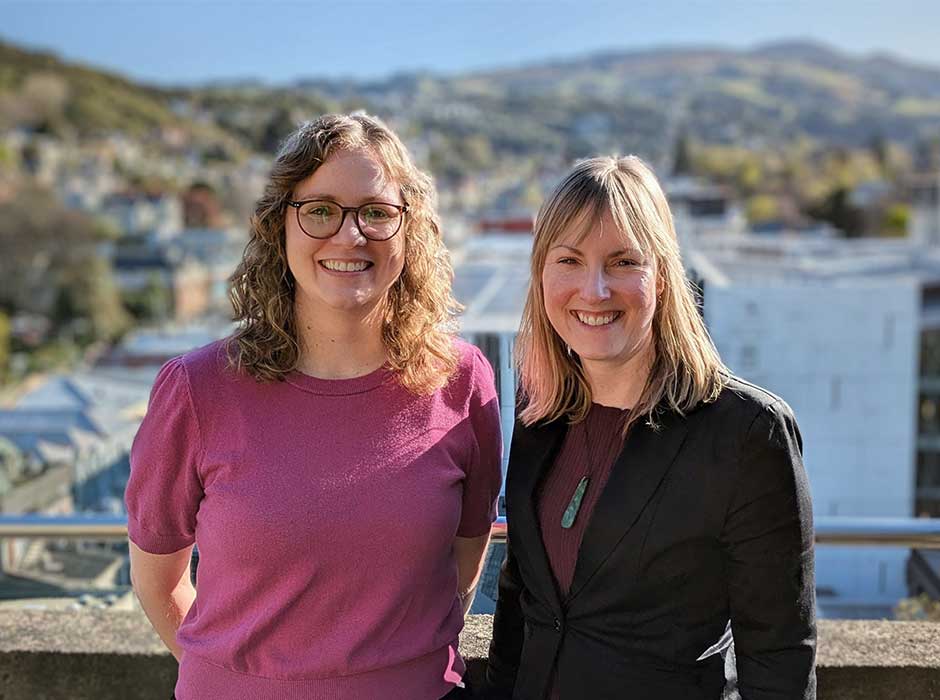
Based in the School of Pharmacy, Dr Amber Young (left) and Dr Lisa Kremer (right) are dedicating their careers to infant wellbeing and are motivated by the belief that infants deserve a high standard of healthcare so they might grow and thrive.
Today, November 7, is Infant Protection Day – a day raising awareness of the rights, health and safety of infants. University of Otago academics Associate Dean (Māori) Dr Lisa Kremer (Kāi Tahu, Kāti Māmoe, and Waitaha) and Director of the Pharmacy Programme Dr Amber Young (Taranaki Iwi) are two wāhine Māori kairangahau in the He Rau Kawakawa School of Pharmacy who have dedicated their careers to infant wellbeing. They explain why pēpi are our most sacred taonga, and why the work done to put their health first is so important.
With research in infant medications and maternal vaccinations, both Lisa and Amber are motivated by the belief that infants deserve a high standard of healthcare so they might grow and thrive.
“Pēpi are the embodiment of whakapapa as they carry our tīpuna,” Lisa says.
“Throughout time, Māori have demonstrated the value of whakapapa and the importance of caring for pēpi through cultural practices such as naming pēpi after tīpuna. Though Infant Protect Day initially started in North America and Europe, it can be a day where we can acknowledge important traditional cultural values right here in Aotearoa.”
Lisa has spent the past decade investigating how to increase the safety of eye drops used in the care of preterm infants by developing appropriate formulation and drop size.
A key motivation for Lisa’s mahi is her desire to ensure the medication given to infants is based on high-quality clinical trial data, rooted in evidence-based decision making, and involves Māori perspectives and participation.
Born four weeks early herself, Lisa’s parents have shared with her the fears they had for her wellbeing as they were unprepared for her premature birth and were rurally located.
Fortunately, her parents were able to navigate this with the support of both sets of grandparents and Lisa had no complications. However, the knowledge of this event made her aware of how scary unexpected experiences can be for new parents.
“Although I didn't initially enter the field of pharmacy to contribute to preterm infant health, I’ve serendipitously found myself working in this field and deeply value the opportunity to support pēpi and play my part towards achieving health equity for whānau Māori.”
Lisa hopes for a future where healthcare professionals are better equipped to make evidence-based decisions that support the health and wellbeing of pēpi – a hope equally shared by Amber in her maternal vaccinations research.
Amber is investigating how to increase the uptake of vaccinations in pregnancy to protect hapū māmā (pregnant women) and their pēpi.
Through her equity-focused research, Amber has found since the Covid-19 pandemic people are wanting to know more about vaccinations including why they are necessary, whether they’re safe, and what is in them.
“It’s good that people are asking these questions as, ultimately, everyone wants to do the best for themselves and their infant and so they should be provided with this information from a trusted health professional and reputable sources,” Amber says.
“Here in Aotearoa New Zealand we’re currently in the middle of a whooping cough epidemic with three young pēpi tragically dying from this last year.
“Vaccinating during pregnancy is the only way to protect pēpi when they are extremely vulnerable to disease and are too young to get their own vaccinations to protect themselves.
“When hapū māmā vaccinate, their immune system builds protection which is passed to pēpi through the placenta. This protection lasts for a few months after they are born and will protect them from severe whooping cough or influenza.”
Having two children of her own, Amber can understand parents’ worries regarding their infants getting sick and how unaware parents might be as to the serious effect illnesses like influenza can have on their infants.
“Hearing about children getting sick from vaccine-preventable diseases makes me very sad and I feel like the system is failing these whānau.”
Amber says hapū māmā often don’t get vaccinated because they are unable to access vaccination services or have not been informed in a way that makes them comfortable with vaccination.
The spread of disinformation also plays a role in people choosing not to vaccinate and so Amber’s research is investigating ways these barriers can be overcome.
Acknowledging the importance of research like Lisa’s and Amber’s, the University of Otago’s Clocktower will light up purple from 17-23 November to mark World Prematurity Day as it aims to raise awareness for the about 4,800 infants born prematurely every year and the health concerns that can follow.
-Kōrero by the Division of Health Sciences Communications Adviser, Kelsey Swart
Study Pharmacy at Otago
Pharmacists help improve health outcomes for communities, while enjoying an amazing work–life balance.
Find out more