Women travellers

| While there was undoubtedly some anxiety
about women travelling, those who could manage to travel often found
it liberating. They usually shared the aims of their male counterparts,
but often provided more nuanced comparisons of social practices, especially
those relating to women. There was also plenty of anxiety about publishing one's travels. Sarah Scott chose to adopt a male persona, whereas Lady Mary simply held onto the manuscript during her lifetime. By the end of the eighteenth century, however, travel emerged as an acceptable genre for women, and by 1830 professional women travel writers such as Mariana Starke and Louisa Stuart Costello were well established. |
Millenium Hall 
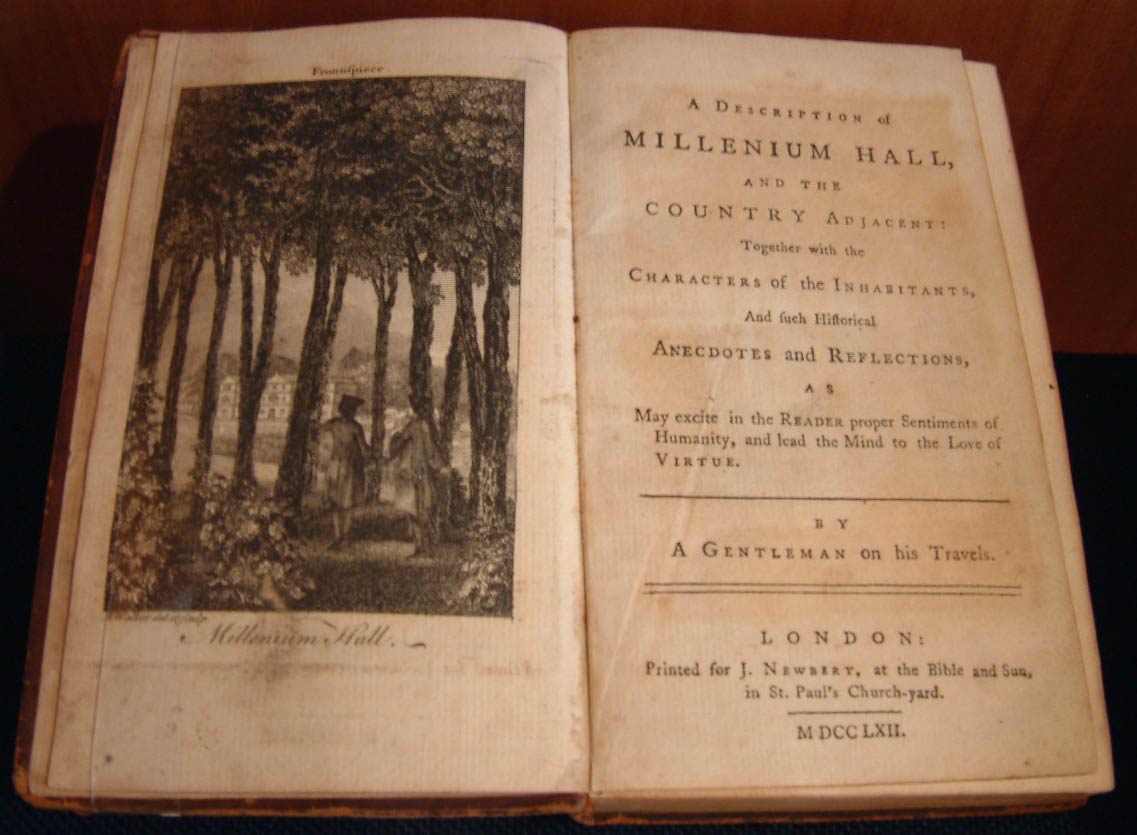
Although Millenium Hall is fictional, the title-page presents it as a domestic tour, and the explicitly 'improving' aim of the work is not out of keeping with other travels of its day. John Newbery, to whom Scott dedicates her book, was the first major English publisher of books for children, and she shared his sentimental objectives even though she did not write this book for a younger audience.
The use of an anonymous male pseudonym befits the rather unusual voyeuristic
frontispiece (Millenium Hall is a secular convent), but was primarily
a way of lending the book, with its strong philosophical arguments for
female education, a seriousness that Scott rightly believed a woman novelist's
name would not evoke.
check list
Hester Thrale Piozzi
By 1789 Hester Thrale Piozzi was presenting a well-worn tale, but she managed to do so with surprising success. She acknowledges that her journey is unoriginal, but the fineness of her analogy reveals why her perspective might be worth reading:
Italy, at last, is only a fine well-known academy
figure, from which we all sit down to make drawings according as the light
falls, and our seats afford opportunity. Every man sees that, and indeed
most things, with the eyes of his then present humour, and begins describing
away so as to convey a dignified or despicable idea of the object in question,
just as his disposition led him to interpret its appearance.
(I.288-89)
Here her frank discussion of stereotypes about Venetian women displays
the voice and perceptions that distinguished her from her fellow tourists.
check list
Mary Wortley Montagu
Lady Mary's letters, many to her sister, are wonderfully crafted, yet
retain a sense of directness and immediacy that have ensured their sustained
popularity. Her almost clichéd analysis of the problems facing
travel writers is saved from the mundane by its clever association of
the 'fabulous and romantic' with the 'Arabian Tales'.
check list
Ann Radcliffe
Like many of her male counterparts, Ann Radcliffe was given to a sense of English superiority. This disappointed description of the source of Seltzer water combines her real ability in depicting landscapes with her very pedestrian conclusions about the sights. In 1798 Joseph Hunter, an apprentice knife-maker, borrowed her tour from a circulating library and noted that 'I was not so much entertained with it as I expected, tho her descriptions are very fine'. Hunter had read all of Radcliffe's gothic novels and may have approached the book with the wrong expectations.
Radcliffe's Journey is also interesting for its frequent reliance on
Mrs. Piozzi's Observations and because her trip was cut short at the French
border by passport difficulties, whereupon she and her husband decided
to visit the Lakes District. This new destination clearly suited her talents
in depicting picturesque landscapes, but it was very much an afterthought.
check list
|
|
|
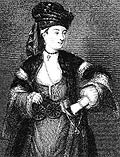
| Lady Mary Wortley Montagu, from an original miniature. In: The letters and works ... | |
 |
|