
PhD students
Zoe Battershill
Kiwifruit skin science
Supervisors: David Burritt, Sean Bulley, Jeremy Burdon, Chelsea Kerr
Alex Charlton
Edible seaweed as future foods: the impact of season, environment and lifecycle on raw seaweeds
Supervisors: Linn Hoffmann, Katja Schweikert, David Everett
James Crofts-Bennett
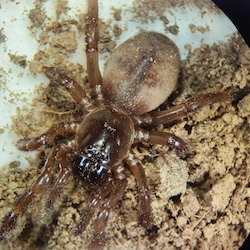 Araneae throughout Otago history, trawling historical collections for modern data
Supervisors: Janice Lord, Barbara Barratt
I've studied the Otago Museum's Forster spider collection and used historical records to revisit old field sites, comparing past and present spider populations. This turned up about five species new to science, expanded ranges for several Otago endemics, and rediscovered obscure Theridiidae unseen since the late 1800s. With the Otago Regional Council, I published a full spreadsheet of known Otago spider fauna.
Lately I've focused on coastal Migas: four of Otago's six species are strictly coastal, and I've photographed all four, including the endangered Migas taierii (see photo, likely the only photograph of a live specimen). I may have found a new coastal species near Portobello, though confirming this is complicated since existing Migas taxonomy may be outdated.
Casey Cuthbertson
Impacts and restoration opportunities of fire and grazing in New Zealand dry limestone habitat
Supervisors: Matt Larcombe, Janice Lord, Clement Lagrue
Caitlin Daley
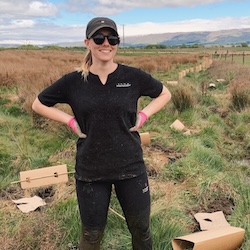 Assessing wetland restoration success: Insights from the Tiaki Maniototo Project
Supervisors: Janice Lord, Katja Schweikert
I am really interested in community and catchment scale restoration. My thesis is focused on the ecological and social drivers of success in wetland restoration on private land, using the Upper Taieri Scroll Plains in the Maniototo as a case study. It evaluates the outcomes of Tiaki Maniototo’s large scale native planting project while also investigating the factors that influence landholders’ decisions to participate in and sustain wetland restoration.
Sajini Dissanayake Dissanayake Appuhamillage
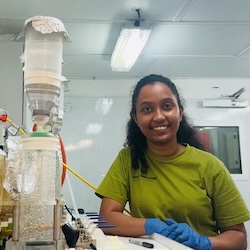 Distribution, Diversity and Community Structure of Syndiniales Across Southwest Pacific Marine Ecosystems
Supervisors: Linn Hoffmann, Tina Summerfield
Syndiniales is a diverse group of marine parasitic protists, that occupy all marine environments. My research explores the diversity, distribution and ecological patterns of Syndiniales, across coastal and oceanic environments of the Southwest Pacific. Using molecular approaches and environmental data, I investigate how these communities vary across different habitats, seasons and water masses, and their associations with other plankton. By examining these patterns across coastal New Zealand to open ocean, my research aims to improve our understanding of the ecological role of marine parasites in plankton communities.
Grace Figgess Cocker
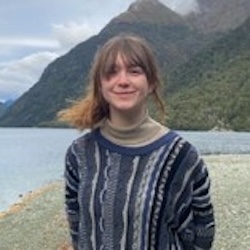 Lichens as Diverse Metacommunities: The Influence of Primary Symbiotic Partners and Environmental Factors on Microbiome Structure and Function
Supervisors: Tina Summerfield and David Orlovich
I’m interested in all things symbiosis and microbial ecology, this naturally led to the perfect combination, lichen microbiomes! My project investigates the interactions and drivers of the lichen holobiont, from primary symbiont interactions with the microbiome to environmental drivers and the influence of climate change on the lichen symbiotic system.
Nicole Heaton
Investigating cyanobacterial bloom and bacterioplankton dynamics across three Ōtākou lakes
Supervisor: Tina Summerfield
Rae Lerew
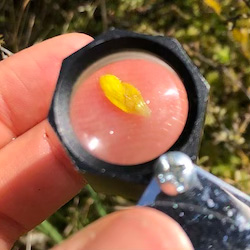 Bamboozling Buttercups: Investigating the Taxonomic Status of Ranunculus ‘Hope’ and R. ‘Burgoo’—Threatened Buttercups in Northwest Nelson
Supervisors: David Orlovich, Matt Larcombe, Ludo Dutoit
My primary research interest is vascular plant taxonomy—i.e., when does bread become toast? As a past DOC ranger, I witnessed the impacts of taxonomic uncertainty (and mis-certainty) on conservation outcomes. I am also interested in weed eradication, ecological restoration, being Mum, and scrub-bashing. Te reo Māori belongs in taxonomy.
Rebecca Mace
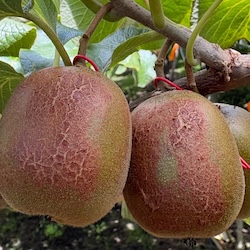 Superficial or Substantial: The interaction between pre- and post-harvest factors in the development of skin markings in kiwifruit
Supervisors: David J. Burritt, Chelsea Kerr
My interests involve combining multiple disciplines of science to better understand the nuances of the natural world. Specifically, the chemical and biochemical interactions that govern plant development and behaviour. My current research utilises cross-disciplinary tools to investigate skin defects in kiwifruit, aiming to elucidate the cause-and-effect mechanisms behind these skin markings at a cellular and molecular level.
Julz McMullan
 More Resilient Shellfish Spat for a Changing Ocean: Induction of Stress Tolerance by Dietary Supplementation
Supervisors: David J Burritt, Katja Schweikert, Natali Delorme and Chelsea Kerr
While the wider repercussions of climate change, especially on coastal ecosystems and aquaculture species, are still unknown, it is becoming clear that more resilient spat (juvenile shellfish) need to be developed before transfer to marine farms to ensure high post-transfer survival rates. Research has shown that pre-treating spat with algal or plant extracts, can boost their internal stress defence mechanisms and improve their resilience to environmental stress. For my research I will be conducting feeding trials and stress resilience trials on mussel spat and investigating their physiology, biochemistry and gene expression, in collaboration with the Cawthron Institute in Nelson.
Sorrel O'Connell-Milne
 Connecting catchments to kelp forests
Supervisors: Linn Hoffmann, Katja Schweikert, Carolyn Lundquist, Emily Tidey
My research investigates how land-based stressors, particularly terrigenous sediment, influence coastal kelp forests. By combining sediment-source tracing, field sampling and remote sensing, I aim to understand how catchment land use connects to sediment and light conditions in coastal waters and, ultimately, kelp forest distribution and condition. The research seeks to identify where kelp forests are most vulnerable and provide tools to support targeted catchment and coastal management. Research interests: Coastal and marine ecology; impacts of human activities and climate change on marine ecosystems; connections between land and sea; sediment impacts on coastal habitats (estuarine and rocky reef); coastal restoration; stable isotope techniques; and Antarctic ecosystems.
Jessica Paull
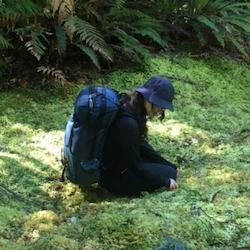 The Endomycobiome of Moss Communities
Supervisors: Paul Guy, David Orlovich
I am very interested in mosses and all aspects of their biology and ecology. For my research, I am examining the prevalence and ecological relationships of endophytic fungi in moss communities. Endophytic associations influence their host plant in numerous ways, from core biological processes such as nutrient acquisition to aiding in chemical resistance against herbivory and competition. Though most plants are known to harbour endophytic fungi, these interactions have rarely been examined in mosses. This work will additionally add to previous research of endophytic communities in tussock grasslands (Cervantes, 2024), which can provide an opportunity to examine these associations at a broad ecosystem-level scale.
Afreen Saeed
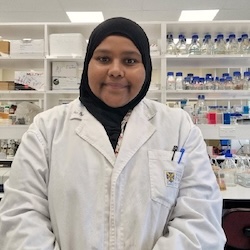 Investigating the distribution and diversity of Photosystem II proteins in cyanobacteria
Supervisors: Tina Summerfield, Julian Eaton-Rye
My research explores protein structure and function using cyanobacteria as a model system. I am particularly interested in understanding how microorganisms adapt to their environment and how molecular flexibility underpins biological functions. My current work investigates the diversity and distribution of Photosystem II proteins across cyanobacteria, with a keen focus on marine Prochlorococcus strains to see how key components of oxygenic photosynthesis vary and adapt.
Stefanie Storz
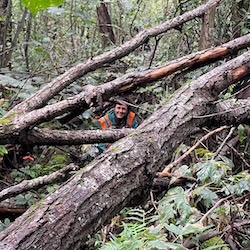 Managing Sycamore (Acer pseudoplatanus) in New Zealand: Evaluating Control Strategies and Ecological Impacts
Supervisors: Janice Lord and Matt Larcombe
My PhD investigates the invasive tree Acer pseudoplatanus (sycamore) in New Zealand. Combining field surveys and soil seed bank experiments, I examine sycamore's invasion dynamics, its impacts on native forest regeneration, and the belowground legacy it leaves via soil and mycorrhizal communities. Using species distribution modelling, I predict where sycamore could thrive under future climate scenarios to help target management toward the areas most at risk. Alongside this, I work with landowners and contractors across New Zealand to document current control practices, aiming to build evidence-based, practical recommendations for managing sycamore and restoring native forest after control.
Quan Tay
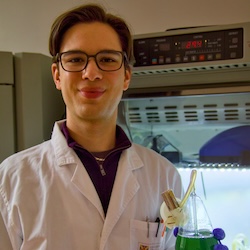 Cyanobacteria as robust chassis for synthetic biology
Supervisor: Tina Summerfield
An interest in molecular biology, biotechnology, and sustainability has led me to study how cyanobacteria maintain the integrity of their genomes. Using techniques such as CRISPR-Cas gene editing, my PhD research aims to improve our understanding of how photosynthetic prokaryotes repair their DNA. If we can enhance genome stability, they may become reliable and robust chassis for synthetic biology and sustainable production of bioproducts.
Lydia Turley
Population genetics of Agaricomycete fungi, with application to Amanita muscaria
Supervisors: Matt Larcombe, David Bryant, David Orlovich, Janice Lord, Ludovic Dutoit
Amir Zaheri
Future-Proofing Forests Recovery in Aotearoa New Zealand: A Strategic Framework for Ecological Restoration
Supervisors: Matt Larcombe, Peter Harrison
MSc students
Rehaan Ali
NZ exotic forest Cenoccoum geophilum genotypes
Supervisor: David Orlovich
Andrew Baynham
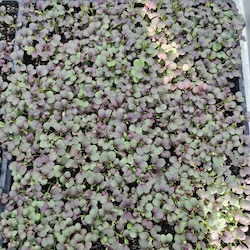 Microgreens, a Future Food: Mild Salinity as an Elicitor of Bioprotective Secondary Metabolites for Humans
Supervisor: David J Burritt
My research explores how controlled environmental stress can be used to improve the nutritional quality of microgreens. I am investigating how different levels of salinity can affect the growth and production of health-related compounds in mizuna (Brassica rapa). By exploring this trade-off between plant growth and nutritional enhancement, I aim to identify salinity treatments that improve crop quality without significantly reducing yield. This project matches my broader interest in developing resilient and sustainable horticultural systems.
Meagan Burton
New friends or old friends? Exploring ectomycorrhizal fungi associated with introduced Eucalyptus and native myrtaceous hosts in Aotearoa New Zealand
Supervisors: David Orlovich, Matt Larcombe
Oscar Dennison
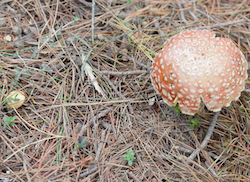 Investigating potential mycoparasitic interactions between Amanita muscaria and Chalciporus piperatus
Supervisor: David Orlovich
Kia ora my name is Oscar Dennison I’m a MSc student During my undergrad I became fascinated with fungi in particular ectomycorrhizal fungi and their interactions.
My research organisms are Amanita muscaria (fly agaric) and Chalciporus piperatus (peppery bolete). A. muscaria is an ectomycorrhizal species while C. piperatus doesn’t form mycorrhizal associations and in New Zealand these two species are often found growing together in the field. This could indicate mycoparasitic interactions between the two species. My project involves growing the two species together on media and in growth pouches on the roots of pine and native Beech.
Kacey Hutchison
Lichenometry as a dating method in archaeology
Supervisors: David Orlovich, Ian Barber
Hana Leith
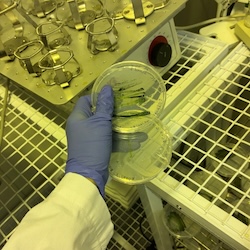 Photosystem II Adaptation to Far-Red Light: Investigating D2 Variants in Cyanobacteria
Supervisors: Tina Summerfield, Julian Eaton-Rye
My project focuses on investigating how some cyanobacteria can acclimate to far-red light. Photosynthetic organisms are generally incapable of utilising wavelengths beyond ~700 nm. A subset of cyanobacteria has been found to use far-red light for photosynthesis. Species utilising Far-Red Light Photoacclimation (FaRLiP) response restructure Photosystem II, including the core reaction centre proteins D1 and D2. I aim to characterise modified strains containing the D2 far-red and investigate the function of these modified Photosystems by measuring photoautotrophic growth, oxygen evolution, and fluorescence measurements. This will contribute to understanding far-red PS II reaction centre proteins, supporting future engineering of far-red light-adapted photosystems.
Seruwaia Matairavula
New Zealand blackcurrants (Ribes nigrum L.): phytochemical composition before and after drying, and potential health benefits after simulated human digestion.
Supervisor: David Burritt
Mitchell Ousey
 Investigating the Diversity of G4-D1 Proteins, specifically in the C-terminal region of Cyanobacteria to Improve Photosynthesis Under Stress Environments.
Supervisor: Tina Summerfield
Kia ora! My name is Mitchell, and I am an MSc Candidate in Plant Biotechnology. I am interested in cyanobacteria and photosynthesis, specifically Photosystem II (PS II). My project focuses on the D1 protein of PS II, which is primarily susceptible to photodamage (damage caused by UV light). The rate at which D1 can be repaired influences how quickly PS II can recover and resume photosynthesis. By investigating the natural diversity of the G4-D1 protein, I aim to identify potentially important single-amino-acid changes that can be introduced into mutants and used to investigate how these changes affect the cyanobacteria's response to different stress environments.
Kanishtha Rambal
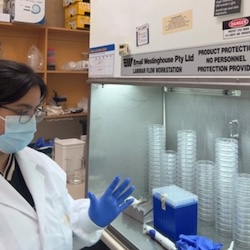 Micropropagation and Secondary Chemistry of selected New Zealand ferns
Supervisors: Janice Lord, John van Klink
My research interests mainly revolve around plant biotechnology and phytochemistry. My MSc research explores micropropagation and secondary chemistry of selected New Zealand fern species, combining in vitro propagation with chemical analyses to investigate their growth and phytochemical diversity. Through this, I aim to contribute to a greater understanding of New Zealand fern biology and the diversity of their secondary metabolites.
Laura van Lindt
The identification and study of growth over time of fungal colonies on mammalian remains
Supervisors: David Orlovich, Angela Clark