

Based in the School of Pharmacy and Pharmacology, Komal Komal has graduated with a PhD on developing cannabidiol (CBD) dry powder formulations for patients to inhale with the aim of delivering its possible therapeutic benefits directly to the person’s lungs.
After a delayed start brought about a challenging beginning to her PhD journey, this Otago graduate couldn’t be more elated to have crossed the graduation stage last Saturday.
Based in the School of Pharmacy and Pharmacology, Komal Komal’s doctorate investigated developing cannabidiol (CBD) dry powder formulations for patients to inhale with the aim of delivering its possible therapeutic benefits directly to the person’s lungs.
CBD is an active constituent of cannabis with non-intoxicating effects and several potential therapeutic properties, including potential uses in treating inflammatory respiratory diseases such as chronic obstructive pulmonary disease and asthma.
However, the therapeutic potential of CBD is limited when taken orally because only a small and variable amount reaches the body.
Initially funded by an Otago Medical research Foundation Laurenson Grant, Komal’s research looked at overcoming this obstacle by delivering CBD directly to the lungs in the form of an inhalable dry powder.
“I investigated different methods of producing these powders and different ingredients that could improve their performance, before testing how well the powders could be delivered into the lungs, how stable they were, and whether they maintained their anti-inflammatory activity,” Komal says.
“Research like this is so important because the method by which medicine is delivered to the body is equally as vital as its potential therapeutic properties.”
For inflammatory lung diseases, delivering CBD directly to the lungs could overcome some of the limitations of oral administration, as the lungs provide a large surface area for absorption, allow rapid drug uptake, and avoid metabolism in the liver.
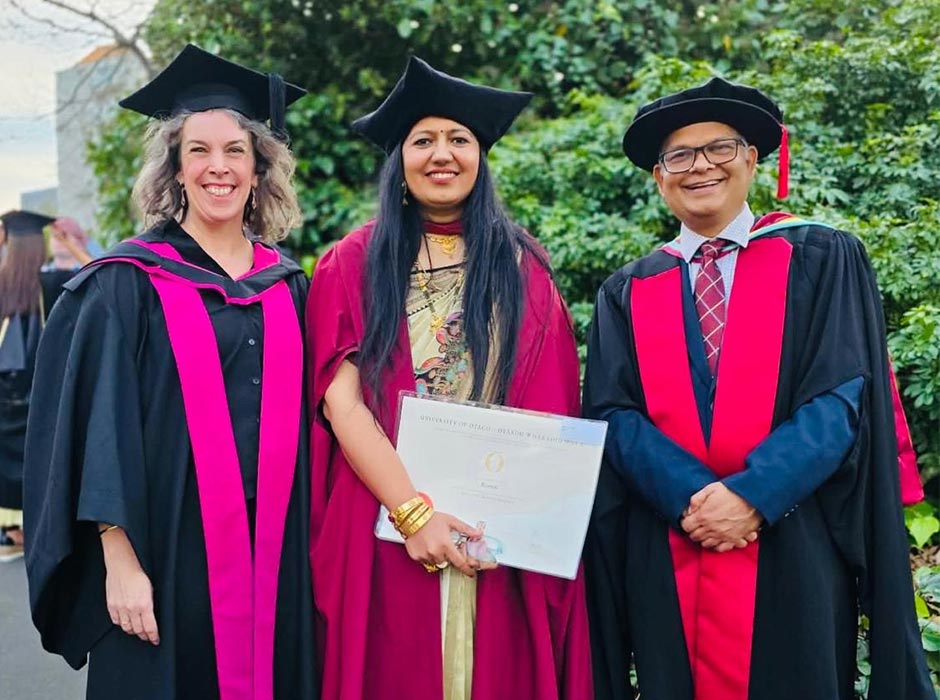
Head of the Faculty of Health Professional Programmes Associate Professor Ailsa McGregor, Dr Komal Komal and Professor of Pharmaceutics Shyamal Das, celebrating with Komal at her graduation.
Komal says it has been so rewarding doing research in an area that could have a direct impact on people’s wellbeing, and made overcoming the challenges she faced over the years all the more meaningful.
One of these challenges included navigating how Komal might be able to work with CBD in the first place, as it is a regulated compound requiring appropriate licencing and approvals.
This was a complex process taking nearly eight months to resolve, which hugely delayed the experimental work. This also meant future challenges Komal faced, like CBD’s poor water solubility, lipophilic and adhesive nature, needed to be resolved as quickly as possible for her to meet her deadlines.
Juggling these challenges alongside the responsibilities of being a mother and managing a family was daunting at times, but Komal credits the support of her supervisors, Professor Shyamal Das and Professor Michelle Glass, as well as her husband, daughter and wider family for enabling her throughout the journey.
Komal has her sights set on furthering her research and growing her career in pharmaceutical formulation and drug-delivery research.
“My PhD has given me much more than scientific knowledge. It has taught me patience, perseverance, independent thinking and, most importantly, how to find a way forward when things do not go according to plan. I hope to use these experiences to contribute to research that can translate promising therapeutic compounds into practical medicines and ultimately improve treatments for patients.”
– Kōrero by the Division of Health Sciences Communications Adviser, Kelsey Swart
He Rau Kawakawa
The School of Pharmacy and Pharamcology offers a clinically-oriented, patient- and whānau-focused curriculum that includes learning opportunities for contributing to achieving equitable health outcomes.
More about the School