
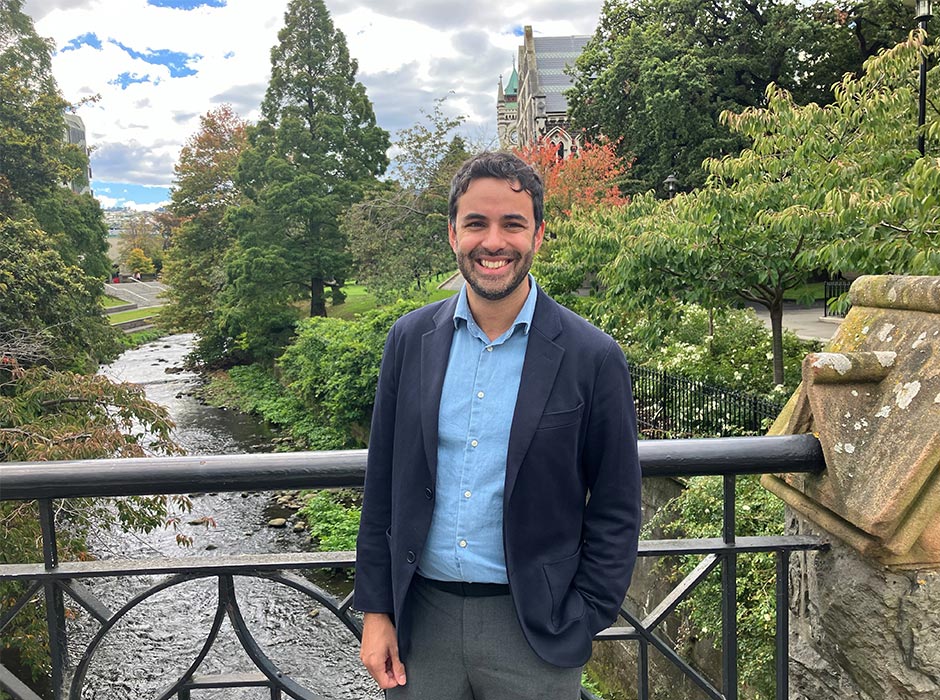
Within the space of a few jetlagged days, Joshua Ryan-Saha gave four talks at the Tourism Policy School and four at the Otago Business School – and somehow managed to show no signs of presenter fatigue throughout.
Mind your plumbing. That’s what travel tech guru Joshua Ryan-Saha wants us to do. Not the bathroom variety – though that is worth minding too – but rather the vital and hidden tech infrastructure of tourism. He told delegates as much at the recent Otago Tourism Policy School (TPS) in Queenstown, where he was a guest speaker.
Joshua travelled from Scotland for TPS to speak about the benefits of building a thriving, tech-enabled tourism sector. It’s something he’s learned plenty about in his role as Director of Traveltech, Tourism and Festivals at Edinburgh Futures Institute, University of Edinburgh.
While here, Joshua spoke to TPS and Otago Business School audiences about the worth of harnessing the data (all the decisions we make online when booking and reviewing trips) that flows through that back-of-house travel plumbing – and the need to treat it as critical national infrastructure.
"If we have better data, we can understand which places get too busy and that can help us create tourism that lives within its capacity and limits.” – Joshua Ryan-Saha
“I think data is becoming more important – especially in visitor management with issues like loss of biodiversity or ecological damage. There’s real potential for data science and AI to throw up some exciting opportunities for the tourism sector – like how to push that technology infrastructure to achieve the outcomes we want to see, such as regenerative tourism.
"If we have better data, we can understand which places get too busy and that can help us create tourism that lives within its capacity and limits.”
He says that in order to influence how people see New Zealand in a way that serves our national interests, we need to influence how people book New Zealand.
“It would allow you to bring social, socio-economic, biodiversity and regenerative values into play that don't exist in the current infrastructure. You could influence the game so that the infrastructure serves broader interests than just profit motive.”
He’s had much experience in this field – primarily through his involvement with the Scottish Tourism Data Partnership Project. A collaborative initiative between industry, the public sector and universities, it aims to shape the way data and technology can best serve that nation’s tourism future.
But here’s the hitch: this sort of work requires effort and good financial backing.
“It's not an easy thing to fund,” Joshua says.
“It's capital – but it's not bricks and mortar. I’ve been working in tourism data since 2019 and we still haven't got good data in Scotland. At the moment it's a voluntary initiative. It's not mandated so we're trying to raise some money for it. But it's how things start, isn't it?”
Though we don’t have a tourism data partnership project as yet, Joshua thinks we might be more advanced than Scotland in our thinking.
“After hearing the discussions at TPS, I’d say New Zealand is almost further ahead.”
Joshua thinks our size and Aotearoa cast of mind might well be our superpower on this front. He was particularly impressed by what he perceived as a sort of “soft positive patriotism” on display at TPS and thinks it could go a long way towards helping New Zealand embrace an effective tourism-meets-tech future.
He points to the presence of Sir Rod Drury (New Zealander of the Year 2026, Founder of Xero, and tourism data sovereignty enthusiast) as a guest speaker at TPS.
“I don't think I could get a millionaire at an event like that in Scotland to talk and be open and to listen. I suspect it's a cultural thing too, because I met others in Queenstown who were backing initiatives for the benefit of the area rather than their own financial gain.
"The level of commitment that's taking place within that ecosystem is great.”
He says frank policy conversations can often be quite adversarial and thinks the fact that TPS provides a university-led neutral space for discussion helps mitigate that.
“The thing that makes TPS work is the mix of researchers, policymakers, and business people in the same room, all taking tourism seriously at a strategic level. That's rarer than it should be. It was very candid – and that's rare too. It was also a really relaxed environment. It made me think that we should do something like this in Scotland and get speakers from different groups to talk directly about current and future policy.”
If Joshua succeeds on that front, he may well invite experts from a future New Zealand Tourism Data Partnership Project to speak at a future Scottish Tourism Policy School about all their bold, new, well-funded tourism plumbing initiatives.
– Kōrero by Claire Finlayson, Communications Adviser (Otago Business School)
Study Tourism at Otago
When you study Tourism you’ll explore how travel, culture and business meet, and how destinations are shaped and reshaped by global change.
More about Tourism