
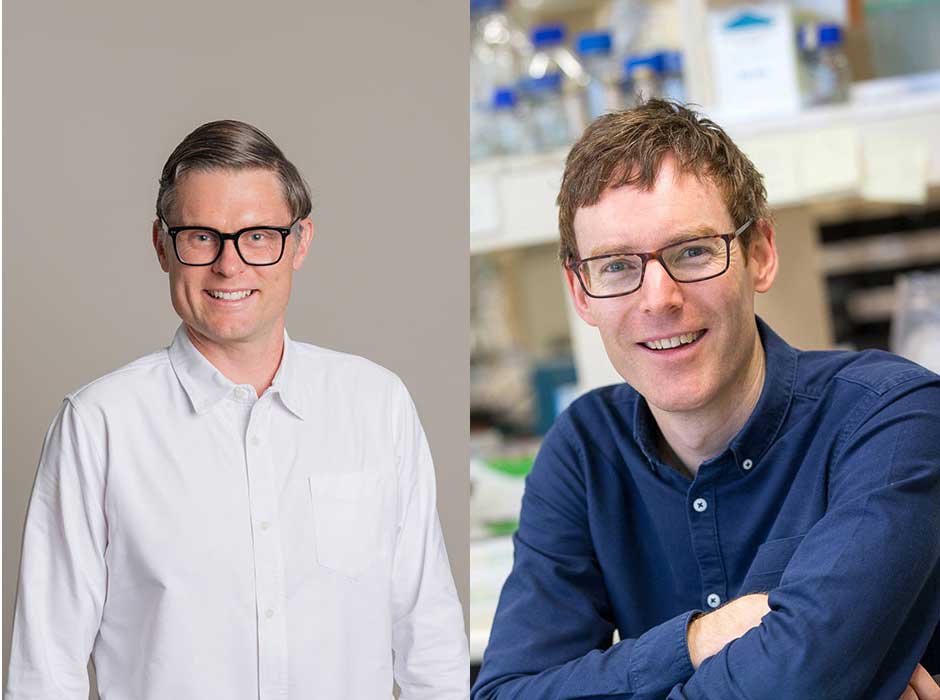
Associate Professor Andrew Reynolds, pictured left, from the Department of Medicine, has been awarded the Rowheath Trust Award and Carl Smith Medal, while the Distinguished Research Medal has been awarded to Professor Peter Fineran, on the right, from the Department of Microbiology and Immunology.
The creativity, dedication and impact of University of Otago – Ōtākou Whakaihu Waka researchers have been recognised in this year’s Otago Research Awards.
Ten researchers and one research group from across divisions and campuses have received accolades.
Acting Vice-Chancellor Jacinta Ruru is pleased to be able to celebrate the exceptional work of established and emerging Otago researchers.
“I congratulate these inspiring kairangahau for their significant achievements.
“Their research is clearly making a substantial contribution to the nation and we’re proud to showcase their accomplishments.”
Acting Deputy Vice-Chancellor (Research and Enterprise) Martin Gagnon says it is always a privilege to celebrate the incredible research that takes place at Otago.
“We have an amazing group of researchers that generate incredible impact through their creativity and dedication.”
This year, the standard of nominations was so high that choosing winners was “incredibly tough”, he says.
“What makes this even more special is the spirit of collaboration behind these achievements—so much of this success comes from teams working together to push boundaries, from senior professors to students getting their first taste of research.
“It’s especially exciting to shine a spotlight on our early career researchers, who are already making a real difference and have such a bright future ahead.”
Distinguished Research Medal
The Distinguished Research Medal is awarded to Professor Peter Fineran of the Department of Microbiology and Immunology.
Peter has made world-leading discoveries towards understanding phages, mobile genetic elements and their interactions with bacteria. Phages are viruses that infect and specifically kill bacteria via counteracting bacterial defences.
Peter’s scholarship has been described by his academic peers as “spectacular’” and “stratospheric”, and he is further identified as “one of Otago’s most outstanding, ‘greatest of all time’ scientists”.
He has been awarded multiple national and international prizes and fellowships – to pick amongst them, he is the only New Zealander to have won the Fleming Prize from the Microbiology Society, UK.
In New Zealand he has received multiple national awards and was elected as a Fellow of the Royal Society Te Apārangi.
He says he feels “very honoured” to win the Otago Distinguished Research Medal.
“This recognition reflects the incredible work of the many talented students, staff, and collaborators I’ve had the privilege to work with at Otago.
“I’m really grateful for their contributions and support. It’s also very humbling to be included among such an esteemed group of past recipients.”
Peter says working with phages for more than 25 years has constantly led him down many “exciting, winding and surprising scientific paths”.
“I always think that curiosity is the key for research, and phages are always so full of surprises, partly due to their evolutionarily adaptable nature.”
Phages have “forced the hand” of bacteria into evolving many defence systems against phages, he says.
“These systems are incredibly diverse and we have discovered and characterised these over the years – including CRISPR-Cas systems.”
The fundamental research he has undertaken is now enabling researchers to make progress in developing phages as sustainable, environmentally friendly antimicrobials – with some of his team’s current work focused on their use in agriculture.
Rowheath Trust Award and Carl Smith Medal
The Rowheath Trust Award and Carl Smith Medal is awarded to Associate Professor Andrew Reynolds from the Department of Medicine, whose contribution to human nutrition and public health is globally recognised.
Since completing his PhD at Otago in 2016, Andrew's career has followed a striking trajectory through scholarly achievements, the generation of new knowledge, and sustained leadership in applied health research.
Andrew says he is “genuinely interested” in ensuring that when health professionals and those in positions of authority talk about the health effects of what people eat, they do so from the evidence base.
“The dominant voice in nutrition communication for a long time has been people or organisations that make money off you consuming their content.
“I see my Otago role as trying to shift conversations and advice towards more facts than fiction, with my research trials and meta-analyses providing some of the evidence behind accurate nutrition advice.”
His work underpins multiple World Health Organization guidelines, the European clinical guidelines for the dietary management of diabetes, and closer to home, position statements of the Heart Foundation of Aotearoa New Zealand.
It is also distinguished by his commitment to Tiriti-led, equitable and community-informed research, such as current research with Manawa Ora, Pūtahi Manawa and Ngāti Hine Health Trust, as well as a previous randomised controlled trial undertaken in partnership with Te Kaika Health over a three-year period.
He has been described as an outstanding research leader, building a research group at the forefront of dietary exposures on global morbidity and mortality.
Winning the Rowheath Trust Award and Carl Smith Medal is very meaningful for him, he says.
“It's a really lovely acknowledgment to the tribe of people supporting me and working with me over the last nine years. Research is never done in isolation: I have mentors, I have colleagues, I have advisors, I have students, and I have staff.
“I'm very lucky to be in a position where I can work with great people who support each other - this award reflects the team not the individual.”
Andrew is currently funded by the Heart Foundation Hynds Senior Research Fellowship.
Research Group Award

ASPIRE Aotearoa Research Centre co-directors are, from left, Professor Janet Hoek, Associate Professor Andrew Waa and Dr Jude Ball, and together they won the Research Group Award.
ASPIRE Aotearoa Research Centre, co-directed by Professor Janet Hoek, Associate Professor Andrew Waa and Dr Jude Ball from the Department of Public Health, Wellington.
ASPIRE Aotearoa is a world-leading programme that brings together researchers from diverse disciplines to conduct high-quality research that informs policy and practice aimed at reducing nicotine addiction and eliminating tobacco-related harm and inequities.
The Centre’s researchers have explored the risks and benefits associated with new nicotine products, how smoking and vaping affect wellbeing, and tobacco industry interference in policy making. Their long-running cohort study assesses policies designed to reduce harms from tobacco and nicotine use.
Their work has made a major contribution to policy development in Aotearoa New Zealand and internationally.
The Centre has 12 core members at Otago, and strong links to other universities in Aotearoa and around the world.
Māori Early Career Award for Distinction in Research
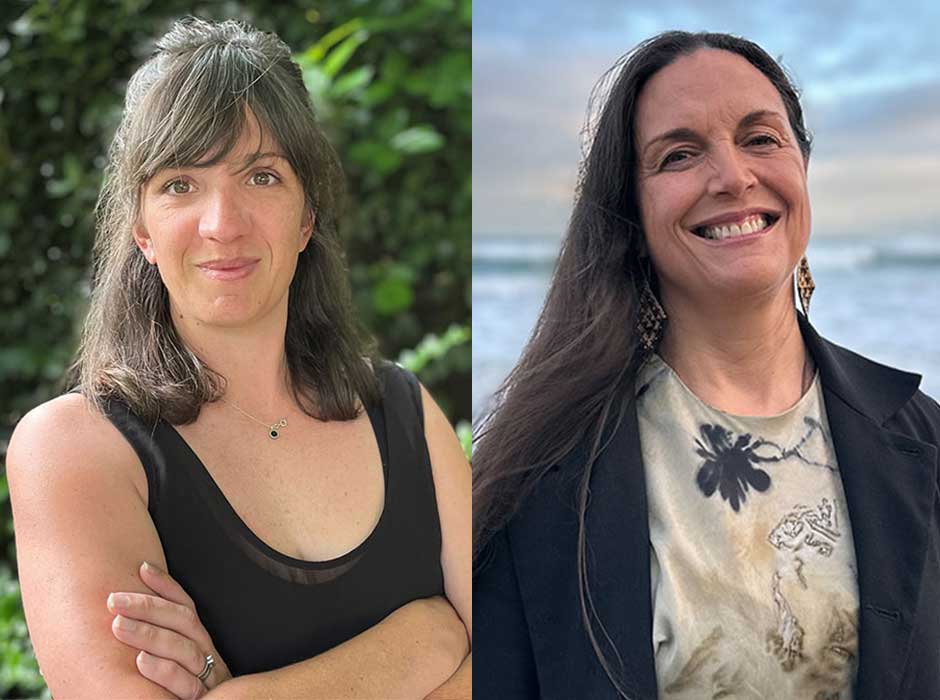
The winners of the Māori Early Career Awards for Distinction in Research are, from left, Dr Megan Leask and Katrina Pōtiki Bryant.
Dr Megan Leask, Department of Physiology
Megan (Kāi Tahu, Kāti Māmoe) is a Rutherford Discovery Fellow and internationally recognised for her interdisciplinary research in metabolic disease and Polynesian genetics. She is well-published and has received multiple awards and research grants.
She is a member of national and international academic societies, including leadership roles in the Maurice Wilkins Centre, director of Otago Zebrafish Facility and co-deputy director of the University Research Theme Genetics Otago.
Megan embodies Manaakitanga Māori. She is mentoring the next generation of tauira Māori and Pacific, maintains genuine Māori and Pacific relationships in research, is a member of the MWC Te Amorangi roopu and has Māori Strategic Framework roles with Physiology and BMS.
Katrina Pōtiki Bryant, School of Physiotherapy
Katrina, Senior Lecturer in Physiotherapy, leads Indigenous-led research advancing equity in health and rehabilitation. Her work centres on Kaupapa Māori methodologies, co-design, and community-led innovation, exemplified by Taurite Tū—a nationally implemented falls prevention programme for Māori aged 50+, integrating mātauranga Māori with evidence-based physiotherapy.
Katrina’s research portfolio spans biomechanics of mau rākau, Indigenous health leadership, and international Indigenous physiotherapy networks. Committed to impact-focused research, she prioritises community engagement, capacity building, and translation into practice over traditional outputs.
She mentors emerging Māori researchers and fosters national and global collaborations, positioning her work at the forefront of Indigenous physiotherapy and health research.
Early Career Award for Distinction in Research
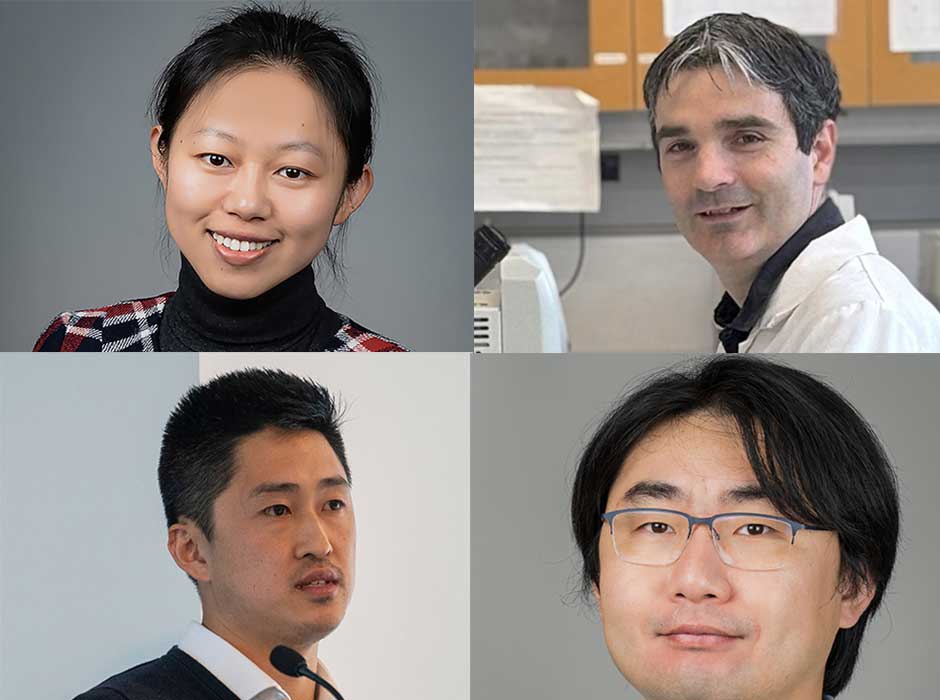
The winners of the Early Career Awards for Distinction in Research are, clockwise from top left, Dr Zihan Liu, Dr Graham McCulloch, Dr Xun Xiao and Dr Joon Kim.
Dr Zihan Liu, Department of Accountancy and Finance
Zihan is a Lecturer in Accounting in the Department of Accountancy and Finance. Her research interest lies primarily in the role of corporate accounting and reporting. Within this area, Zihan is particularly interested in the interactions between business, society, and the environment, with the aim of integrating sustainability considerations into business practices and making policy recommendations.
Her most recent research project, funded by an Australian Government agency, explored the connectivity of financial and non-financial information (the latter covering social, environmental and governance performance). She hopes the findings will improve reporting practice and accountability across sectors.
Dr Graham McCulloch, Department of Zoology
Graham is an evolutionary biologist who uses genomic tools to study how human activities are reshaping the natural world. In 2020, he was awarded a Marsden Fund Fast-Start Grant to investigate the impacts of deforestation on Aotearoa New Zealand’s endemic insect fauna. His current research, recently featured in Science, explores the drivers of rapid evolution in Aotearoa New Zealand’s species. In 2024, Graham received a Royal Society Te Apārangi Mana Tūānuku Research Leader Fellowship, recognising his leadership in uncovering the evolutionary consequences of environmental change.
Dr Xun Xiao, Department of Mathematics and Statistics
Xun’s research expertise lies in Industrial Engineering, an interdisciplinary field that combines mathematical, statistical, scientific, and engineering principles to model and optimise complex systems. As the Principal Investigator of a Marsden Fund Fast-Start Grant awarded in 2024, he is developing novel statistical methods to mitigate uncertainty in managing complex networks of infrastructure assets. Xun has also been a co-investigator on three projects funded by the National Natural Science Foundation of China.
Dr Joon Kim, Department of Physiology
Joon’s research focuses on how brain activity at the single-neuron level governs stress-related behaviours, such as fear and anxiety.
As a Research Fellow, Joon pioneered the development of fibre photometry in New Zealand, an advanced technique for recording neuronal activity in freely-moving animals. This significantly advanced the understanding of stress-related neural circuits, which was published in Nature Communications. He has since freely released his fibre photometry system by open-source which is now used across multiple international laboratories.
He designed a novel animal behavioural test, leading to a Marsden Fast-Start and subsequent Marsden Project grants to explore the neural control of anxiety.
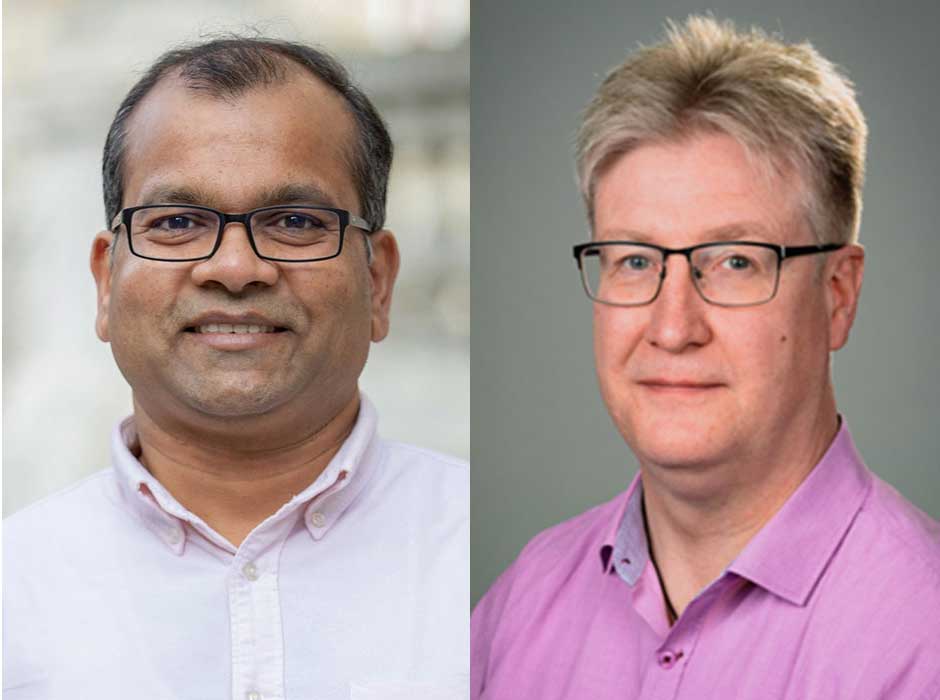
Professor Rajesh Katare, on the left, has won the Three Rs in Animal Research Award and Scott Rhodes, right, has won an Openness in Animal Research and Teaching Award.
Three Rs in Animal Research Award
Professor Rajesh Katare, Department of Physiology
Rajesh has an inspiring commitment to the principles of Replacement, Reduction, and Refinement in animal research.
He is leading a team that is refining the use of nonrodent models. Fruit fly has proved a viable alternative to rodents, and he has established cardiac organoids as an in vitro model for studying heart disease and testing potential therapies. Reviewers say this has enhanced understanding of the contribution of miRNA expression in cardiac aging.
He redesigned a laboratory module for a paper he teaches, replacing diabetic mice with student salivary samples to investigate aging and diabetes-related factors. Students have embraced the change.
Openness in Animal Research and Teaching Award
Scott Rhodes, Head of Biomedical Research Facilities
Scott says he is both honoured and grateful to receive this award having worked for several years to increase transparency at the Biomedical Research Facility. Scott and his team experienced significant positive feedback when staff’s whanau were invited to tour the facility, so they extended this initiative further.
They invited senior students at Dunedin high schools, veterinary nursing tauira, and multiple professional/academic groups to tour the facility and learn about the importance of having a high standard of animal care. These visits, some of which now occur annually, have helped reduce the perceived secrecy that often surrounds animal-based research.
Research at Otago
The University of Otago is ranked in the top 1% of higher education institutions in the world and has been awarded 5 stars plus1 – the highest possible rating for teaching and research. 1. QS (Quacquarelli Symonds) World University Rankings and QS Stars rating.
Find out more