
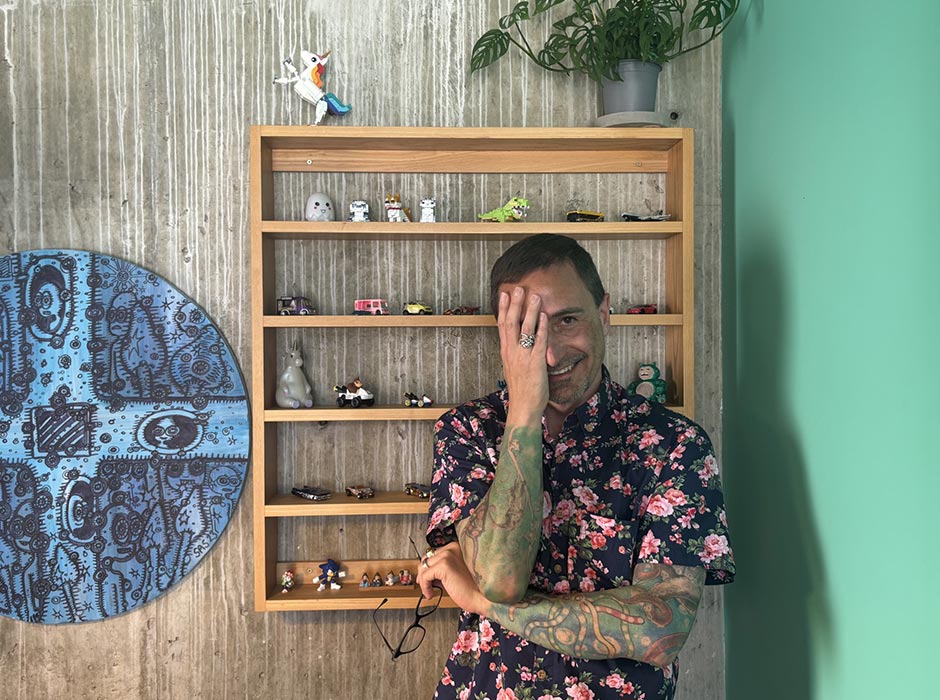
Dr Christian Long (Media, Film and Communications) will be a Fellow at the Netherlands Institute for Advanced Studies in the Humanities and Social Sciences. Photographed in Dunedin by Haruko Stuart.
Otago Film lecturer, Dr Christian Long will use the time and space afforded by a fellowship in the Netherlands to explore the world of espionage fiction, including the lack of representation of Aotearoa in American spy novels.
Christian has been awarded a prestigious fellowship with the Netherlands Institute for Advanced Studies in the Humanities and Social Sciences (NIAS) and will be based in Amsterdam from August until February.
These fellowships are project-based and designed to give recipients time and space to work on interdisciplinary research in an international community.
“They [NIAS] are trying to achieve geographic category balances and, as far as I can see, I am the only person from the Antipodes this year, so I am the geographic balance, which is very exciting,” Christian says.
Christian will use this opportunity to write a manuscript for a book on the imaginary geography of late twentieth and early twenty-first century American spy thrillers.
By taking each named geographic location in a spy novel as a data point location, Christian is drawing maps of the world.
“So, I have about fifty novels. Depending on which cluster of novels I am talking about - written by ex-spies, the Bourne novels, or by who we might call ‘proper novelists’ – I am asking how do they draw the world differently? What places show up, what places don’t?”
Through this process, a map of the world emerges that accentuates some predictable places (Washington DC, London, Berlin, Moscow, Vienna), highlights less-predictable places (Havana, Istanbul, Vientiane), and almost leaves some places off the map; Australia and New Zealand are seldom mentioned as locations in the spy novels Christian has reviewed.
“In the book I am writing, I am trying to come to terms with why that might be - why don’t they include Australia and New Zealand? That’s where I can start speculating and explore from there.”
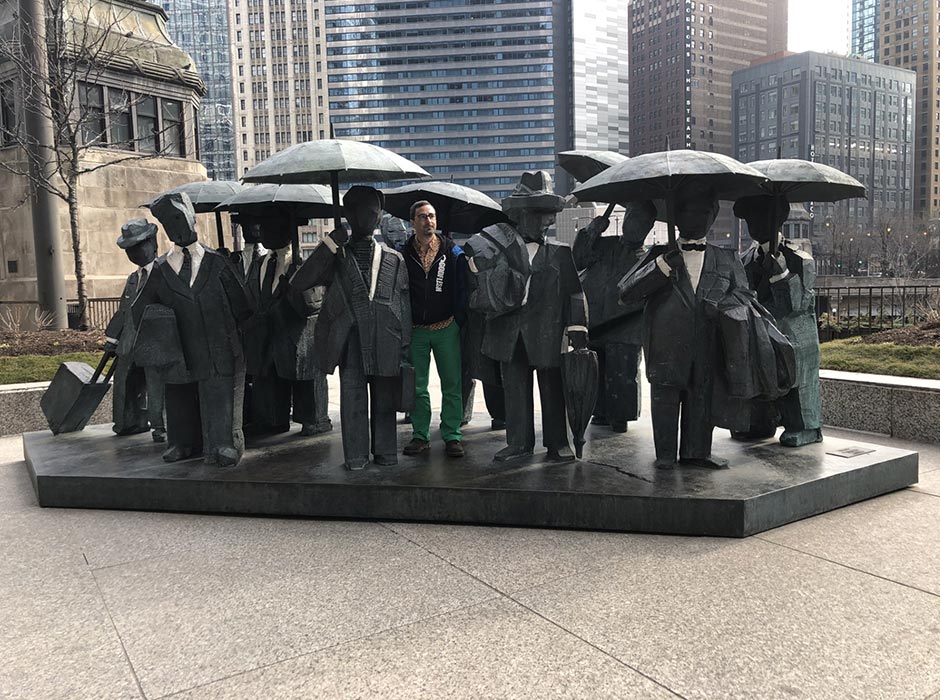
Christian (in the green pants) practicing the art of disguise at "The Gentlemen" sculpture in Chicago. Photographed by Jennifer Clement.
Originally from the United States, Christian was working in Australia when he was offered a role with the Media, Film and Communications programme at Otago, which he started in July 2025. In December, he was offered the Fellowship.
“It’s a great opportunity to have this time and space to pursue my project. I am grateful for how supportive Otago has been of me accepting this,” Christian says.
Christian lectures second and third-year film studies papers MFCO301: Critical Problems in Film and Media and MFCO210: Theory of Film and Media.
Current book aside, his research focus is on contemporary American cinema of the 21st century.
“The worse it is the better.”
During his time in the Netherlands, he will also write an article on Ishtar a Hollywood film released in 1987 starring Dustin Hoffman and Warren Beatty as CIA agents.
“A misbegotten bomb of a movie that I actually quite like. They are a strange CIA Simon and Garfunkel, but not talented at all - two idiots stuck in geopolitical excitement.”
What really piques Christian’s interest is, once again, the geography of the work.
“Ishtar is set in a fictional country, and I am interested in the world that it draws up, and how these two CIA assets navigate geopolitics. Usually, espionage films put the most important place where you least expect to find it.”
Read more about Christian’s research.
- Kōrero Antonia Wallace, Communications Advisor | Kaiarataki Pārokoroko
Study Film and Media Studies at Otago
Read on if you’re fascinated by film, television, and online media, and how they influence culture, society, and everyday life.
Explore Film and Media Studies