

Three key staff members are involved in Otago’s Queenstown presence. Pictured from left: Professor Maree Thyne is leading the business academic programmes, Professor Richard Barker is Establishment Director of the Queenstown/Lakes District Project, and Kellie Bain will manage Hākitekura. Photo: Federico Pagola, Frame Power
Queenstown's remarkable beauty has long made it a tourist destination. Now the University of Otago – Ōtākou Whakaihu Waka is helping to make it a destination for tertiary study.
The Queenstown-Lakes District is expanding so rapidly that it may have a greater population than Dunedin by 2040. This may put added pressure on the area’s infrastructure, but the University of Otago is offering bold support.
The University’s Queenstown strategy is to establish a local campus in the long-term and provide the area with targeted academic support that helps drive regional growth and innovation along with global impact and connectivity.
Multidisciplinary teams specialising in business leadership, entrepreneurship and digital technologies will run programmes from short upskilling courses to graduate and postgraduate degrees and advanced education.
Immediate projects include a Bachelor of Entrepreneurship, executive education short courses, a Master of Digital Technologies, and developing an academic retreat on land gifted for the purpose.
University research of national significance will align with regional interests to provide positive impact and aims to include collaborative projects with local community partners. Long-term goals include establishing centres of research excellence and a full University of Otago, Queenstown campus.
Professor Richard Barker, Establishment Director of the University of Otago Queenstown/Lakes District Project, is excited to be driving the University’s ambitions after decades of successful involvement in the region.
“Queenstown’s current technology presence is less than 1 per cent of its total GDP and even if this reached the national average for comparable urban areas, which is 7 per cent, that would add a billion dollars of value to the local economy.” – Professor Richard Barker
The drive stems from a post-Covid challenge given to Roger Sharp, now chair of Technology Queenstown, by the then mayor, to transform the local economy away from its almost total reliance on tourism and the tourist-servicing sector towards a high-return technology sector instead.
“Queenstown’s current technology presence is less than 1 per cent of its total GDP and even if this reached the national average for comparable urban areas, which is 7 per cent, that would add a billion dollars of value to the local economy,” Richard says.
“It was an obvious opportunity for the University to support.
“We can make a material difference to the community and economy by focusing on digital technology and business and entrepreneurship. We can provide upskilling in governance and leadership and hopefully help develop technology solutions.”
Initial academic programmes should lead to further expansion based on industry needs.
“Our goal is to provide programmes and specialisations that take advantage of what's unique about Queenstown and will attract national and global talent as well as supporting and enhancing the local business community,” Richard says.
Success will drive timelines, but the aim is for a staged expansion, beginning with an AI Residency this year, a Bachelor of Entrepreneurship in 2027, as well as a postgraduate Digital Technologies programme in 2028.
Scaling up to fit demand would involve developing new programmes.
Over time, teaching facilities will be built including a technology hub and centre for innovation as well as amenities needed in a growing community, such as student childcare and accommodation.
“We anticipate various commercial partners joining us in this precinct,” Richard says.
“By partnering with the right companies we could develop and drive curricula, working together on delivery and sharing information as to the latest developments around the world. Partner companies and visiting guest companies would offer the region an international perspective.”
Professor Maree Thyne, Otago’s Pro-Vice-Chancellor (Commerce) and Dean of the Otago Business School, is leading the business academic programmes. As a former Head of the Department of Marketing and with decades of international experience in researching the needs and wants of tourists, Maree understands more than most what might best suit the region.
Her wide-ranging work with businesses has given her experience in developing courses that can effectively apply academic theory to real-world business challenges.
The articulated Bachelor of Entrepreneurship also involves Professor Conor O'Kane, of Otago’s Department of Management, working with Queenstown Resort College (QRC) and will be the first time an Otago qualification will be able to be completed through QRC in the town.
“We believe that this is a clear and distinct opportunity for students to be able to stay in their residence of choice and complete a degree qualification. Many are working in the area already so this will allow them to maintain existing employment and internship roles,” Maree says.
“We need to establish what other programmes will best suit Queenstown and its surrounds. Our first degree is a good fit because the area has always attracted people with entrepreneurial and innovative skills.” – Professor Maree Thyne
The flexible degree will not require as many prerequisites as some other programmes, so Maree believes it will appeal to students with many different backgrounds from all over the country.
“We need to establish what other programmes will best suit Queenstown and its surrounds. Our first degree is a good fit because the area has always attracted people with entrepreneurial and innovative skills.”
The Queenstown Lakes District Council and its Economic Development unit are in full support. Many local organisations are interested in providing work and integrated learning opportunities for future programmes, such as guest lectures, mentoring and internships.
In addition to the AI Residency, Maree plans other extensive executive education programmes, which she expects will also appeal to overseas professionals.
“Queenstown is an ideal hub for fly-in fly-out participants because it is well served both nationally and internationally to Australia. We expect this connectivity will also attract some big-hitter guest speakers for our programmes.
“Students at all levels can come for a valuable education and stay on for a holiday or establish business connections in the Queenstown Lakes district. They can combine travel, teaching, business and holiday all in one destination.”
Deputy Vice-Chancellor (External Engagement) Professor Jessica Palmer emphasises the importance of wide involvement with local industry, alumni and the community.
The University has an established history of regular interaction in the district including alumni gatherings, Otago’s Tourism Policy School and events at TechWeek and MindJam. Last year, Otago hosted its long-running annual National Security Forum in Queenstown for the first time, together with the Aspen Institute.
“Events like this bring together leaders in their fields across academic, business, government and NGO sectors,” Jessica says.
“They often catalyse new policy initiatives and research projects that have the potential to make a real contribution to a prosperous and thriving society. We anticipate we will create and support more events like this as our presence grows in the region.”
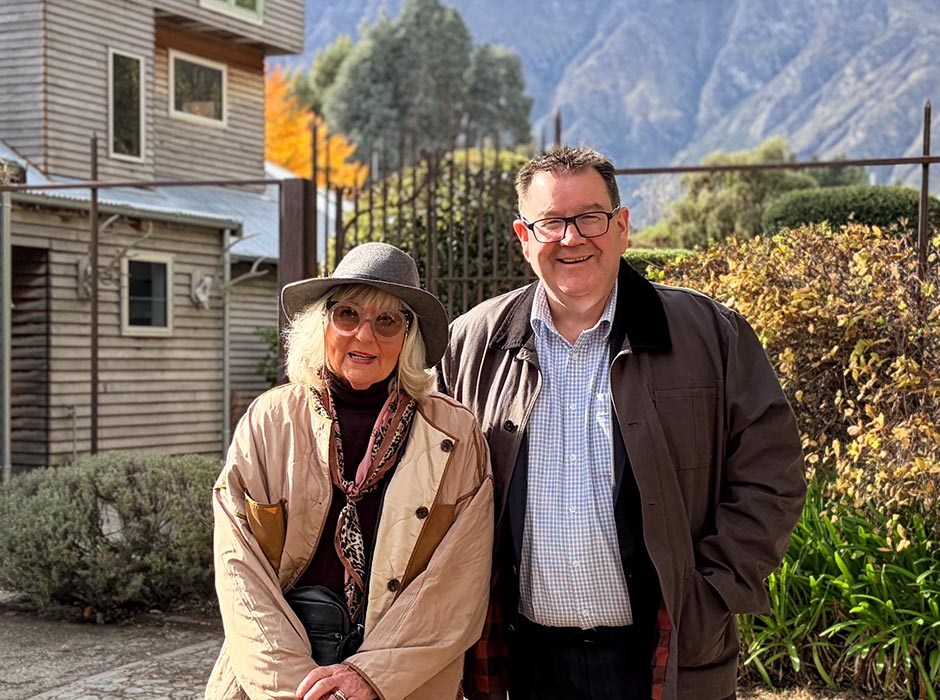
Jillian Jardine – pictured here with Vice-Chancellor Grant Robertson at Hākitekura – and her husband Dick gifted the four-hectare lakeside property to the University in 2016. Photo: Professor Jessica Palmer
An important part of that presence will be Hākitekura, a four-hectare lakeside property near Jack’s Point, gifted to the University by locals Dick and Jillian Jardine in 2016.
The historic restored woodshed will be managed by Kellie Bain and will host academic retreats and symposia, short courses and executive education programmes, University-wide gatherings and community events. It will open as a multi-room facility in 2027, hosting up to 60 people.
“It’s a joy to be able to bring to life the Jardines’ generous gift and we are looking forward to the special role Hākitekura will play in the development of ideas, relationships, discussion and collaboration – all things that are crucial to a successful university,” Jessica says.
She is optimistic about what lies ahead and believes that while the University’s strategy for Queenstown is ambitious, it is strongly focused on collaboration and partnership.
“These are ways of working that we are excited to embrace and which help to ensure the University continues to play an important role in meeting the needs of the community, locally and globally.”
– Kōrero by Nigel Zega
This story first appeared in Issue 59 of the University of Otago Magazine, released in July 2026. Download the full Magazine here