
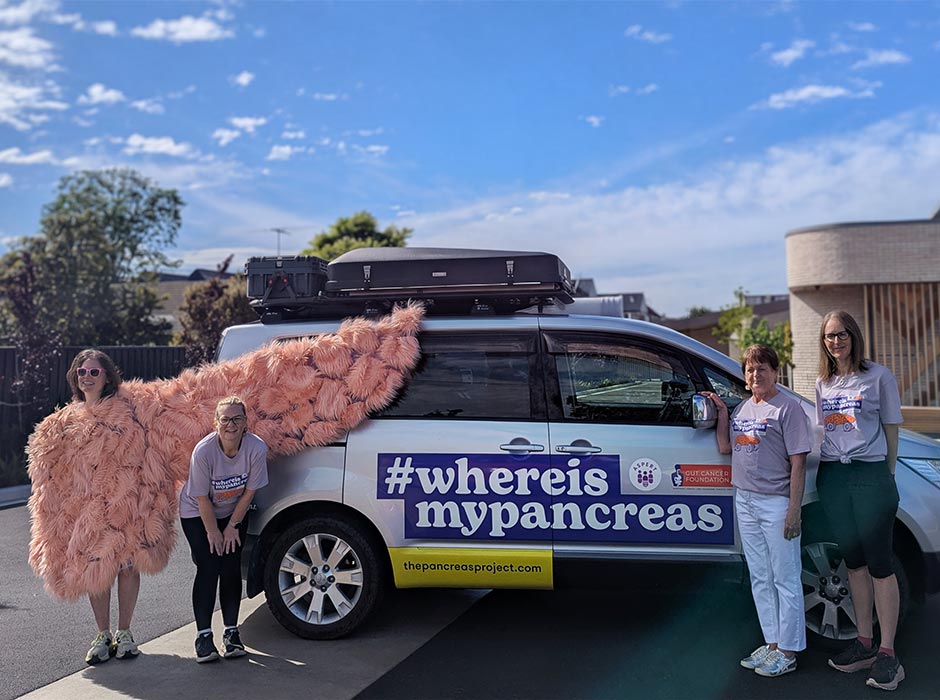
Pancreas "model" Allison Love pictured with the ASPERT team alongside their travelling van. From left: Allison, Dr Amanda Landers, Helen Brown, and study coordinator Fiona Robertson.
A campervan, a giant handmade pancreas and a team of University of Otago Ōtākou Whakaihu Waka researchers have taken an important health message to communities throughout Aotearoa New Zealand, in an unusual nationwide roadshow.
It is not every day that a giant pancreas turns up at your local hospital, takes part in a Saturday morning parkrun or parades along the Wellington waterfront.
Yet that is exactly what happened when the University of Otago's #WhereIsMyPancreas Roadshow toured the country in the first 19 days of November. It was a unique way for the Christchurch-based research team to communicate its message about pancreatic cancer, digestion and pancreatic health to the public.
Beginning in Bluff on 1 November, the roadshow travelled the length of the country in a branded campervan, visiting hospitals, hospices and communities along the way. It reached its final destination in Auckland, coinciding with World Pancreatic Cancer Day.
The initiative was the work of ASPERT, a pancreatic research group based at the University's Faculty of Medicine – Christchurch-Ōtautahi campus, which wanted to find a more engaging way of raising awareness of an organ most people know surprisingly little about.
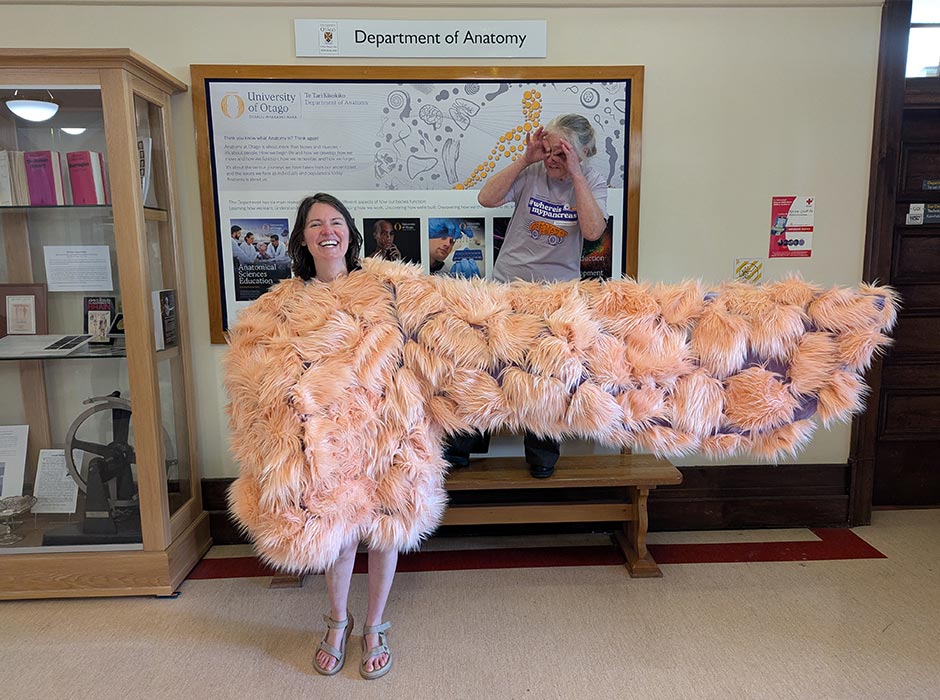
ASPERT research assistant Allison Love modelling the finished pancreas costume at the Lindo Ferguson building prior to the roadshow, with costume designer Fieke Neuman looking on.
At the centre of the campaign was an enormous wearable pancreas, designed and constructed by University of Otago Anatomy Teaching Lab Manager and textile artist Fieke Neuman.
For ASPERT Research Assistant Allison Love, who drove the roadshow and took on the unusual role of ‘person inside the pancreas’, the journey was an opportunity to take research out of the University and connect directly with the communities it aims to benefit.
“Researchers don't often get the chance to talk directly to the public because their work can be quite niche or hard to describe,” Allison says.
“But work this important deserves an audience – and maybe even a huggable mascot.”
The roadshow invited people to follow the team's progress on Facebook, guess the pancreas's location each day and enter prize draws, with prizes handed out to people who spotted the giant organ in real life.
Behind the fun, however, was a serious health message.
ASPERT Principal Investigator Dr Amanda Landers says there is a significant gap in public awareness of pancreatic cancer and pancreatic enzyme replacement therapy (PERT).
“Our 2021 study suggested 40 per cent of pancreatic cancer patients had never heard of PERT,” she says.
“PERT treatment can make a huge positive impact on digestion and quality of life in people with pancreatic problems, and that's why our team went on the road.”
The pancreas produces digestive enzymes that help the body break down food and absorb nutrients. When pancreatic cancer, surgery or other pancreatic conditions affect its function, people can experience uncomfortable symptoms, including bloating, cramping, weight loss and reduced energy.
PERT is a fully funded medication taken with meals and snacks to help the body digest food when the pancreas can no longer produce enough enzymes.
ASPERT Co-Director Helen Brown, a palliative care dietitian at Nurse Maude Hospice, says the effects of pancreatic conditions can extend well beyond physical symptoms.
“If you have uncomfortable symptoms after eating, you tend to pull out of activities, which can be incredibly isolating,” she says.
“PERT can make such a difference for people with pancreatic issues and allow them to continue enjoying day-to-day activities and experiences with their whānau.”
The roadshow also provided an opportunity to promote ASPERT's current research, investigating ways to improve the identification of pancreatic enzyme insufficiency and access to treatment.
The team's PEI-SS Tool Study is recruiting New Zealanders either diagnosed with pancreatic cancer or who’ve undergone pancreatic surgery for cancer within the past two years. It is testing a simple set of diagnostic questions that could help health professionals identify pancreatic problems earlier and start treatment sooner.
The roadshow was a significant collaborative undertaking, with the giant pancreas itself representing a particularly creative contribution from Fieke.
She says working with Allison and Amanda to develop the design was great fun, although bringing the unusual creation to life required considerable ingenuity and many hours of work.
“It was a privilege to create it. Bending aluminium and spending many days sewing innumerable fur lobules onto the organza were memorable parts of the process for me,” Fieke says.
The initiative also received support from the Gut Cancer Foundation. Chief Executive Kristin Bernstone praised the ASPERT team's novel approach to raising awareness during Pancreatic Cancer Awareness Month.
“We’re proud to support the ASPERT team as they take this important message to communities across Aotearoa New Zealand,” she says.
The roadshow concluded in Auckland after travelling through Queenstown, Tekapo, Christchurch, Kaikōura, Wellington, Whanganui, Hawke's Bay, Taupō, Rotorua, Tauranga, Hamilton and Raglan.
The final stop included an education session for Auckland City Hospital staff, followed by an appearance at the NeuroEndocrine Cancer Research Day at the University of Auckland.
The ASPERT team gathered 80 more Facebook followers and at least 17 new potential study participants as a result of the roadshow.
And while a giant, rather glamorous pancreas may not be the conventional way to deliver a research message, it has certainly provided a memorable vehicle for an important conversation.
Find out more
To learn about ASPERT's research and the PEI-SS Tool Study, visit thepancreasproject.com.
Follow ASPERT's work at facebook.com/aspertresearch.
– Kōrero by Lorelei Mason