
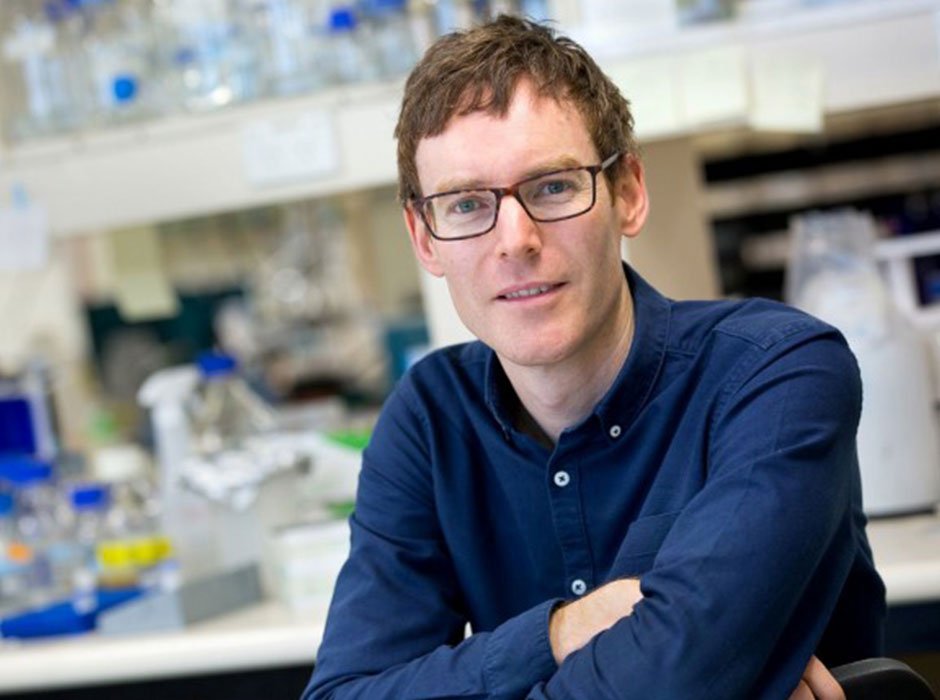
Professor Peter Fineran, Department of Microbiology and Immunology, was recently awarded the University of Otago Distinguished Research Medal 2025, for his work on bacteria and their viruses.
Like many good scientists, Professor Peter Fineran is driven by curiosity.
Winner of the University of Otago Distinguished Research Medal for 2025, Fineran has spent more than 25 years uncovering how bacteria and their viruses, called phages, interact. For the past 17 years, he has led research in Otago’s Department of Microbiology and Immunology, delving into questions that bridge fundamental science and practical solutions.
Phages are viruses that specifically infect and kill bacteria. Because of their precision, they could one day provide alternatives to antibiotics or agrichemicals in fighting harmful bacteria. With this vision, Fineran is heading a MBIE-funded programme developing phage-based tools to combat bacterial plant pathogens impacting New Zealand’s cherry orchards.
His fascination with bacteria and phages began during postgraduate studies at the University of Canterbury and deepened during his PhD and postdoctoral research at the University of Cambridge (UK). There he explored how bacteria communicate, regulate genes, and defend themselves against phage attack.
“We knew that phages can infect bacteria but little about how bacteria fight back or how phages get around those defences,” he says.
He was captivated by what he found - bacteria co-operate to defend their communities and even self-destruct to stop phages from spreading.
“It might seem small but discoveries like this are the foundation for using phages to our advantage. We need that fundamental knowledge to move science forward.”
This deep curiosity has kept Fineran at the cutting edge of one of biology’s most transformative discoveries - CRISPR-Cas - a bacterial immune system that has become a revolutionary gene-editing tool.
For over 15 years, he has been alongside other global leaders at the forefront of understanding CRISPR biology and mechanisms, and more recently, adapting it for biotechnological purposes.
“Our work began with curiosity about how bacteria and phages interact,” he says.
“Those same questions led to unexpected technologies that could have huge benefits for human health.”
To make their mark internationally, Fineran’s team are selective and creative with the problems they tackle.
“We focus on gaps in knowledge that we find interesting and then dive deep,” he says. “That’s helped us earn a reputation for creative, high-impact research. It’s great to see that recognised with this award.”
Otago’s strength in this field is evident in the international recognition of Fineran’s work. His research features in leading scientific journals, and earlier this year he hosted the international CRISPR conference in New Zealand, attracting many of the world’s top scientists.
He says science is a team effort; his group of around 20 students and staff bringing a diversity of ideas and energy that drives their success. “Everyone brings their own strengths, sometimes a completely different perspective sparks a breakthrough.”
Collaboration is crucial to success; we have strong ties to national and international labs and people with complementary expertise, as well as links with end users. Together this expands the type of research we can do as well as the likelihood of achieving impact.
Research like ours depends on a lot of people working together, from technicians to support staff. Even something as simple as keeping the autoclaves running makes all the difference.”
-Kōrero by Claire Grant, Communications Advisor, Faculty of Biomedical Sciences
Department of Microbiology and Immunology
Find out more about research into the unseen world of microbes and immunity.
View