
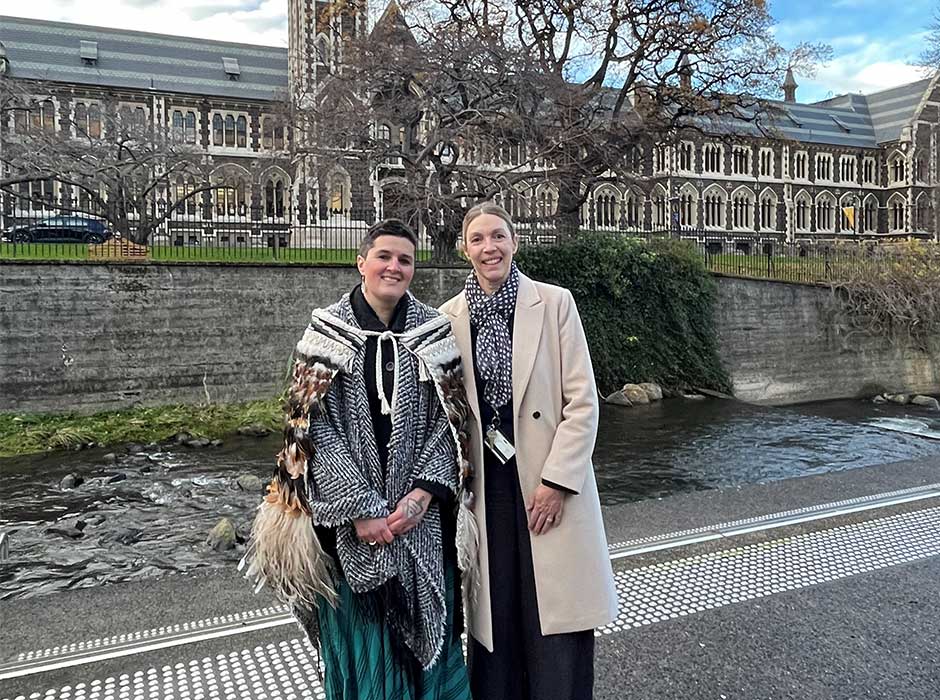
Dr Alana Alexander, on the left, and Jackie Daniels, on the right. Alana, as kaikōrero, was wearing the BMS kahu huruhuru for the first time at Matariki celebrations earlier this year.
This year’s celebration of Matariki was a very special one for Māori and non-Māori alike in the Faculty of Biomedical Sciences Te Kaupeka Mātai Rokoā-Koiora.
Led by Dr Alice Eruera, members of a rōpū (group) from Te Tari Matū Koiora, Department of Biochemistry and Te Tari Moromoroiti me te Ārai Mate, Department of Microbiology and Immunology dedicated hundreds of hours to creating a special kahu huruhuru.
The traditional cloak was worn for the first time at the Faculty’s Matariki event on June 19 by Te Tari Kikokiko, Department of Anatomy’s Dr Alana Alexander, as kaikōrero (speaker).
Taking its name Manurere, meaning ‘bird that soars’, from the whakataukī “Mā te huruhuru te manu ka rere”, it has been gifted as a taonga (treasure) to the Faculty.
The garment is a kahu huruhuru- a Māori term for a traditional feather kahu (cloak), made of huruhuru (bird feathers) woven into a base of muka (flax fibre). This taonga is a contemporary version as the base is woven from cotton.
Distinct from a korowai, which is adorned with hukahuka (tassels), either can be worn for significant occasions and gifted as an acknowledgment of achievement, leadership and responsibility.
The idea for a departmental kahu huruhuru stemmed from Te Tari Matū Koiora (TTMK) rōpū Te Wherawhera o Ahurea, set up in 2022 by Dr Nathan Kenny, Senior Lecturer in Biochemistry, to encourage the use of te reo, learn waiata, and to share skills and knowledge. It has become a supportive network and a celebration of Te Ao Māori.
The inspiration for making a kahu huruhuru came from a weaving workshop, and then a discussion about undertaking a significant kaupapa to bring the team together and share this tradition. After speaking with Otago Kaitohutohu Māori Hata Temo, it became a collective project for TTMK rōpū.
Almost two years in the making, Alice says this kaupapa was the contribution of many. As the whakataukī reminds us: E koekoe te kōkō, e ketekete te kākā, e kūkū te kererū. The kōkō (tūī) chatters, the kākā (parrot) cackles and the kererū (wood pigeon) coos.
Manurere is now cared for by the Departments of Biochemistry and Microbiology and Immunology and is on display in Biochemistry’s seminar room. Having been worn once, its kaupapa is evolving but the aim is to make it available to BMS staff and students for special occasions, for example, to support tauira who don’t own a kahu on graduation day.
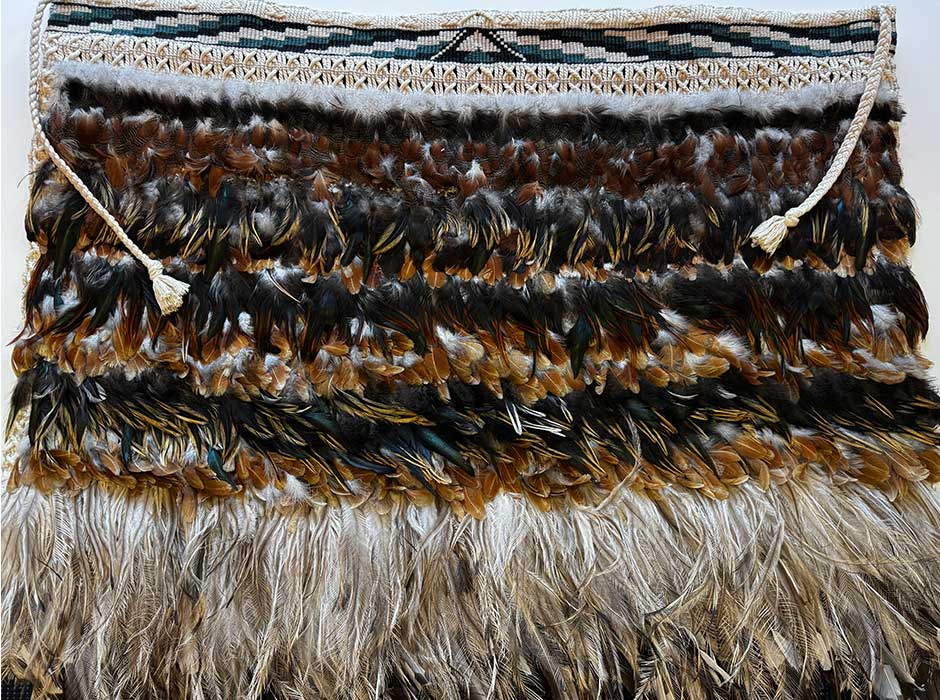
A close look at the stunning huruhuru (feathers) of the new Faculty of Biomedical Sciences kahu huruhuru.
Manurere's journey - the weaving
The creation of a kahu huruhuru is a time-consuming, highly skilled and collaborative process, involving kōrero, karakia, design, sourcing materials, creating a weaving board, following tikanga and the weaving process.
Each design is different yet steeped in tradition.
There is meaning layered into Manurere’s design – the māwhitiwhiti (crossed thread pattern) reflect its origins in a science institution, the whatu (weave) connecting mātauranga and western science.
Edging up the side of the kahu, and under the tāniko (woven border), the māwhitiwhiti design was deliberately done with a right-handed twist to reflect DNA double helix and protein alpha helices – the molecular structures of life.
“It represents a life force for the whole of BMS,” Alice says.
The tāniko across the top of Manurere includes a poutama (stepped pattern) design representing elevation of knowledge and the maunga (mountains) reflect the achievement reached, challenges overcome and new horizons ahead.
Some of the people involved weaving Manurere contributed a row or two, others developed their weaving skills and became regular weavers, more deeply connecting with this cultural tradition.
Students and staff contributed to feather finding – one lab even had a collection jar for feather donations.
The feathers determine the final look and colour. The many manu (birds) represented in the kahu huruhuru reflect the many people who contributed, and the koha from the birds themselves. Feathers came from around the Otago region, from:
*Akiaki (seagull)
*Tauiwi (emu)
*Heihei karaka (orange hen)
*Tame heihei (rooster)
*Pūtangitangi (Paradise duck)
The journey continued into the ingoa (name) chosen by the rōpū. Manu is bird and rere means to fly, but Manurere is much more poetic than its literal meaning. Peter Williamson, BMS Māori Strategic Framework Facilitator says Manurere represents flight - of knowledge, of te reo Māori, of an ancestral vision.
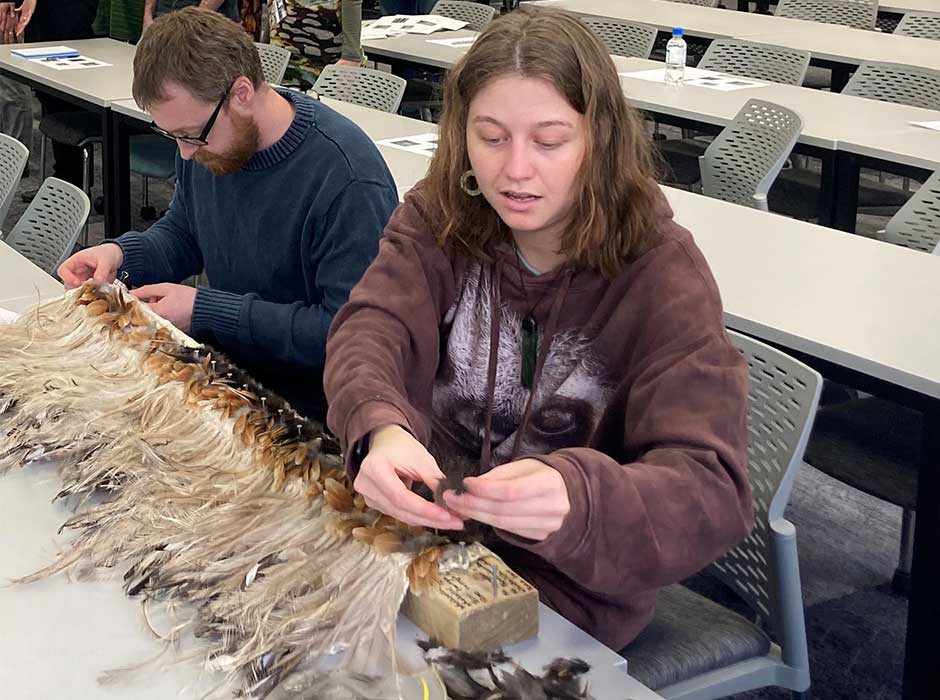
Dr Alice Eruera weaving the BMS kahu huruhuru.
Wāhine weavers
Seeing the completed kahu huruhuru worn in ceremony was a particularly emotional moment for Alice Eruera and Jackie Daniels who led the weaving.
Alice, a post-doctoral fellow working on viruses and their structural biology in the Department of Microbiology and Immunology, was instrumental in its design and weaving. But taking on a new job at the Harvard Medical School in Boston, USA meant she couldn’t be on campus to see it in use for the first time.
“I was sad not to be there, but it was also exciting to see her in a new place,” she says.
Alice began with the intention to not just create a beautiful kahu huruhuru, but to lead and teach this weaving practice and to bring those involved together in kotahitanga (unity). “It became really nice to have a collective project.”
She says the weaving technique of whatu, used to produce fabric, is much more than a traditional practise of combining patterns, fibre and feathers. “It’s tikanga, it’s an art, its collaboration and it’s a spiritual process that connects the weaver with their tūpuna (ancestors). The connection of weaving is very important. And for me leading the project has also been about being brave - it’s been a good way to build the leadership skills you need to be a research fellow.”
Jackie from the Department of Biochemistry stepped up to help with weaving when Alice was away.
She too expanded her own knowledge, and with Alice’s encouragement took up an invitation to join a weaving rōpū in Ōtepoti Dunedin, learning to teach and guide traditional weaving practises for TTMK rōpū, as well as for her whānau and community.
She says weaving is symbolic and reflects lessons in life.
“It isn’t technically hard but takes tenacity and stamina to repeat each row and to follow a pattern. The first few rows look terrible, so you have to trust that the process will reveal her beauty. You also learn to pivot to make the most of the feathers gifted to you.”
While it was hard mahi, passing knowledge on has been one of the joys of the process. “The many hands that have contributed weaving are part of a lovely story.”
Jackie was still finishing details in the early hours leading up to the Matariki event, and seeing it worn was a very overwhelming and emotional moment. “Seeing it on Alana for the first time was so beautiful.”
-Kōrero by Claire Grant, Communications Advisor, Faculty of Biomedical Sciences
Bachelor of Biomedical Sciences
The Bachelor of Biomedical Sciences (BBiomedSc) degree provides students with a sound foundation in the scientific principles underpinning biomedical research and thus our current understanding of health and disease.
View