
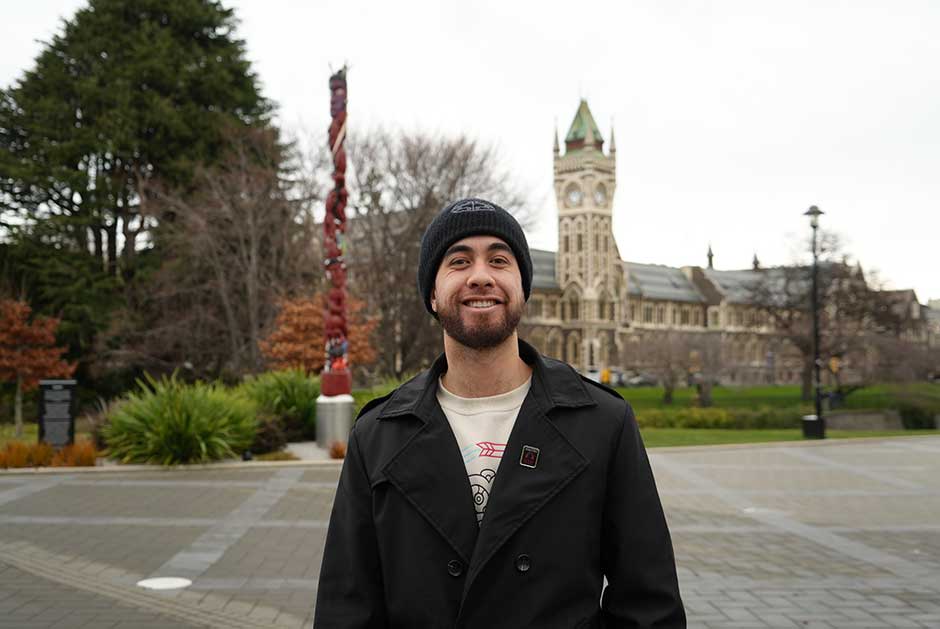
Pou Tiaki Maioha Watson has written a new karakia for the University. “My hope is that it doesn’t just become a closing and opening karakia but also helps to ground people.”
Helping people feel grounded is at the heart of a new karakia.
Created for the University of Otago – Ōtākou Whakaihu Waka, the karakia provides a shared way to open and close hui and everyday gatherings while reflecting the values of mana whenua.
Its opening words, “Tau mai te mauri”, calls for the mauri to settle.
That is the purpose of the karakia – to help people arrive fully, be present with one another and move forward together in a calm and intentional way.
The idea came from the University’s Pou Tiriti Megan Pōtiki (Kāi Tahu, Kāti Māmoe, Te Ātiawa), who wanted to create a karakia that people throughout the University could confidently use.
“When I first came into the role, I was thinking, ‘How do we get everyone singing from the same song sheet?’”
For Megan, that question sits within a wider commitment to partnership.
“To me, Treaty-led is full partnership, equal partners at the table,” she says.
“When you need someone to open and close with a karakia or do a mihi, it will always default to Māori. I am all about empowering tangata Tiriti to be the best partner in the marriage.”
While acknowledging that some karakia remain within specific Māori contexts, she believes opening and closing meetings is something everyone should feel confident doing.
“I am a full believer that Pākehā can do that too, and we should make them feel good about that,” she says. “I want to be able to say, ‘You can do that’.”
‘Tau mai te mauri’ is a new karakia
Pou Tiaki and composer Maioha Watson hopes the karakia will encourage people to practice and feel empowered to use te reo on campus, all while acknowledging mana whenua and University values. Pou Tiriti Megan Pōtiki says the karakia will help get “everyone singing from the same song sheet”
Acknowledging the importance of place
Written in the Kāi Tahu dialect, the karakia acknowledges the importance of place and relationship, while upholding tikaka and the mana whenua values of mana, tapu, whakapapa and mauri.
To bring the idea to life, Megan turned to the University’s Pou Tiaki Maioha Watson (Waikato, Ngāi Tūhoe, Ngāti Mutunga).
Raised in Kirikiriroa Hamilton, Maioha grew up immersed in te ao Māori through Kōhanga Reo, Kura Kaupapa Māori and Wharekura. A champion of te reo Māori, Maioha has completed his Toi Reo Māori Translating Licence and served as a judge for Te Mana Ākonga Te Huinga Tauira Kaiwhakawā (National Māori Student Association). Maioha has also contributed heavily to Te Rōpū Māori and is currently completing a Master of Arts in Māori Studies at the University.
As Pou Tiaki in the Office of the Deputy Vice-Chancellor Māori, Maioha supports the advancement of Māori aspirations and the strengthening of the University’s commitment to Te Tiriti o Waitangi.
Megan says Maioha was a natural person to lead the composition.
“For Maioha, ko te reo Māori tōna reo tuatahi, so for his thinking, he thinks differently to me, because I learned Māori as a second language. It is natural for him.”
Although Maioha has written karakia for whānau before, composing one for Ōtākou Whakaihu Waka required a different level of consideration.
“It always starts with the kaupapa and the context – who it’s for, the spaces it will be used in, what we’re trying to uphold and where we’re trying to go.”
Supporting people on their reo Māori journey
Before any kupu were written, Maioha, Megan, Koro Hata Temo and others considered what the karakia needed to do. It had to open a space, centre the kaupapa, acknowledge mana whenua values and support people at different stages of their reo Māori journey.
Only then did it begin to take shape.
“Even with this karakia, I draw from the reo imagery, whakataukī even, and align it to the purpose,” Maioha says.
For Maioha, the karakia needed to feel meaningful without being inaccessible.
“I really wanted it to be quite simple and make sure everyone who recites it knows exactly what they’re saying, why they’re saying it, and the meaning behind it.”
While the karakia carries Maioha’s voice, he sees it as a collective piece.
“I’ve had heaps of mentors across the years who have helped me and my development right from when I was an undergraduate student to now,” he says.
“I wouldn’t be here without them, without my whānau, so even though that’s me, the karakia, that’s theirs.”
Megan hopes the karakia will help others find confidence too.
Rather than worrying too much about perfect pronunciation from the beginning, she believes regular use will help people become used to the karakia, and correct pronunciation will follow.
“If you’re all singing from the same song sheet and doing it over and over again, I believe most people will start to get the hang of it.”
- Kōrero by Ani Ngawhika, Kaitohutohu Pāpāho Māori
Karakia
Tau mai te mauri Te mauri tū Te mauri ora Te mauri o tēnei kaupapa e whakaū nei i kā uara ki Ōtākou Whakaihu Waka Te mana Te tapu Te whakapapa me te mauri Puritia kia ū, puritia kia mau Haumi e Hui e Tāiki e | Let the mauri settle The mauri that stands firm The mauri of wellbeing The mauri of this purpose affirming the values at the University of Otago Mana Tapu and mauri Hold fast, hold firmly Let us be united Let us come together It is complete |
Study Māori Studies at Otago
Māori Studies invites you to engage in a world that offers ways of seeing, understanding, and shaping the future through values that connect and enrich us all.
View