
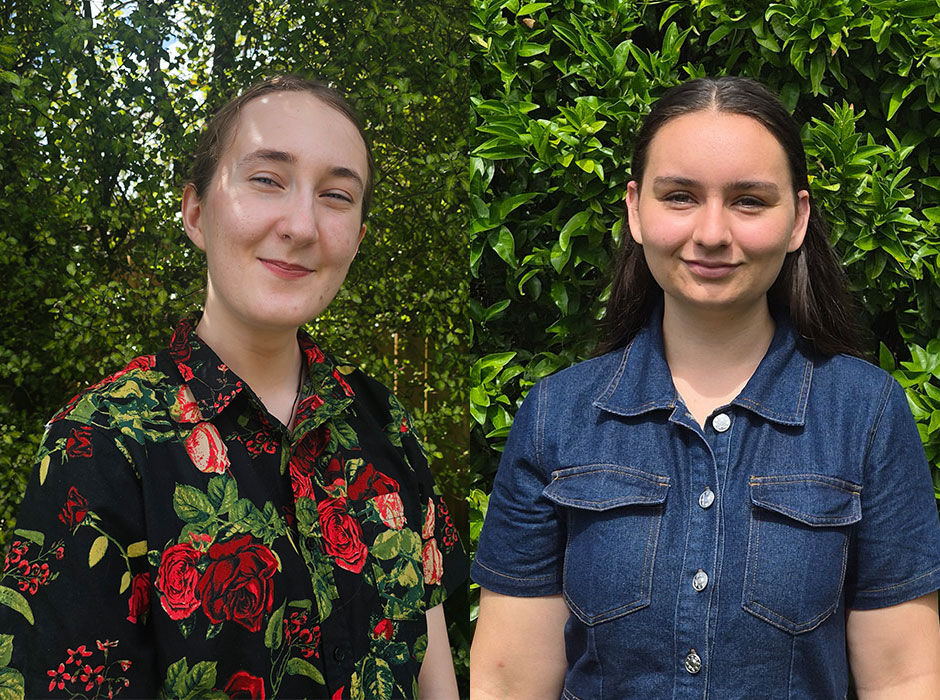
Third-year medical students Amelia Fitton, left, and Jade Fisher were among 48 students who joined the summer studentship programme based out of the Wellington campus, spending their summers working on research projects.
Two Otago medical students chose to spend their summer break, not on holiday, but hard at work on research projects.
The two friends, Jade Fisher and Amelia Fitton, will start their third year of medical school this year and were among 48 students who joined the summer studentship programme based out of the Wellington campus.
They signed up to research young people’s views and experiences of oral nicotine pouches and stayed on in Dunedin for a month after the end of semester to undertake interviews, guided by Professor Janet Hoek, their supervisor and Co-Director of the ASPIRE Aotearoa Research Centre.
Amelia’s project focused on exploring young people’s awareness, perceptions and experiences of oral nicotine pouches, while Jade investigated their views on the potential legalisation of the products.
Amelia found being around the same age as the people they were interviewing helped to develop a rapport.
“It made it easy to relate to their concerns due to our similar stages of life, particularly (with their) concerns around vaping.”
Jade found being able to interview participants in person made for a great learning experience.
“It was also valuable to work collaboratively with Janet and Amelia as we could observe, discuss and reflect on the interview process together. That on-the-job learning was incredibly helpful for developing my confidence and skills as a researcher.”
Together, they have developed new information explaining how young people see oral nicotine pouches fitting into their everyday lives, and how they think these products should be regulated.
Amelia says although oral nicotine pouches are not legally sold in New Zealand, they are widely promoted on social media.
“Participants’ perceptions were heavily influenced by marketing, product packaging and social media. They felt the discreet nature of oral nicotine pouches, which are placed in the mouth, meant they would fit easily into school, university and sporting environments.”
Jade explored participants’ thoughts on specific regulatory measures that could be adopted, such as limits on flavours and nicotine strength, standardised packaging, where the products should be sold and who should be able to purchase them.
“Our research participants recognised the need for strong policies that protect young people. Although they acknowledged people need help to quit smoking or vaping, they felt more research on oral nicotine pouches was needed to learn how effective they were and any risks they could present.”

Professor Janet Hoek, a co-director of the ASPIRE Aotearoa Research Centre, who supervised the summer research projects on oral nicotine pouches, is grateful for Health Research Council programme funding which has enabled the centre to support two to three summer students each year for the past six years.
Janet says the research is very timely as Cabinet has, in principle, approved legalising sales of oral nicotine pouches in New Zealand.
“There are serious concerns about the unintended consequences of allowing sales of these products, particularly given social media promotions that target young people who do not smoke. Participants had seen and experienced harms from inadequate vaping regulation and felt concerned oral nicotine pouches could pose similar threats to their wellbeing.”
She is very impressed by Jade and Amelia’s diligence and commitment.
“They worked incredibly hard. They interviewed 25 people, coded all the data from participants, interpreted the data, and prepared advanced draft manuscripts that will eventually become research papers we submit for publication.
“The ASPIRE Aotearoa Centre is very grateful for Health Research Council programme funding, which has enabled us to support two to three summer students each year for the past six years.”
Jade and Amelia worked remotely from their home towns when it came time to analyse and write up their findings.
Jade spent her time in Whitianga, where she is a former pupil at Mercury Bay Area School, while Amelia headed back to Raumati, Paraparaumu, where she attended Kāpiti College before heading to Ōtepoti Dunedin for university.
Both feel their time as researchers has been a valuable learning experience, teaching them skills they will be able to take into their medical careers.
Amelia says she would 100 per cent recommend a summer research project to other medical students, especially if they can collect their own data through interviews with research participants.
Jade has found the summer research to be a good fit with her studies in medicine.
“The work has taught me a lot about interacting with people, and listening and communicating carefully, which are essential skills for future clinical practice.
“Research is also a fundamental part of medicine, underpinning evidence-based practice and informing both clinical decision making and public health policy.”
Amelia and Jade hope research may form part of their future work as doctors.
Amelia says working as a researcher has reinforced to her how vital it is for clinicians to have good information to act on.
“This experience has shown me how many questions are unanswered and how keeping up to date with research, and conducting it yourself, allows you to act with the backing of accurate information.”
Jade enjoyed the process of asking questions, and learning from the data and people’s experiences.
“I see research as a valuable complement to clinical practice, and something I’d like to stay involved in throughout my career.”
The annual 10-week summer studentship programme gives students from across the University the chance to work on research projects under the supervision of academic staff and is funded by external sponsors.
- Kōrero by Cheryl Norrie, Wellington Communications Adviser
Study Public Health at Otago
Public health is a diverse and vital area, encompassing all aspects of our lives. The issues that influence public health are often changing and knowledge is constantly evolving.
Explore Public Health qualifications