
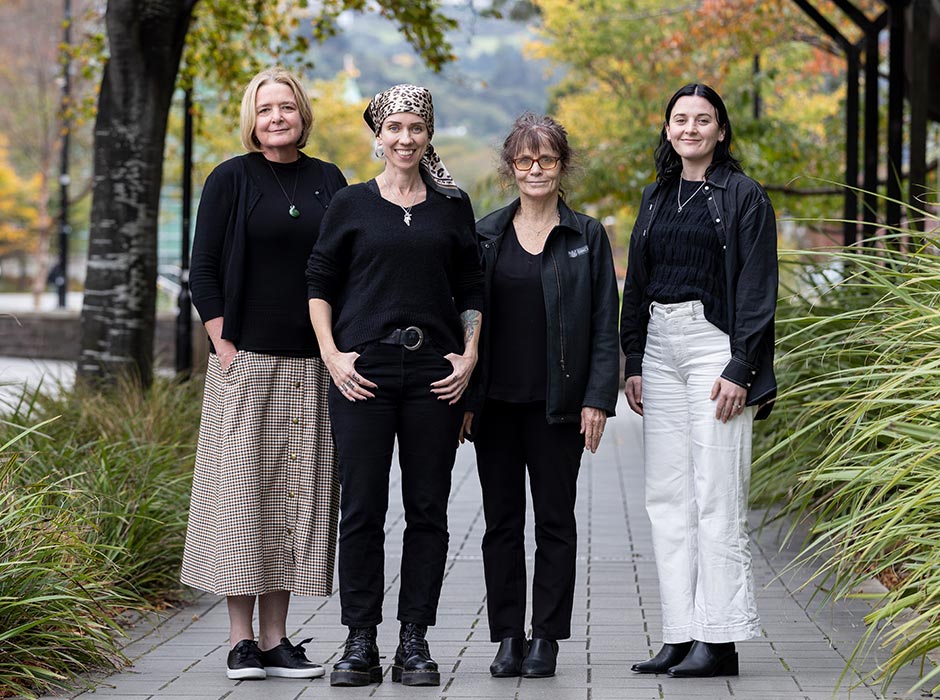
Dr Fairleigh Gilmour, second from left, believes teaching degree-level classes to prisoners is a human rights issue rather than simply an educational one. Pictured with the team from Corrections (from left) Sherie Lucke, Frederica Shannon and Amy Beeby. Photo: Graham Warman
Believing that education is a basic human right, an Otago academic is working to bring university-level learning into prisons — offering inmates the opportunity to study and grow behind bars.
Teaching degree-level classes to prisoners is a human rights issue rather than simply an educational one for University of Otago Senior Lecturer in Criminology and Gender Studies Dr Fairleigh Evelyn Gilmour.
In 2021, Gilmour became the first academic in recent decades to teach ‘inside the wire’ in an Aotearoa New Zealand prison. Since then, other colleagues have joined the programme at Otago Corrections Facility (OCF) near Milton, and it is hoped that by the end of 2025 the team will grow to five.
Although Gilmour has a PhD in Criminology, her motivation does not stem from an interest in prison education per se, but from a belief everyone has a right to education.
“We are collaborating quite closely with Massey University. Right now, incarcerated people cannot finish a full degree inside a New Zealand prison, but that is something we’re working on together to find avenues for people to do that.
“I want to give broader access – I really believe in access to education.”
Otago is the only university offering in-person tutorials, rather than solely distance learning.
Gilmour is teaching papers in the Sociology of Crime and Deviance to prisoners via a two-hour prison tutorial each fortnight.
A first-year Social Work paper and a first-year Sociology paper are also offered, while a second-year Social Work paper and an Introduction to New Zealand Politics paper are in the works.
“A lot of them are just very curious to try university. Most of the men have not completed formal schooling. They will try one paper and see how it goes.”
Students range from men in their early 20s to into their 40s and Gilmour says most are highly motivated and likely to continue to pursue other papers with Otago or Massey.
"They often express that they are not the kind of person who usually goes to university, and they’re not cut out for it." – Dr Fairleigh Evelyn Gilmour
They will do every reading for the tutorial, often multiple times, she says.
Gilmour believes in-person teaching is particularly important for this cohort of learners.
“We find that because they have had limited or disrupted formal education when relatively young, there’s often a lack of confidence and a distrust of what the experience is going to be like. They often express that they are not the kind of person who usually goes to university, and they’re not cut out for it.
“In fact, the incarcerated students have a higher average achievement than the campus students. They are cut out for this,” Gilmour says.
“The guys start to feel really confident about their own ability to critically engage with things – and often they’ve actually experienced the care system, or the criminal justice system, and think about it in really thoughtful ways.
“They also feel confident to share those ideas in discussions. They are voices we don’t always get to hear.”
But the numbers of incarcerated people accessing tertiary education in Aotearoa New Zealand are low. Gilmour looks across the Tasman to Queensland, Australia, which has a similar prison population, and says New Zealand needs to do more.
“We’ve got less than 0.5 per cent of our prison population in tertiary education, while they’ve got more than 6 per cent. Even if we had half the percentage Queensland does, it would still be massive.”
Large-scale studies in prisons in the United States show education is the single biggest thing you can do to reduce reoffending – and the higher the level of education, the bigger the impact.
“We should value this more as a society. I just worry that we have more emotional reactions to incarcerated people. We don’t always choose the option that would make our community safer.”
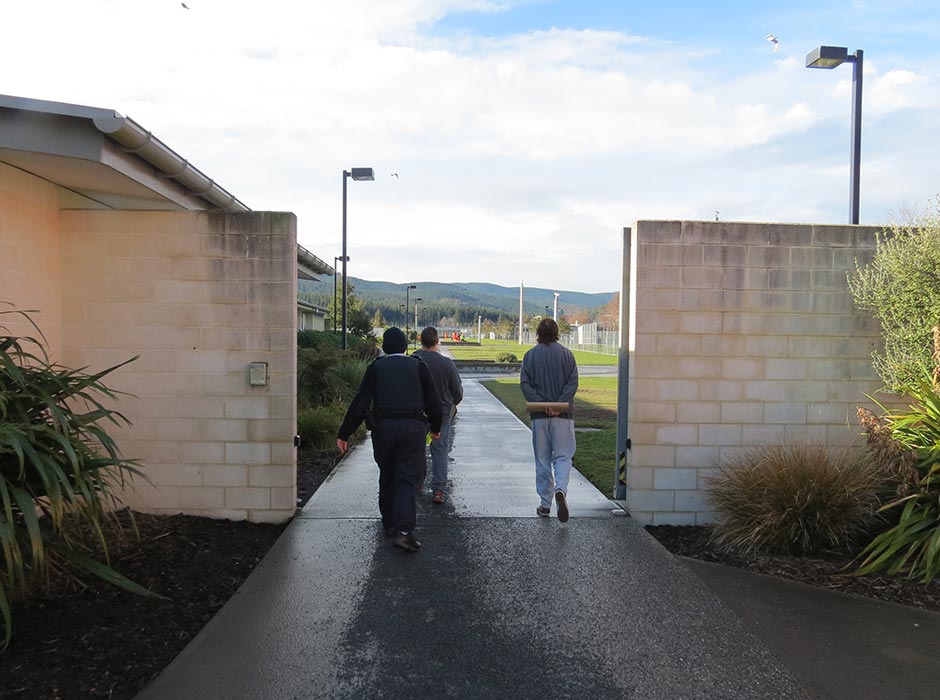
Prisoners head to class at Otago Corrections Facility. Photo: Department of Corrections
The Practice Manager Education and Training for South Island prisons, Sherie Lucke, says Otago’s offerings sit among a range of education and work opportunities available at OCF.
“When new prisoners arrive, the onsite tutors complete learning pathway reports with them to identify their learning goals while they are in prison.
“This can involve Literacy and Numeracy for Adults’ Assessments to indicate their English literacy and numeracy level. The learning pathway conversation with the Education Tutor and subsequent report is key in that person’s journey through education and training while in prison.”
For safety reasons, distance learning is a challenge in the prison environment with very limited access to computers and to internet services, so all study is paper based.
OCF Education Tutor Frederica Shannon says as the inmates improve their numeracy and literacy, their self-esteem and mental wellbeing also improves.
“Many people who are doing higher learning will comment that they now see a different future for themselves and that they have proved to themselves they can actually do something. It has given them different options.”
OCF Learning Interventions Delivery Manager Amy Beeby is an Otago alumna who graduated with a Masters of Psychological Medicine. She says the programmes give learners an identity other than ‘prisoner’.
“For quite a few of the men, they have felt defined by their criminal history and failure for much of their adult life. Through engaging and succeeding in these programmes, they get to feel like they have an identity as a student, are achieving academically as never before and that can be huge for them.
“The education tutors do an amazing job at adapting the way our learners engage in education. There is a lot of stigma initially – ‘I don’t want to go to school, I hated school, it made me feel bad about myself’ -but it’s adapting content in a way that suits our learners and makes it easy and accessible for them.”
Beeby says OCF has a very supportive leadership team that prioritises educational opportunities.
“They see the benefits of men being busy and engaging in learning activities on site and improved overall behaviours.”
The OCF team says Otago’s programme is addressing a huge gap in prison education, with face-to-face contact with university tutors – and that the learners love the way papers like Criminology give them the opportunity to put their experience and reflection into the process.
Lucke would like to see the programme expanded to new papers as the partnership with Otago grows.
“Education has been shown to make a positive difference for people in prison, for their whānau, and their community. It changes people’s perspectives and understanding of the world around them, increases opportunities for employment and, most importantly, when people are living a life beyond crime our communities are safer places for us all.
“This partnership is important for the University and the prison and could possibly be a blueprint for other universities that have prisons within their area.”
- Kōrero by Mark Wright
This story first appeared in issue 58 of the University of Otago Magazine. Check out the full edition here.
Sociology, Gender Studies and Criminology
Explore the contemporary world in a challenging and exciting interdisciplinary environment.
Find out more