
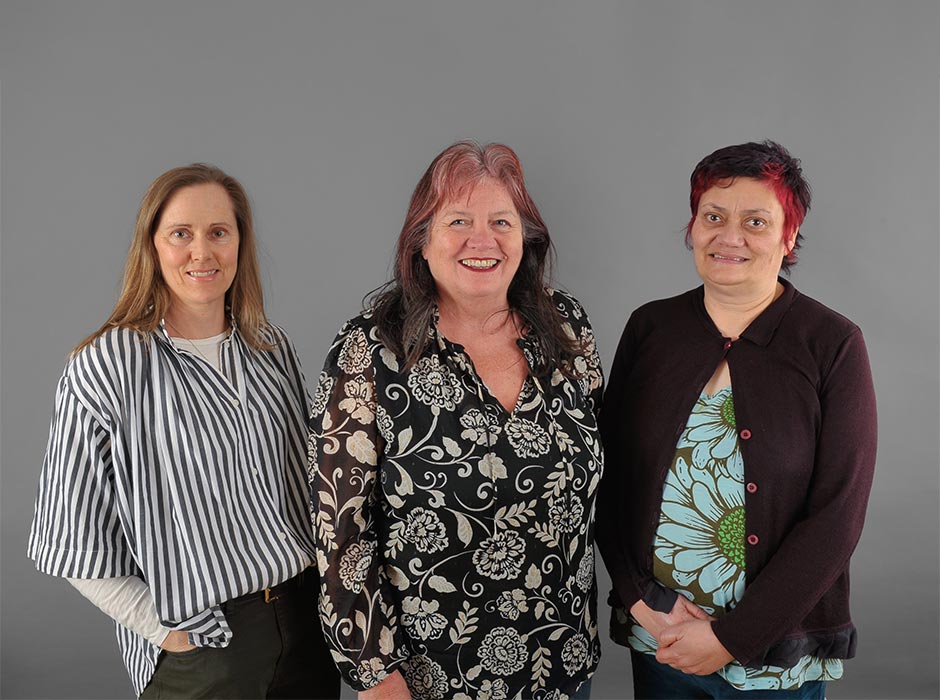
Left to right Dr Sally Rose, Associate Professor Lesley Gray (both from the Department of Primary Health Care and General Practice) and Carmen Parata (Department of Public Health).
Researchers on the Wellington campus have been awarded a $1.2 million Health Research Council (HRC) project grant to study the acceptability and utility of cervical screening self-tests for big-bodied people.
The research is led by Associate Professor Lesley Gray from the Department of Primary Health Care and General Practice. She will work with her colleague in the department, Senior Research Fellow Dr Sally Rose, and with Carmen Parata (Ngāti Kahungunu), a Research Fellow in the Department of Public Health.
They will study the extent to which New Zealand’s cervical screening programme – including facilities, staff, communication and equipment – works for big-bodied people (those with high body mass index, and/or body weight usually above 150kgs, and/or people whose body fat distribution may impact the intended test or intervention).
Lesley says this is a population that has historically been overlooked in research and underserved in screening, increasing their risk of undetected cervical cancer.
The National Cervical Screening Programme now uses HPV primary screening to look for ‘high-risk’ types of the human papillomavirus (HPV) known to cause most cases of cervical cancer. This includes a universal self-testing option and is expected to reduce inequities in participation and cancer outcomes.
Dr Rose says we know from research and clinical experience that the self-test is a fantastic tool for most people in the general population.
“Our research aims to understand how well the new screening pathway, including the practicalities of self-testing and the broader clinical context, supports the inclusion of big-bodied people.”
The team will use a pragmatic qualitative approach, inviting big-bodied people to share their cervical screening experiences.
Carmen says they will partner with Mana Wāhine and other community providers who have key connections with Māori and Pacific communities on the project.
“It is essential we work alongside Māori and Pacific whānau to ensure the new screening pathway supports a wide range of whānau realities and abilities.”
Dr Gray says there are high levels of stigma and bias in healthcare associated with body size and fatness that mean people delay seeking help, and that also impacts the quality of care people receive.
“A range of factors determine how accessible and size-inclusive services are, from the built environment in which we deliver care, to the equipment and language we use in practice. For example, the supplied swab is a standard length – we are interested to know how practical this is for big-bodied people wanting to self-test.”
Lesley says her latest research will guide the development of practical approaches and recommendations for implementing size-inclusive cervical screening and will have relevance for healthcare delivery more broadly.
“Investing in size-inclusive approaches will help improve screening coverage and achieve downstream reductions in cancer incidence and mortality.”
This latest study builds on Lesley’s long-term commitment to education and research relating to size-inclusive healthcare. She is currently working with Sally and Carmen on research on the most appropriate needle lengths for intramuscular vaccinations for big-bodied people. They are working on the project with external partners including Dr George Parker, a Lecturer in Health Service Delivery at Te Herenga Waka – Victoria University of Wellington and Dr Ash Gillon, a Lecturer in Māori Studies at the University of Auckland, as well as with the Medical Research Institute of New Zealand, and a wider primary and community-based team including Mana Wāhine and Total Healthcare PHO. Together, they work closely with big-bodied people to ensure and promote size-inclusive care.