
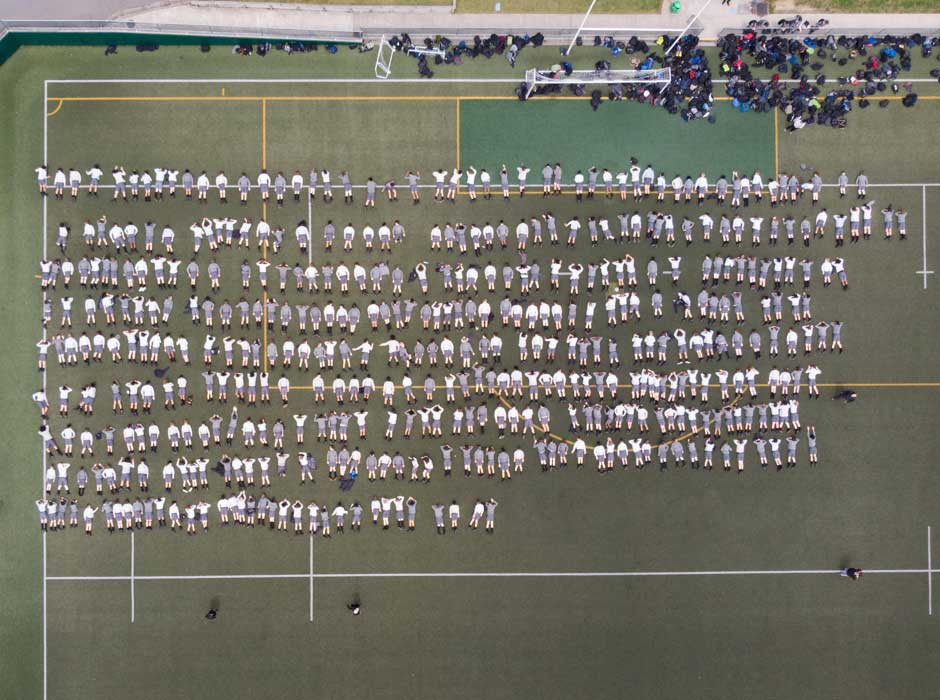
This photo, taken at Wellington College in 2018 to mark the centenary of the 1918 influenza pandemic, represents the 440 people who died on the worst single day of that pandemic. PHOTO: Luke Pilkington-Ching, University of Otago, Wellington.
How the 1918 influenza pandemic spread so far, so fast in Aotearoa New Zealand is set to be analysed by a group of international researchers.
Academics from the University of Otago, Wellington – Ōtākou Whakaihu Waka, Pōneke, the UK’s Durham University, and Germany’s University of Tübingen, will complete the first digital analysis of the pandemic to provide insights for managing future infectious disease emergencies.
The group has received a Matariki Network of Universities Research Seed Fund grant to support the work.
Project co-lead Professor Michael Baker, Director of Otago’s Health Protection Aotearoa Research Centre (HPARC), says the pandemic is still the largest natural disaster in New Zealand’s history.
It swept through the country in November 1918 and killed about 9,000 people in six weeks. That was about 0.8 per cent of the population, equivalent to about 40,000 people today.
“While the social history of this pandemic has been comprehensively described by historians, notably Professor Geoff Rice, there has not been a full epidemiological analysis using case data.
“This project will fill that gap and provide insights into how a poorly controlled modern influenza pandemic could affect the country.”
Dr Sarah Pirikahu (Ngā Rauru), a biostatistician and disease modeller in HPARC, will lead the analysis, alongside Professor Frank Krauss of Durham University.
“A key aim of this research project will be to model with great detail the spread of the 1918 influenza pandemic in Aotearoa New Zealand. The analysis will particularly focus on better understanding the causes of the markedly higher risk of death seen for Māori during the pandemic,” she says.
The project is led by Professor Rebecca Gowland, a bioarchaeologist and world leading expert in past diseases and epidemics. She and two of her colleagues from Durham will be visiting Wellington for a project meeting in August.
“This current project is a first step towards a more comprehensive programme of work aimed at better understanding past pandemics at a global scale,” she says.
Her group has also been modelling the first wave of the Black Death in 1348 and how it spread in medieval England.
They will be working with the Otago researchers on applications for European funding to support more comprehensive modelling of past pandemics, including the 6th century Justinian Plague in Europe, the Tudor-era English Sweating Sickness, and the 1918 influenza pandemic in New Zealand.
The aim is to better understand how social connections and differences influenced the spread of pandemics through the centuries, and how individuals and societies at different times and places responded to the threat they pose.
HPARC Webinar series - Insights from past pandemics, and preparing for the future:
A series of free public webinars on pandemics will run from August 18 to 22. Register and view the programme here.
Ōtākou Whakaihu Waka, Pōneke
Research and study health sciences and medicine through our Wellington campus. We teach medicine, radiation therapy, physiotherapy, postgraduate qualifications and papers, and undertake a wide variety of health-based research.
View