
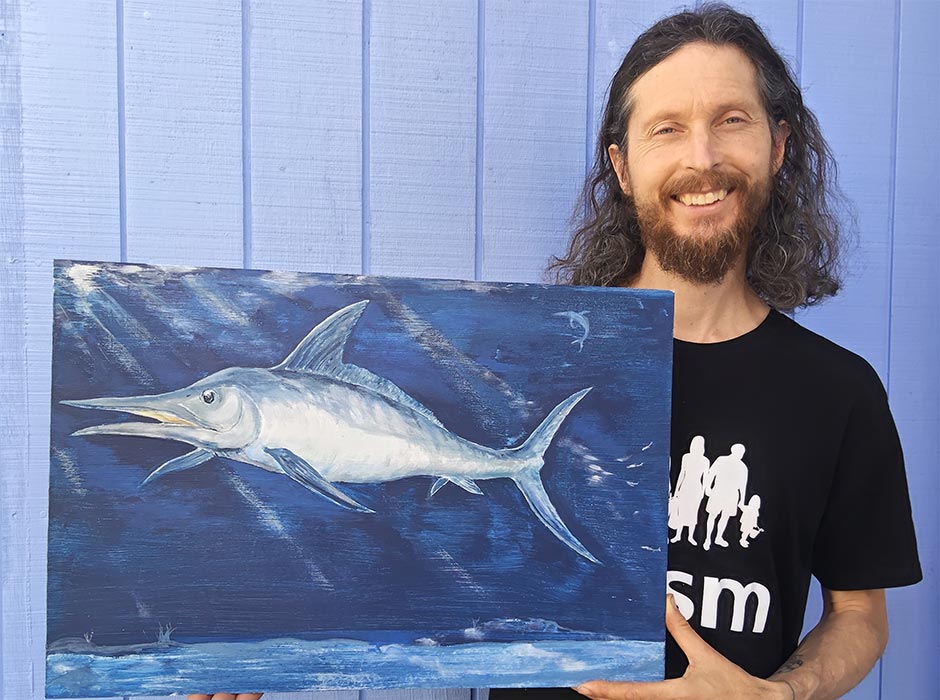
Researcher Seabourne Rust holds an artistic reconstruction of 'Zealandorhynchus fordycei'. Painting: S. Rust. Photo: D. Yanakopulos
The name of a new species of fossil billfish honours a world-leading palaeontologist who inspired generations of young researchers.
Zealandorhynchus fordycei is named after the late Emeritus Professor Ewan Fordyce, a renowned vertebrate palaeontologist who had a 40-year career at the University of Otago – Ōtākou Whakaihu Waka Department of Geology.
Professor Fordyce passed away in November 2023 but his legacy lives on.
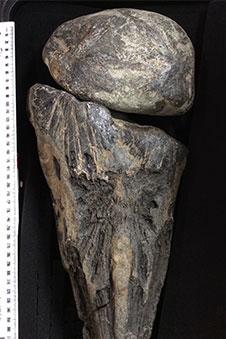
The fossil skull of the newly-described Eocene billfish Zealandorhynchus fordycei.
A paper recently published in the journal Gondwana Research describes two large, rare fossil billfish skulls from the early Eocene (about 50 million years ago) found in Otago, New Zealand.
Billfish are large predatory fish, such as marlins and swordfish, known for their long, spear-like upper jaw which is used to catch prey.
Lead author Dr Seabourne Rust says the skulls represent early extinct forms of billfish.
“The more complete skull belongs to a new genus and species that we have named Zealandorhynchus fordycei, after the late Professor Fordyce,” he says.
The latest fossil skull was discovered by study co-author Morne Wium, near the site where another fossil fish skull was found nearly 40 years ago.
Both are now housed in the Earth Science New Zealand (formerly GNS Science) National Paleontological Collection.
Due to their large size, they are believed to have come from adult billfish, estimated to be several metres in length.
“These billfish specimens represent notable additions to a rather sparce Early Eocene fish macrofossil record from New Zealand,” Dr Rust says.
“They hint at ancient diversity and widespread southern distribution reached by early billfishes during the Eocene – this is very significant as previously known distribution was considered to be nearly exclusive to the northern hemisphere.”
After undergraduate study at Otago, Dr Rust later completed his Master of Science thesis on fossil fish in the Geology Museum collections under the guidance of Professor Fordyce in 1997-2000.
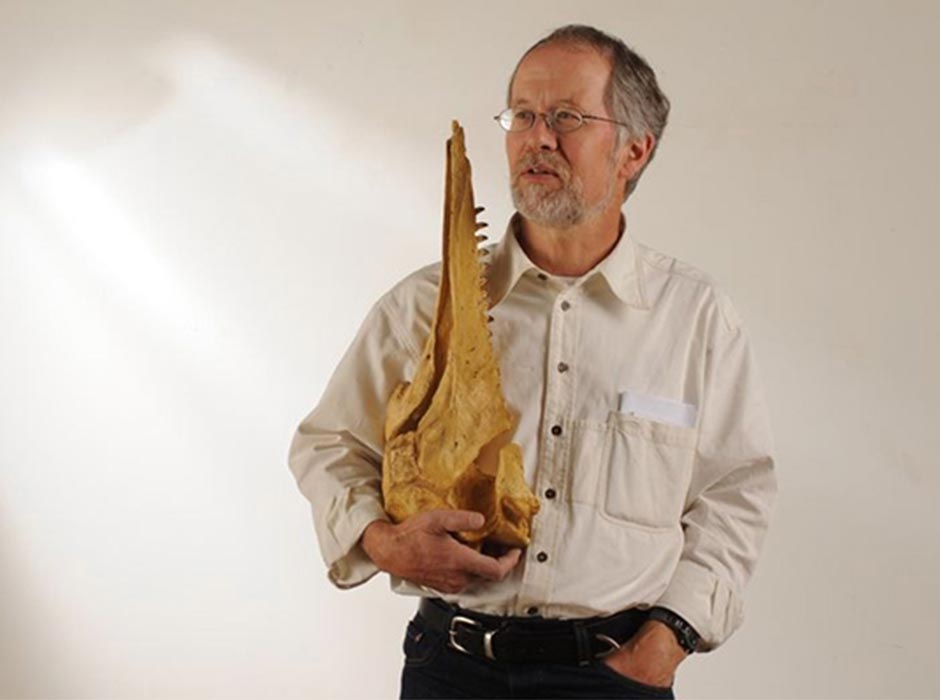
The late Emeritus Professor Ewan Fordyce, a renowned vertebrate palaeontologist who had a 40-year career at the University of Otago.
“Ewan gave so much to his students, his well-illustrated lectures and legendary field trips brought the subject to life,” he says.
“He was a guiding mentor for me and many other budding palaeontologists. He has left such a legacy with his work on fossil vertebrates from Southern Zealandia, in particular.
“Many important discoveries were made during fieldwork in North Otago and Canterbury to recover ancient whales and dolphins (Ewan’s specialty) and subsequent long hours preparing the fossils unveiled insights into the creatures living in our area millions of years ago.
“My colleagues and I felt very privileged to honour Ewan’s memory by naming our new fossil billfish taxon after him.”
Publication details
Fossil billfish (Xiphioidei) from the Eocene of Hampden, North Otago, New Zealand
Seabourne Rust, Morne Wium, Rodrigo A. Otero, Marianna Terezow.
Gondwana Research
Department of Geology
As one of New Zealand's leading geoscience departments, Otago offers an active postgraduate programme and practical undergraduate foundation. Graduates are in high demand as society shifts to a low-carbon future.
Find out more