
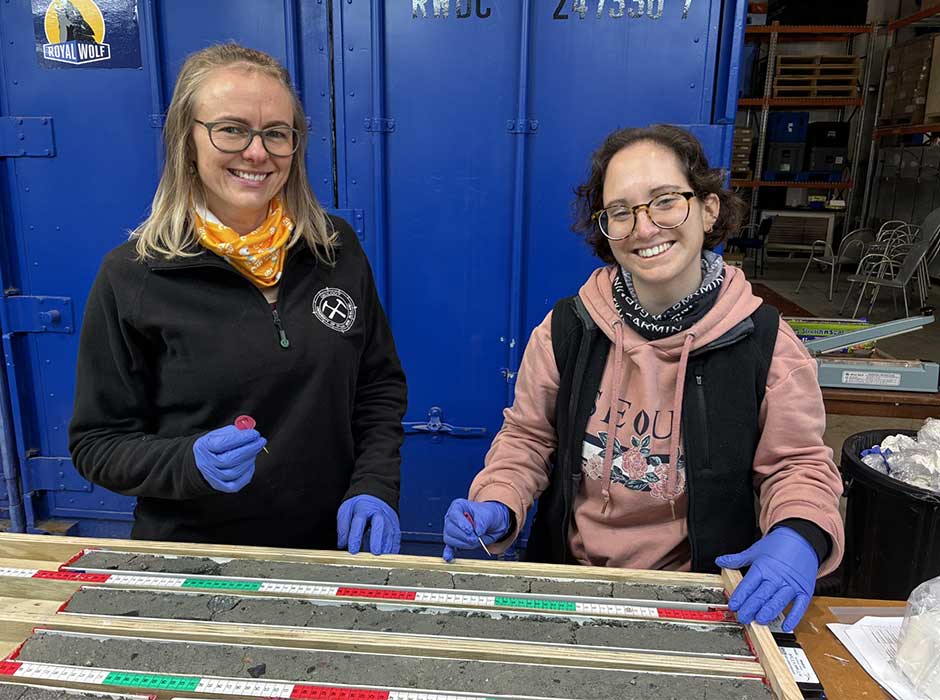
Geology PhD candidates Natalie-Jane Reid, left, and Luisa (Lulu) Fontanot support top international scientists during an Antarctic core workshop at the Otago Repository for Core Analysis (ORCA). The workshop was part of the Sensitivity of the West Antarctic Ice Sheet to 2 Degrees Celsius of Warming (SWAIS2C) project, an international initiative tasked with understanding Antarctica’s potential contribution to future sea-level rise.
“What goes on in Antarctica doesn’t stay in Antarctica – it has global implications,” Geology tauira Natalie-Jane Reid says.
Natalie-Jane is one of two Otago PhD candidates who contributed to an Antarctic sediment core workshop at the Otago Repository for Core Analysis (ORCA) held during the first two weeks of June.
The pair joined 30 top scientists who split, scanned, described and analysed 228m of ancient mud and rock retrieved from under the ice sheet at Crary Ice Rise in Antarctica’s Ross Sea.
Natalie-Jane chose Otago for her PhD study because she wanted to contribute to the Sensitivity of the West Antarctic Ice Sheet to 2 Degrees Celsius of Warming (SWAIS2C) project, an international initiative tasked with understanding Antarctica’s potential contribution to future sea-level rise.
“I’ve always been obsessed with Antarctica – how it affects the rest of the world and everything that’s going on around us,” she says.
Participating in the SWAIS2C core workshop was a dream come true, but collecting the crucial sediment from beneath 523m of ice was far from straightforward. Fellow PhD candidate Luisa (Lulu) Fontanot says it took several attempts over three years to obtain the core.
“Due to the remoteness of the site, the extreme conditions and the complexity of the drilling machine, this project needed a huge coordination effort. Three attempts later, we now have a beautiful long marine sediment core!”
The core, which holds an archive of past environmental conditions, contains clues as to how quickly the ice sheet may melt in the future.
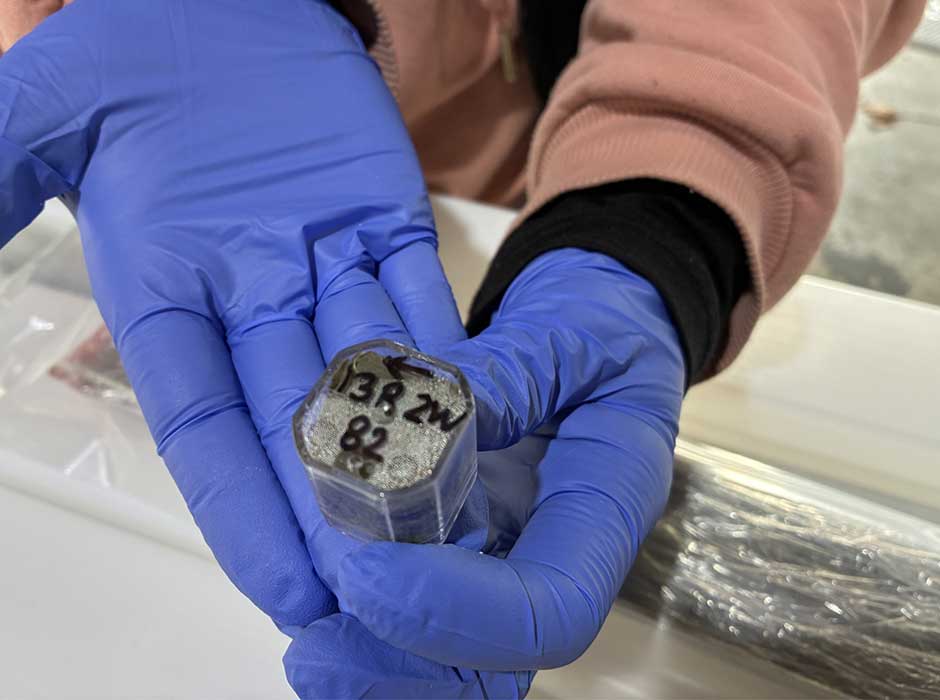
Luisa Fontanot holds a small sample of core.
“Sediment drill cores are like geological history books, and we can read each layer the way you can read a page of a book,” Natalie-Jane says.
“The team at the workshop opened sections of core and described them, looking at the physical properties like colour, density and geochemical data. Here at ORCA, we’ve got the right equipment to do it.”
The scientists worked in groups, with Natalie-Jane and Luisa supporting the paleomagnetism team in its efforts to provide an age model for the core.
In the specialised environment at ORCA, Natalie-Jane says even the workplace gossip was inspiring.
“All the chatter that went on was about science, and we were sponges soaking up everything that was going on.”
Luisa says the pair was “so happy” to work alongside some of the best researchers in the world, even though it meant putting in long days and weekends. The timetable was particularly gruelling for Luisa, who had handed in her PhD thesis just before the workshop began.
Originally from Italy, Luisa has long been interested in oceanography and coastal morphology. During her research she read about Otago’s Dr Christian Ohneiser and Dr Catherine Beltran and realised she’d like them to be her PhD supervisors.
Three years in New Zealand and a trip to Antarctica later, she’s just as passionate about the ice as Natalie-Jane.
“I like research, I love this environment and I really love the Geology Department. I would love to stay in New Zealand and keep working with Antarctic sediment,” Luisa says.
Natalie-Jane also appreciates the “unique and special” Geology Department.
“I like the close-knit community and the high-quality, high impact science that’s being done. I love having Lulu as my ‘PhD sister’. We’ve worked together on the same cores, we’ve gone to workshops together and we travelled to Europe for paleoclimatology summer school together. We’ve had so many awesome opportunities.”
The pair has plenty of people to thank for their involvement in the SWAIS2C workshop, including their supervisors, the ORCA staff, and Geology Department technician Brent Pooley who made a bespoke instrument for them to use.
Now that the workshop is over, the sediment core will be kept in a repository in the United States and sampled by more scientists to deepen our understanding of Antarctica.
Forget crystal balls and tea leaves – it’s ancient mud and rock that will help us divine our future.
– Kōrero by Kathryn van Beek, Communications Advisor | Kaiarataki Pārokoroko
Department of Geology
Geologists study rocks, minerals, landforms, climates and biota, and the processes that affect them.
View