
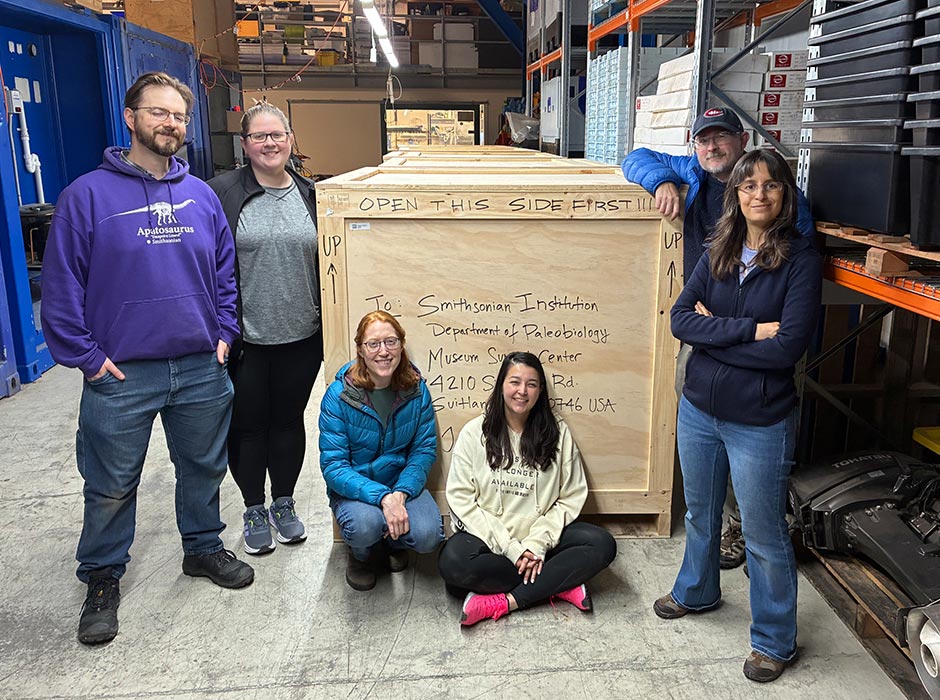
A team from the Smithsonian Institution visited the University of Otago last week, where they packed a 34-million-year-old whale fossil into crates for transportation to Washington DC. Pictured with the team is Paleobiology Chair and Co-Lead; Curator of Fossil Marine Mammals Nick Pyenson, second from right.
It’s not every day you get to fulfil your mentor’s final wish – particularly when it involves transporting an enormous whale fossil 14,500km from a Dunedin basement to Washington DC.
When the Smithsonian Institution’s Nick Pyenson promised to reunite the fantastically heavy fossil with a jaw and skull fragment held by his department, he wasn’t sure how he was going to make it happen. But he knew he couldn’t let Professor Ewan Fordyce down. After all, Ewan not only fostered Nick’s love of whale fossils – he also changed the trajectory of Nick’s career.
“I came to New Zealand from the US as a graduate student in 2005. I spent a summer studying the evolution of whale feeding at the University of Otago, and Ewan was my advisor,” Nick says.
“I’ve considered him a mentor ever since.”
The two men’s lives were intertwined because of one long-dead animal: an eight-metre, sharp-toothed, 34-million-year-old Llanocetus denticrenatus, a distant ancestor of today’s humpback, blue, and other baleen whales.
“In the 1970s the fossil of a chunk of jaw with an unusual tooth was collected from really old rocks on Seymour Island in Antarctica and found its way into the Smithsonian,” Nick says.
“It was the first example of that species that was collected.”
Ewan discovered the rest of the previously unknown animal’s remains during a 1987 expedition. Intuiting it would yield important clues about whale evolution, he dedicated the rest of his life to studying and preparing the specimen – a process he once described as like trying to extract an eggshell from a block of concrete.
“The fossil’s really big and it’s in really hard rock, which makes it a really challenging object,” Nick says.
“But it’s a spectacular example of evolution.”
Ewan’s research suggested that large gums in whales like Llanocetus gradually became more complex over time, giving rise to baleen. In 2018 he published a paper on his findings and expressed his hope that the fossil would ultimately join the jaw fragment in the Smithsonian.
In a twist of fate, his former protégé had gone on become the Smithsonian’s palaeontology department chair and Curator of Fossil Marine Mammals. The pair had kept in touch and when Ewan became unwell, Nick assured his mentor that he’d arrange the relocation of the fossil from the Geology basement. Ewan died in 2023 and Nick set about making good on his promise, culminating in a Smithsonian team traveling to Dunedin last week to prepare the fossil for shipping.
“There are about 100 pieces that range from teeth that you can hold in your hand, through to 100kg blocks of ribs,” Nick says.
“Each item was photographed, catalogued, assessed for fragility, and nestled into dense foam before being packed into custom-made crates.”
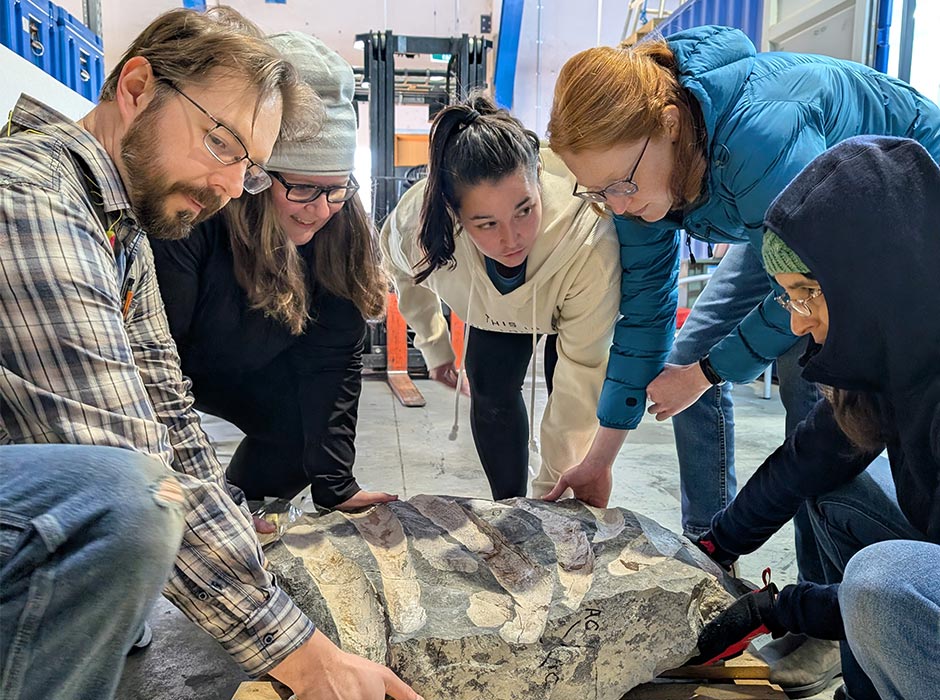
Smithsonian team members carefully ease part of a fossil whale jaw into a foam cradle for secure transport to Washington DC. Photo: Nick Pyenson
The crates will fly from Auckland to Los Angeles and be transported on critical freight from the West Coast to the East Coast on a truck that never stops, arriving in early June.
“We didn’t want to put all this effort in for it to get lost in transit!” Nick says.
There have been logistical challenges along the way, such as insuring the specimen for shipping.
“The insurance company asked what it would cost to replace it. Well, for a start, you’d have to mount a modern-day expedition to Seymour Island, which is in one of the most unreachable parts of the planet.”
The priceless fossil will enjoy a pampered existence at the Smithsonian, where Nick hopes it will help inspire the next generation.
“We’re the right place to care for the integrity of this specimen, and we can make it visible, accessible and useful. Fossils tell us about bygone life in a past so distant we can’t really wrap our minds around it. Because this is an important specimen, we’re going to 3D scan it, digitise it, and make that data open access.”
Nick says ancient pieces of rock not only tell us about our past, they can also help us prepare for the future.
“If we don’t know about the world, how can we teach future generations to care for it? How are we going to get people to care about the crises of our time – climate change and extinction – without examples? And I can’t think of a better example than a fossil of a whale from Antarctica.”
Nick says he’s grateful for the assistance he’s received from the University of Otago’s Geology Department.
“It’s been a group effort from both sides of the Pacific, and if it helps inspire the next generation, that’s the best possible outcome.”
On a personal level, Nick’s proud to help set Professor Ewan Fordyce’s legacy in stone.
“I’m closing a lot of circles. I’m reuniting this specimen with its jaw fragment in a collection I oversee, and I’m following through on a promise I made to a mentor.”
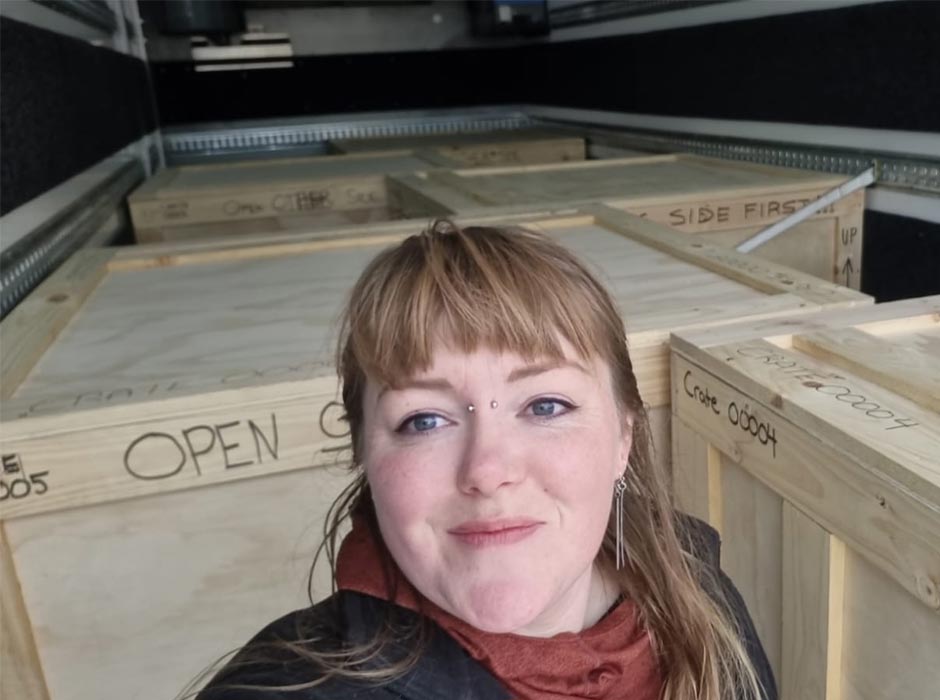
All 1,930kg of Llanocetus loaded up with Otago's Palaeontology Lab Manager and Collections Manager Sophie White.
Emeritus Professor Daphne Lee, palaeontologist and Ewan’s colleague for forty years, says, “I am extremely grateful for the work that Nick and his team have carried out in close collaboration with Palaeontology Lab Manager and Collections Manager Sophie White, Otago Repository for Core Analysis manager Bob Dagg, and the students and staff in the Geology Department to reunite Llanocetus with the rest of the skeleton.
"Ewan would have been pleased to see that the long migration of this exceptionally important whale back and forth across the Pacific is about to be completed.”
Head of the Department of Geology, Professor Andrew Gorman, says the University of Otago is grateful to the Smithsonian Institute for making the challenging logistical exercise happen.
“We hope the collaboration between palaeontology researchers in the Geology Department and the Smithsonian will continue Ewan’s legacy for decades to come.”
- Kōrero by Kathryn van Beek, Communications Advisor | Kaiarataki Pārokoroko
Study Geology at Otago
Geology at Otago is hands-on and full of discovery. You’ll spend time in the field and in the lab, collecting and analysing data, solving real-world problems, and working alongside others who share your curiosity. You’ll develop critical thinking, technical, and teamwork skills that apply far beyond science.
More about Geology