
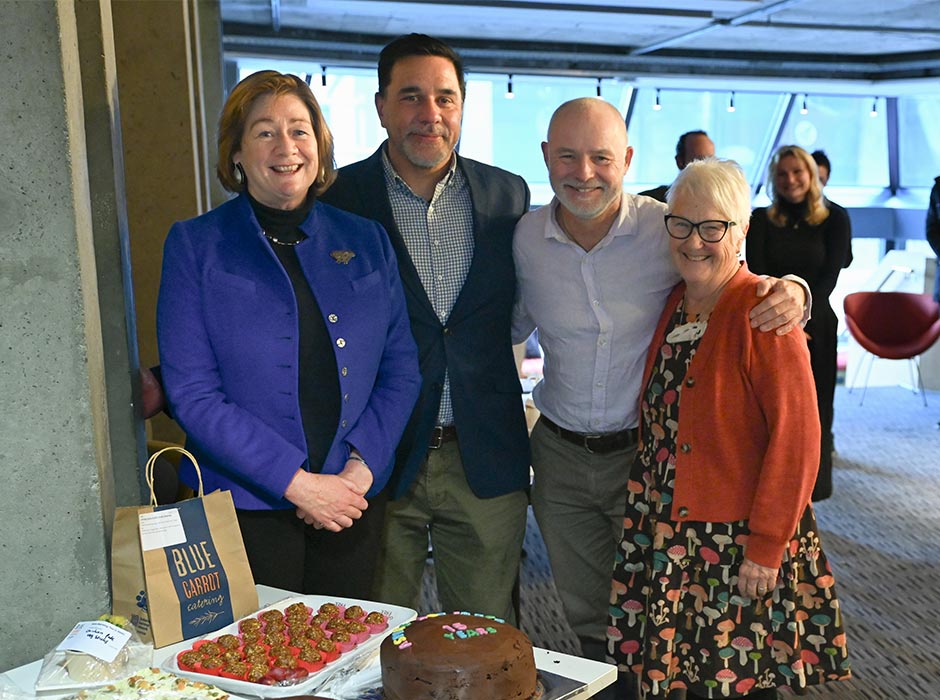
A symposium celebrating 15 years of the ASPIRE Aotearoa Research Centre was held on the Wellington campus this month. Pictured are founding directors of ASPIRE Aotearoa, Professor Janet Hoek (left) and Honorary Professor Richard Edwards (third from left), with Co-Director Associate Professor Andrew (Anaru) Waa and Dr Heather Gifford, Chair of the centre’s Rōpū Kaitiaki and a foundation member of ASPIRE.
Researchers took time to reflect, celebrate and share their latest findings when they came together in Wellington on 2 July to mark the ASPIRE Aotearoa Research Centre’s 15th anniversary.
The centre brings together researchers from diverse disciplines with the goal of achieving a tobacco-free Aotearoa.
Co-Director Professor Janet Hoek says the event offered the chance not just to share the group’s latest findings, but to create new research connections and extend existing collaborations.
She looked back to the support the group received in the early days, particularly from former Associate Health Minister Dame Tariana Turia, who launched the Tobacco Control Research Collaboration – Aspire 2025 in July, 2011 as a partnership between major Aotearoa New Zealand research groups involved in tobacco control research.
“We began as a loosely connected group of people but, with support from the University, we were able to bring on board early and mid-career researchers, and become an intensely productive research group,” she told those at the symposium.
Over the last 15 years, the group has brought in more than $20 million in external funding, including two Marsden Fund project grants, two Marsden Fast Start grants, six Health Research Council (HRC) project grants, two HRC programme grants, and funding from the Cancer Society and, via collaborations, the Australian National Health and Medical Research Council.
The centre was one of eight University of Otago Research Centres to be selected last year and received the University of Otago Research Group Award in 2025.
The Deputy Vice-Chancellor, Research and Innovation, Distinguished Professor Greg Cook, told those at the symposium the honours reflect an outstanding body of research as well as the collaborative values-driven approach that has become the hallmark of ASPIRE.
“Your work has shaped major public health initiatives, including plain packaging, graphic health warnings and vaping regulation. This is research with real-world impact – evidence that has helped governments make better decisions and improve health outcomes for communities.”
Dean and Head of Region at the Faculty of Medicine – Wellington, Professor William Levack, congratulated ASPIRE Co-Directors Professor Janet Hoek and Associate Professor Andrew (Anaru) Waa, together with former ASPIRE Co-Director Professor Richard Edwards, on the centre's sustained leadership in tobacco control research.
“ASPIRE's long-term contribution has provided a unique perspective on how research evidence influences policy over time. Working in a highly visible field, often in opposition to large corporate entities with significant commercial interests, also brings additional scrutiny and challenges, and I want to acknowledge the professionalism, integrity and resilience with which the team has continued to deliver research that has made a significant contribution to public health in Aotearoa and internationally.”
“The story of ASPIRE is about collective action, and about combining that effort with the same level of courage.” – Associate Professor Megan Gibbons
Associate Professor Megan Gibbons (Ngāpuhi), the Pro-Vice-Chancellor of the Division of Health Sciences, told those at the symposium that Otago was very proud of ASPIRE’s legacy and journey.
“The story of ASPIRE is about collective action, and about combining that effort with the same level of courage.”
Two international speakers, Associate Professor Raglan Maddox and Distinguished Professor Emily Banks, both from the Australian National University, travelled to Wellington to give the keynote addresses.
Raglan, who focuses on developing population-based Indigenous health information systems using community driven processes, spoke on the topic of ‘Defining the industry, strengthening the response: voices of resistance and public health action’. His presentation highlighted opportunities to strengthen coordinated system-wide responses to tobacco and nicotine-related harms.
Emily, who is a public health physician and epidemiologist with interests in chronic disease, tobacco control, Aboriginal and Torres Strait Islander health and healthy ageing, discussed applying evidence, celebrating success and managing risk in relation to new nicotine products.
Researchers from ASPIRE presented on the latest findings from their work, covering topics such as tobacco industry interference, Indigenous excellence, tikanga, and perspectives of rangatahi regarding nicotine and shared recent data and trends related to nicotine products and their implications for Aotearoa.
Speakers included ASPIRE Co-Directors Associate Professor Andrew (Anaru) Waa (Ngāti Hine, Ngāpuhi) and Professor Janet Hoek, Honorary Professor Richard Edwards, Anna Graham-DeMello, Dr Lori Leigh, Dr Karyn Maclennan, Dr Janine Nip, Lani Teddy (Ngāti Ranginui, Ngāi Te Rangi) and Associate Professor Robin Quigg (Raukawa).
ASPIRE also hosted a public lecture by Emily on the topic of ‘Lies, manipulation and exploitation: addressing tobacco and e-cigarette industry tactics for effective public health’ the evening before the symposium.
The symposium abstracts are available on the ASPIRE Aotearoa website.
University of Otago, Wellington
At our Wellington campus we teach Medicine, Radiation Therapy, Physiotherapy, postgraduate qualifications and papers, and undertake a wide variety of health-based research.
More about Wellington