
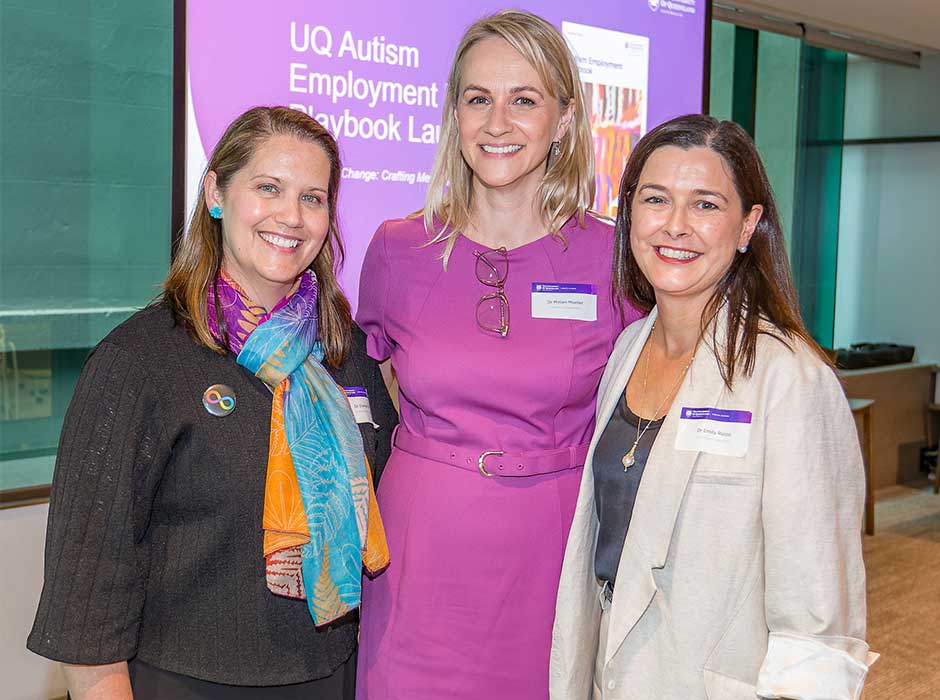
Dr Dana L. Ott (left) with Drs Miriam Moeller and Emily Russo at the launch of the Autism Employment Playbook in Brisbane in December 2024.
Department of Management lecturer Dr Dana L. Ott is on a mission to help autistic employees flourish in the workplace – and, therein, redress the reductive, deficit-based thinking on neurodiversity that informs the popular imagination.
Dana spent more than a year working alongside two researchers from Australia’s University of Queensland – Drs Emily Russo and Miriam Moeller – to create the Autism Employment Playbook (AEP). This real-world-ready practical resource signposts the path towards meaningful and sustained employment.
Supported by a grant from the Endeavour Foundation, an organisation working in the disability space in Queensland, the AEP project drew its data from three stakeholders: autistic jobseekers and employees, Disability Employment Services (DES) providers, and employers who had hired individuals via DES.
Impressed by Dana’s research background in talent management, Emily initially invited her to undertake a literature review on neurodiversity in organisations. Dana says the statistics she uncovered around neurodiversity and employment made for sobering reading and informed aspects of the project.
One study from 2018 showed that autistic individuals in Australia faced an unemployment rate of 31-34%, which is significantly higher than other disabilities and the general population. Another study from 2019 revealed that over half the autistic population had never had a paid job, and of those who had secured work, 54% were seeking a more challenging role and 45% felt overqualified in their current role.
“We were particularly interested in the perspective of autistic jobseekers and employees, because their voice is often missing from research,” Dana says.
The interviews that followed confirmed the trio’s hunch: those missing voices compounded the gaps in understanding across the three stakeholder groups.
“There’s a perception that individuals looking for employment through disability services are just wanting to fulfil their contractual obligations to get government sponsorship. But many are really passionate about opportunities for employment. It was quite emotional to hear them say things like, ‘nobody sees me as someone who wants to have a career, but I am interested in things beyond cleaning rooms’.”
Dana says there were also some heartening findings.
“One thing that was really awe-inspiring was how far above and beyond some of the DES consultants went to help neurodivergent individuals succeed. Some offered to help pick out clothing for jobseekers or drive them to interviews – and often it was something they were doing outside of their normal work hours.”
Soon after its Australian launch in December last year, the AEP was picked up – and lauded – by one of that country’s DES providers. Keen to see the resource gain similar traction on this side of the Tasman, Dana secured an Impact and Engagement Award through the Otago Business School. She’ll use this to bring one of her Queensland colleagues over to help run two dissemination events in New Zealand later this year.
“We’ll reach out to organisations and HR individuals so they can be more knowledgeable about neurodiversity and aware of the simple things that can be done to make organisations more neuroinclusive. I think there’s an appetite for it here – it’s just a matter of spreading the word.”
Dana says they’ll contextualise the AEP for New Zealand stakeholders with some Aotearoa-specific statistics. For instance, she points to a 2022 survey by Diversity Works NZ that confirms how applicable the resource will be in this country. It shows that a third of neurodivergent respondents reported their condition had negatively impacted their career advancement and more than 60% of neurodivergent employees said their employers didn’t know about their condition as they were actively masking (concealing neurodivergent traits in order to appear neurotypical).
Does Dana hope these dissemination events might start a national conversation around how to support autistic individuals in the workplace?
“I’d love that.”
On a broader level, she hopes the launch of the AEP will help combat the swirl of misinformation about autism that persists in the media.
“Globally, we’ve had prominent politicians say autism is a tragedy and that it destroys families. Also, studies have found that some media outlets still rely on negative language when reporting about autism. Such stigmatising rhetoric shapes the way people think about autism and is the biggest challenge. We need to increase awareness and get people to understand that we have to stop focusing on what we think autistic people can’t do and switch the conversation to what they are good at.”
Dana says we need to reframe our understanding of autistic individuals and focus on the strengths they bring (like problem-solving, attention to detail and innovative thinking).
“It’s just about making little changes that can help everybody put their best person forward.”
Kōrero by Claire Finlayson, Communications Adviser, Otago Business School
Study Management at Otago
Great leaders, great entrepreneurs, great business people, even great bosses, all have one thing in common – great management skills!
Find out more