
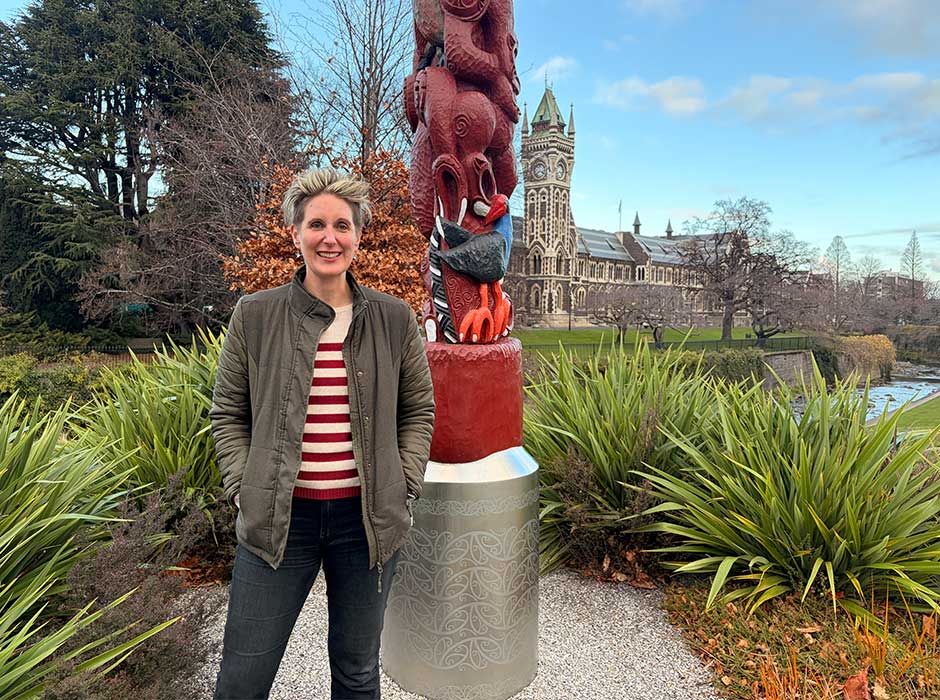
Associate Professor Miranda Johnson has received a prize for work that “speaks to the political, social, and economic implications of scientific change”.
An Otago academic has received an award which recognises outstanding research that resonates with the interests and concerns of undergraduate students.
Kā Kōrero o Nehe - History programme Associate Professor Miranda Johnson says she is thrilled to receive the Ian Langham Memorial Lectureship Prize from the School of History and Philosophy of Science (HPS) at the University of Sydney, Australia.
“It’s such an honour to be recognised in this way, especially because it connects my research with my teaching. It’s wonderful to know that my research connects with students, who I think should be the focus of our work,” Miranda says.
Head of HPS Professor Dominic Murphy says Miranda’s writing has been studied in several of the school’s undergraduate courses, particularly on topics such as Indigenous land claims, and on the nature of historical knowledge and its roles in settler-colonial societies.
“The award was established to honour work in our area that speaks to the political, social, and economic implications of scientific change,” Dominic says.
“It is the prize’s ambition to honour excellent original research that directs students’ attention to critical inquiry about different forms of knowing. Miranda’s work has done precisely that.”
Miranda believes students relate to her work because it is comparative and transnational and helps to explain differences between contexts as well as taking some critical distance.
“I find that students want to learn both about their local communities and the wider world and I think historians are well placed to situate specific issues in wider contexts. I also pay close attention to matters of voice, agency, identity, and knowledge production on the part of both Indigenous and non-Indigenous people and I think that appeals to students,” Miranda says.
The Award is endowed with $1,000 and is named after Ian Langham who used to teach at the School in the 1970s and –‘80s.
Miranda is the second recipient of this award. The inaugural prize last year was awarded to Yuin-Bidjigal saltwater man Uncle Rob Cooley on behalf of the Gamay Rangers in Sydney’s La Perouse community.
The award includes an invitation to deliver the 2026 Ian Langham Memorial Lecture, which Miranda plans to present in November this year.
“I’ll probably speak to my new work which considers matters of decolonization and Indigenous knowledge and what it is that we hope to achieve in transforming universities, teaching and research along these lines. I present my work as politically engaged but also academically independent as I think it’s important to maintain a space for critical dialogue about key political issues,” Miranda says.
Miranda’s first book The Land is Our History: Indigeneity, Law and the Settler State (Oxford University Press, 2016) won the W. K. Hancock Prize in 2018 from the Australian Historical Association. She is currently finishing a book tentatively titled Redeemer Nation: History, Myth and the Politics of Indigeneity in a Southern Settler State, which examines the fraught imagery of ‘biculturalism’ in Aotearoa New Zealand, and with Te Tumu - School of Māori, Pacific and Indigenous Studies Associate Professor Paerau Warbrick, she is collating a collection of Māori petitions to the colonial New Zealand and British imperial governments in the nineteenth century.
Read more about Miranda’s research on Otago’s website.
-Kōrero Antonia Wallace, Communications Advisor | Kaiarataki Pārokoroko