
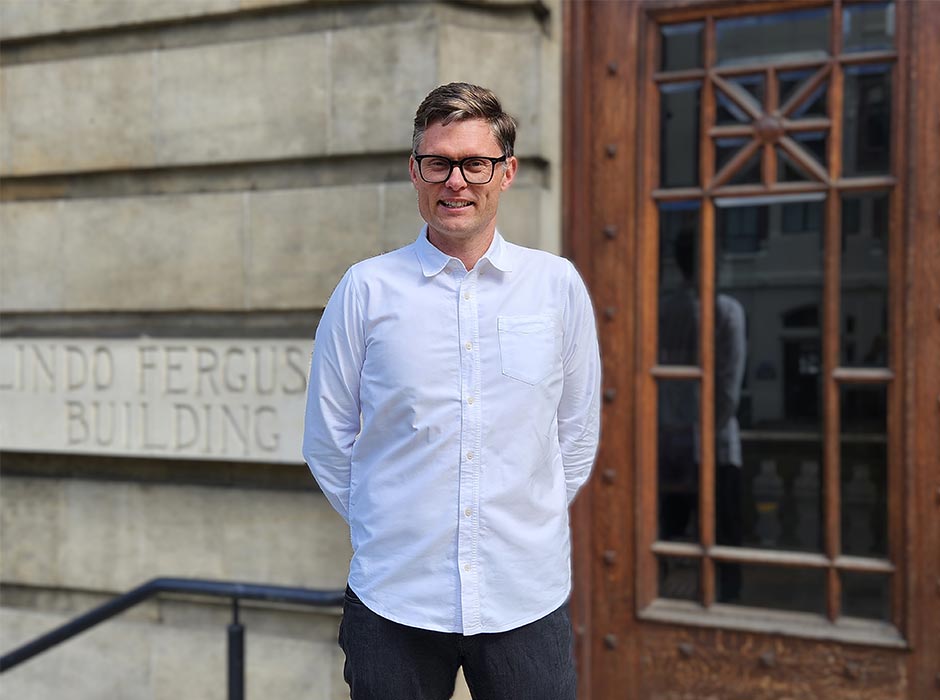
Associate Professor Andrew Reynolds is Otago’s 2025 winner of the Rowheath Trust Award and Carl Smith Medal, which recognises the outstanding research performance of early career staff.
At a time when diet-related diseases are among the world’s biggest health challenges, Associate Professor Andrew Reynolds is helping lead the charge for change.
Andrew is a scientist working at the forefront of research on lifestyle and non-communicable diseases and is this year’s winner of one of Otago’s highest research honours, the Rowheath Trust Award and Carl Smith Medal.
Andrew, who is based in the Department of Medicine (Dunedin), is Co-Director of Otago’s Edgar Diabetes and Obesity Research Centre (EDOR) and Associate Dean Research for the Faculty of Medicine – Dunedin. His contribution to human nutrition and public health is globally recognised.
“The importance and impact of what we eat on our health is a fascinating area to work in,” he says.
While there is a substantial evidence base behind what we should eat, less than two per cent of the population meet all guidelines for healthy eating, which he believes is partly due to mixed messaging.
“Most of the messaging and marketing we see about what to eat is there to make someone money, instead of improve health.”
There are many factors at play when considering how to encourage people to eat more healthily. These include the cost and accessibility of healthy food and the fact it can take more time to prepare and cook healthy meals.
“In research, there is so much more we could do to support people to move towards healthy food intakes. For any individual, change is hard. That’s why research on changing the food environment around people is so appealing, because we aren’t asking already busy people to do more.”
Born in Tasmania, Andrew worked in a few different jobs before realising he needed a university education, starting a BSc in Nutrition Science and Biochemistry at the age of 24. It was when the course focus turned to health impacts of dietary intakes that he realised that was where his interest lay.
After spending his undergraduate years at universities in Melbourne and Oslo, Andrew then completed a trans-European MSc and was working in Rome when he contacted the University of Otago about further study at Otago. Following a Skype meeting with Professor Sir Jim Mann, EDOR founder and a leading endocrinologist, Andrew packed his bags and arrived in Ōtepoti Dunedin in 2013 to start his PhD on lifestyle factors and diabetes.
Having only visited Dunedin briefly as a tourist in 2008, he says, “I thought I would just do the three-year degree here and then go back to Europe. But I never left, and I’m not looking to.”
Andrew’s decision to stay in Ōtepoti is a combination of people and place. He really enjoys working with the great EDOR team, his colleagues in the Faculty of Medicine – Dunedin, and his students.
He also loves the location, size and pace of Ōtepoti, saying “the ease of life here is stunning”.
Since completing his PhD in 2016, Andrew has established himself as an outstanding research leader. He has secured more than $3 million in research funding as principal investigator and has 58 publications with 7,000 citations.
As part of his work to inform evidence-based guidelines, policy and lifestyle change for better health outcomes, he works collaboratively with international groups such as the World Health Organization, the European Association for the Study of Diabetes, and the National Health and Medical Research Council in Australia.
Colleagues describe Andrew as a rare scholar who combines methodological expertise, international standing and a deep commitment to equity.
His work is distinguished by his commitment to Te Tiriti-led, equitable and community-led research. An example of this is current projects with Manawa Ora, Ngāti Hine Health Trust and Pūtahi Manawa, and the completed DiRECT study undertaken in partnership with Te Kāika Health over three years.
Andrew says winning the Rowheath Trust Award and Carl Smith Medal recognises the important work being done by a team of staff and students, rather than his individual contribution.
- Kōrero by Andrea Jones, Team Leader, Divisional Communications
Edgar Diabetes and Obesity Research
Our mission is to improve diabetes and obesity outcomes through equitable partnerships and research excellence.
Find out more