
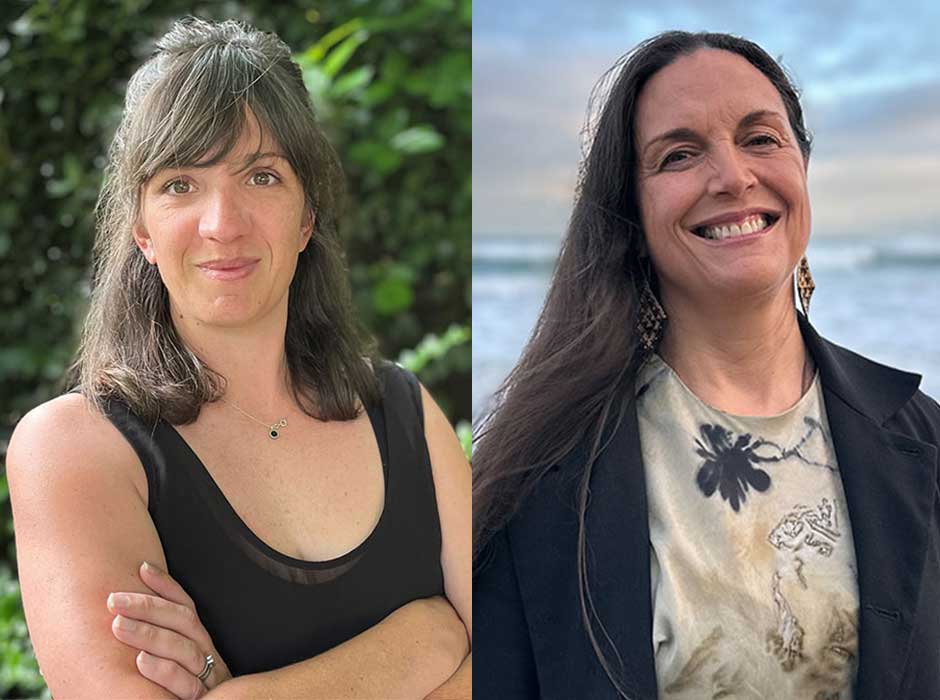
Dr Megan Leask (left), recipient of the University of Otago Māori Early Career Award for Distinction in Research, who has had remarkable productivity since her appointment at Otago. Katrina Pōtiki Bryant (right) receives a University of Otago Māori Early Career Award for Distinction in Research for the myriad of meaningful mahi she has done, namely her work as co-creator of Taurite Tū.
The two Health Sciences Division wāhine recognised in this year’s Otago Research Awards are making a difference - not only in their kaupapa Māori research, but also in their leadership within the University, including supporting Māori students.
Dr Megan Leask from the Department of Physiology and Katrina Pōtiki Bryant from the School of Physiotherapy were both recently awarded Māori Early Career Award for Distinction in Research for 2025.
Dr Megan Leask
Megan (Kāi Tahu, Kāti Māmoe) is a Rutherford Discovery Fellow and lecturer, internationally recognised for her interdisciplinary research in metabolic disease and Polynesian genetics.
Her mahi is impactful.
Megan’s research relies on the exemplary zebrafish animal model to understand how non-coding DNA variants in the genome contribute to gene regulation, and hence complex diseases like gout and metabolic disorders.
She is specifically interested in identifying the gaps in indigenous genomes of Māori and Pacific peoples, who are under-represented in genome-wide analyses. As such, Dr Leask has identified a niche in which she combines her expertise in experimental genetics with population genetics from a kaupapa Māori stance.
This unique approach has enabled Megan to attract multiple awards and research grants. She is well published, including a paper in Nature Genetics, and presented at numerous events, including leading gout symposia.
Although her lab, based in the Department of Physiology, is relatively new, she has already attracted several postgraduate students and postdocs.
Megan embodies manaakitanga Māori. She is mentoring the next generation of Māori and Pacific tauira, maintains genuine Māori and Pacific relationships in research, is a member of the Maurice Wilkins Centre Te Amorangi roopu and has Māori Strategic Framework roles with Physiology and Faculty of Biomedical Sciences.
She was a founder of the Genetics Otago Zebrafish Hub and has roles in the gout and Zebrafish research communities via the Gout Action Aotearoa group and International Zebrafish Society committees.
Leadership responsibilities at Otago include being a member of the senior Māori roopu Te Amorangi at the Maurice Wilkins Centre, director of Otago Zebrafish Facility and co-deputy director of the University Research Theme Genetics Otago.
She’s hoping this award will help support a Pacific summer student this year.
Katrina Pōtiki Bryant
At the heart of Katrina Pōtiki Bryant’s clinical, professional, and academic motivation is her determination to support positive approaches towards hauora Māori.
A Senior Lecturer in the School of Physiotherapy, she champions Indigenous-led, kaupapa Māori research approaches that integrate mātauranga Māori with evidence-based physiotherapy to develop engaging healthcare options for whānau Māori.
Katrina says she is elated to receive a Māori Early Career Award for Distinction in Research, acknowledging the meaningful mahi she has done, namely her work as co-creator of Taurite Tū.
A nationally implemented strength and balance programme for Māori aged 50+, Taurite Tū uses traditional Māori techniques to strengthen muscle, build balance and confidence, and prevent the risk of falling by focusing on posture, breathing, strengthening, stretching, coordination, body awareness, and pelvic floor muscles.
Created in partnership with Te Rūnanga o Ōtākou, Māori communities, and physiotherapy experts, Taurite Tū first came into fruition at Ōtākou Marae on the Otago Peninsula.
“With the support of kaumātua Māori, Māori physiotherapists, and Māori movement experts in mau rākau (Māori martial arts), tī rākau (Māori stick games), poi, tākaro (games), and whare tapare (Māori performing arts), we developed a te ao Māori falls prevention programme aimed at achieving more equitable outcomes for aging Māori,” Katrina says.
“Phase one was rolled out in 2021 with participants from Ōtākou, Puketeraki Marae in Kāritane and Ōtākou Health Clinic’s Te Kāika, with Taurite Tū only growing from there and currently delivered in 28 communities across Aotearoa.”
Committed to impact-focused research, she prioritises community engagement, capacity building, and translation into practice over traditional outputs.
Katrina’s research spans biomechanics of mau rākau, Indigenous health leadership, and global Indigenous physiotherapy networks, emphasising community co-design, translational impact, and Māori research capacity building.
She mentors emerging Māori researchers and fosters national and global collaborations, positioning her work at the forefront of Indigenous physiotherapy and health research.
~ Kōrero by Communications Advisers Claire Grant and Kelsey Swart
Research at Otago
Explore the globally significant, regionally responsive Otago research that is changing lives and environments for a better world.
Find out more