
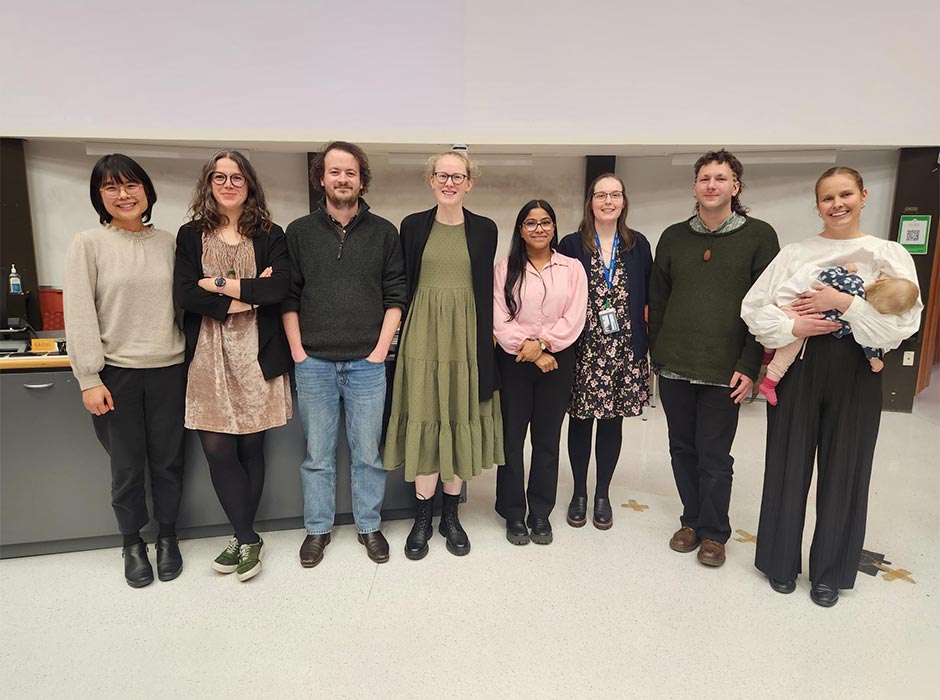
Presenters at the 2026 Otago Medical School Research Society Research Staff awards, from left Jia Yap (Faculty of Medicine), Teodora Georgescu (Department of Anatomy), Michael Perkinson (Department of Physiology), Helen Wardell (Department of Physiology), Anupriya Gupta (Department of Microbiology and Immunology), Hannah Darroch (Department of Pathology and Molecular Medicine), Nicholas Anderson (Department of Anatomy) and Sofia Peters (School of Pharmacy and Pharmacology).
Nicholas Anderson, from the Faculty of Biomedical Sciences (BMS), has taken the top honour in the recent 2026 Otago Medical School Research Society (OMSRS) Research Staff awards.
Eight early career research staff, five from BMS, presented their research findings at the 278th Scientific Meeting of OMSRS, which was sponsored by the Otago Postgraduate Medical Student Association (OPMS) and the Faculty of Biomedical Sciences.
Society President Emily Gray says the standard of presentations was incredibly high.
“The evening was a wonderful showcase of the amazing research being undertaken by our early career research staff. It was heartening to see both the range of research and the calibre of the presentations,” she says.
Nicholas is from the Department of Anatomy and his research focus is that the size of the primordial reserve (also known as the ovarian reserve) in early life does not predict lifetime fertility.
Nicholas has recently handed in his PhD thesis, and has started in a post-doc role in the Department working on a project on polyendocrine metabolic ovarian syndrome (PMOS), formerly polycystic ovary syndrome, looking at ovarian follicle dynamics.
He explains that females are born with a set supply of cells contained in primordial follicles in the ovary. It is assumed that the number of primordial follicles in the ovary at birth determines the onset of infertility and menopause – however, no one has been able to observe follicle loss across the life of an individual.
“Using a novel live fluorescent imaging technique, we have been able to count these follicles in living mice and our data suggests that it is the rate of loss, not the initial number of follicles, that is important for determining menopause and that this does not impact fertility.
“This is the first study of its kind and has been able to answer longstanding questions in ovarian biology and female reproductive ageing,” he says.
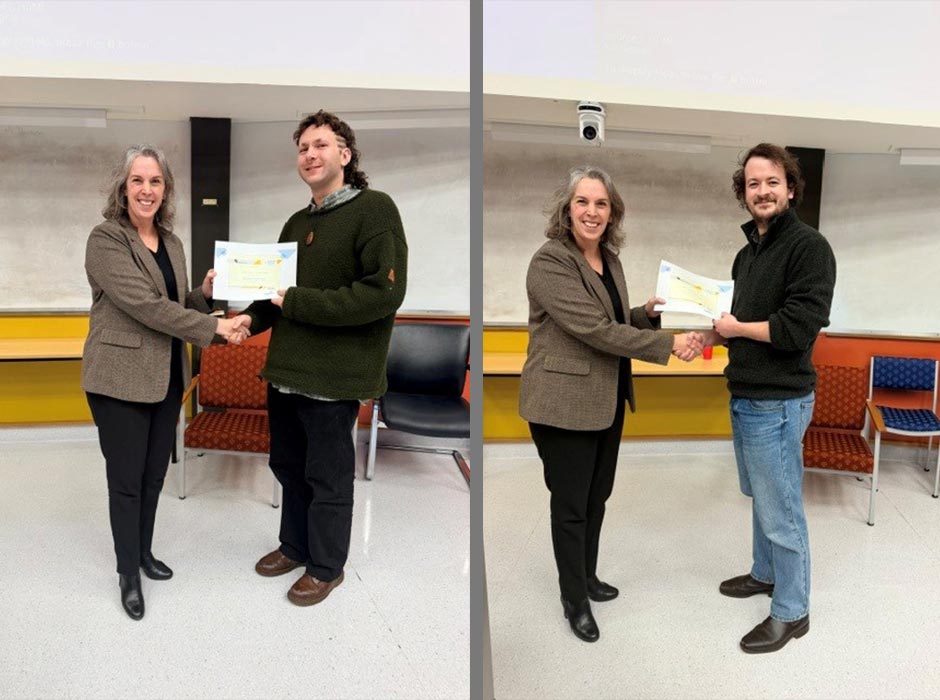
Nicholas Anderson (left), winner and Dr Michael Perkinson (right), runner-up in the 2026 Otago Medical School Research Society Research Staff awards, receive their award from Associate Professor Ailsa McGregor, Head of the Faculty of Health Professional Programmes.
It is always lovely to hear the presentations at the OMSRS and get a glimpse into the other work going on at Otago, Nicholas says.
“The panel of judges have my thanks and it’s really encouraging to get recognition for a body of work that I have put a lot of time, love and care into.”
The runner-up was Dr Michael Perkinson, from the Department of Physiology, who presented his research that a hormone-sensitive neural circuit drives maternal-pup interactions via the dopamine reward system.
Michael works in the Rosie Brown lab, which focuses on how the changing hormones of pregnancy and lactation act on neural circuitry in the maternal brain to influence behaviour.
- Kōrero by Claire Grant, Communications Advisor, Faculty of Biomedical Sciences