
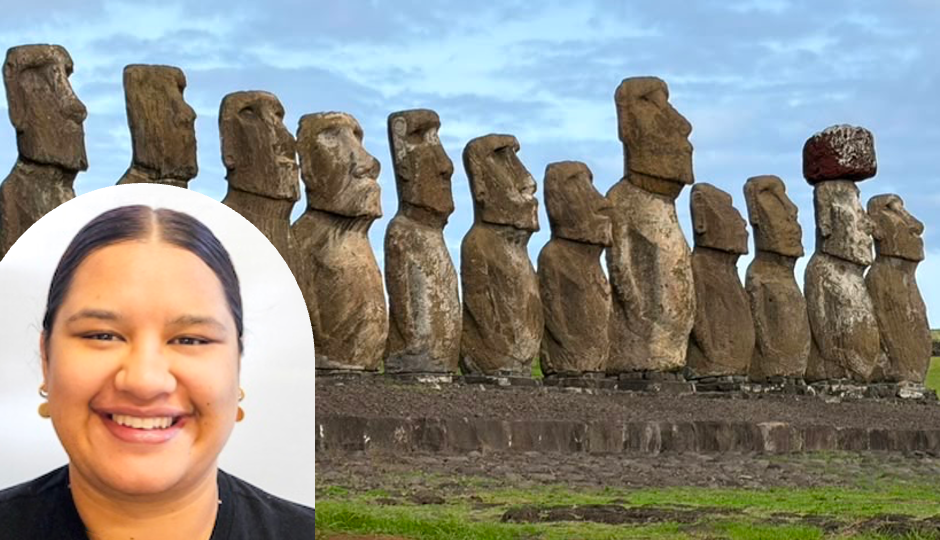
Headshot of PhD student Tyla Hill-Moana overlaid on a photo of moai at Ahu Toŋariki, the largest ahu or ceremonial platform on Rapa Nui.
Tyla Hill-Moana, a PhD student from Te Tari Matū Koiora – the Department of Biochemistry, recently had a trip of a lifetime visiting one of the most geographically isolated inhabited places on Earth, Rapa Nui – Te Pito o te Henua (Easter Island), and making meaningful connections with the Mā‘ohi, the indigenous people of the island.
Tyla was one of eight Māori and Pasifika tauira (students) and four staff from across the University of Otago – Ōtākou Whakaihu Waka who travelled to Rapa Nui for a month in June. The trip was organised by Dr Moira Fortin Cornejo and Associate Professor Esther Willing and funded by a Prime Minister’s Scholarship.
The purpose of the journey was to tautoko (support) international learning and to ‘Whiria te taura here tāngata’ (a whakataukī (proverb) meaning to bind together the strands of humanity) across te Moana-nui-a-kiwa (the Pacific Ocean). The indigenous peoples of Aotearoa New Zealand and Rapanui share Polynesian heritage, and are therefore closely connected through language, culture, and ways of relating.
The Otago delegation took part in a series of community wānanga (forums) covering language, education, health, law, the environment, archaeology, and sport. These experiences enabled the tauira, as future leaders, to practice building relationships that can form foundations for collaborative research and meaningful engagement with indigenous communities.
For her PhD, Tyla is investigating the impacts of freshwater acidification, driven by rising atmospheric carbon dioxide, on kākahi (freshwater mussels) in Te Awa o Waikato (the Waikato River), with a focus on genetic, phenotypic and molecular changes.
Dr Nathan Kenny of Otago Biochemistry is her primary supervisor, and she is also working with Dr Chris Cornwall (Te Herenga Waka, Wellington University of Victoria) and Dr Mark Fenwick (Earth Sciences New Zealand).
We asked Tyla a few questions about her haerenga (journey).
Before you left, what were you expecting Rapanui to be like, and what surprised you most after arriving?
I had never imagined going to Te Pito o te Henua, maybe more of a distant dream. So, I initially thought of the beach, kai (food), moai (giant monolithic stone statues) and reo (language). That whakaaro (thought/opinion) changed the instant we arrived on the henua. We were greeted by all our host whanau (family) and off we went to our respective kaainga (homes), and there were so many similarities to our ahurea Maaori (Māori culture) that it felt like home.
What activities were you involved in there?
A main reason for the haerenga was to make connections, so to connect with the community we held vānaŋa/waananga at Katipare (library). These were an opportunity to discuss different topics (largely relating to our fields of study) and our Aotearoa perspective. In return, the Rapa Nui community also shared their perspective. A beautiful time for sharing reo, culture and maatauranga (knowledge).
The first few days were dedicated to hanging out with our whaanau and getting settled in. After that we had a pretty hectic schedule (an oracle we called it), getting to know the community with visits to the schools, Hoŋa’a Re’o (kohanga reo/early childhood learning centre), hospital and papara’au (traditional healing and medicinal practice), Ūmaŋa Hatu Re'o (language academy), Corporación Municipal de Arte y Cultura Rapa Nui (arts and culture centre), Tatou Arts (artists and creatives), Ma’ū Henua (indigenous community that manages Rapa Nui National Park), to name a few.
We also visited sites of significance around the island such as Rano Kau (volcanic crater), Oroŋo (sacred site where the taŋata manu competition was held) and Rano Raraku (where they built moai).
Was there a particular experience or person that had a significant impact on you?
Experiences, there were many, but navigating multiple languages was a fun one. Within my own whaanau we were switching between Spanish, re’o Rapa Nui, reo Maaori, sometimes a little French and English. It has really encouraged me to learn more languages moving forward.
People, absolutely, ko to’oku whaanau Rapa Nui taku tino. It was my whaanau Rapa Nui that made the haerenga special for me – Mamá Andrea, Yäelle (hermana), Loïg and Yann (hermanos), and even the extended whaanau and friends that I connected with at our hare alone. I did not expect to meet and connect with so many people, some of them I now call family. I was well cared for there and that has left a lasting impression.
Māuruuru e te hua’ai o te kainga e.
How has spending time in Rapa Nui influenced the way you think about your future career?
It’s given me a lot to think about in terms of my research and what the future holds. I would love the opportunity to return to the henua to help or collaborate on any taiao kaupapa (science programme) or art kaupapa because my other passion is toi Maaori (Māori arts).
What advice would you give to other students who are considering applying for similar international opportunities?
Karawhuia! Vamos! Go for it! For me this haerenga was life changing, I met a lot of amazing people and I have another place I can call home.
What is one thing you'll take home from this experience that will stay with you for years to come?
To fully experience the henua and its culture, you have to live with and amongst the people. If I were to travel within the Pacific, I would try to be hosted by whaanau again.
Iorana māuruuru Te Pito o te Henua!
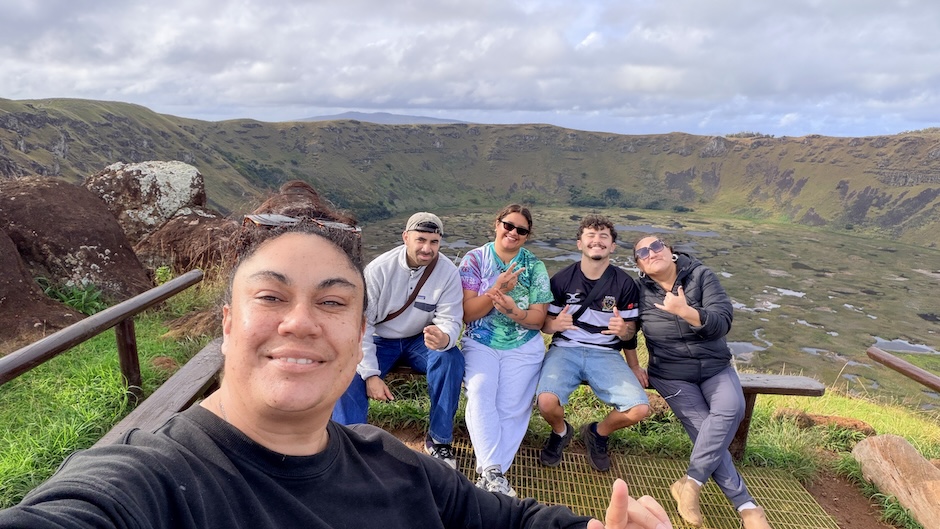
Visiting the crater of the extinct volcano Rano Kau are (from left) Mama Andrea, Sammi, Tyla, Wiremu and Mama Marcela.
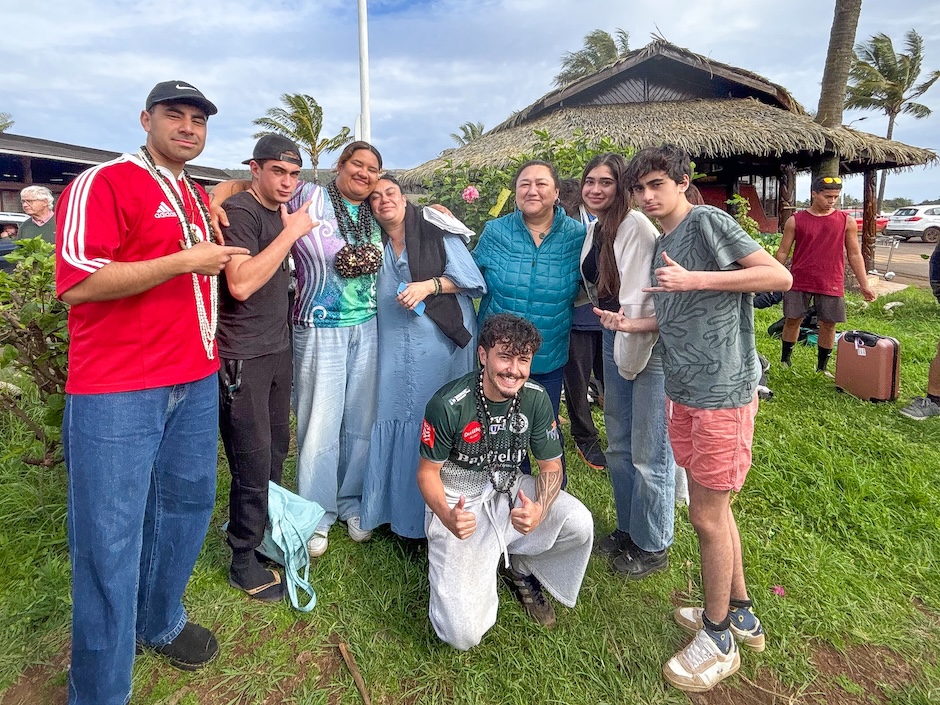
Tyla’s last day on Rapa Nui (at the airport), from left: Sammi, Loïg, Tyla, Mama Andrea, Mama Marcela, Yäelle, Yann and Wiremu (on knee).