
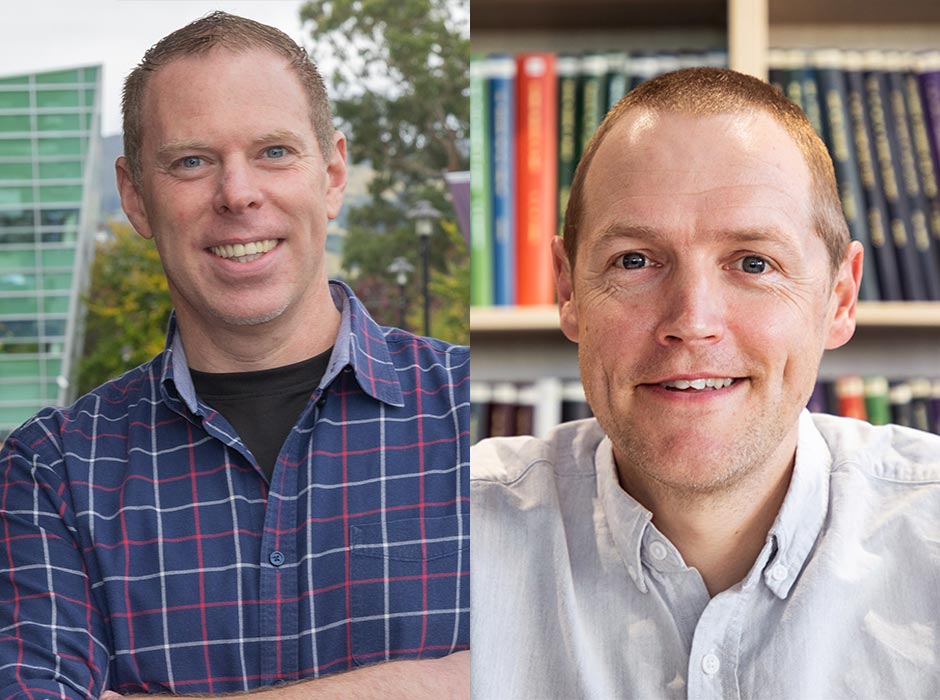
Associate Professor Daniel Pletzer (left) from the Department of Microbiology and Immunology and Professor Peter Mace (right) from the Department of Biochemistry have received funding from the New Zealand – China Strategic Research Alliance.
Two Otago Faculty of Biomedical Sciences projects have received support from the New Zealand – China Strategic Research Alliance (SRA).
The joint funding programme, a bilateral initiative between the Ministry of Business, Innovation and Employment (MBIE) and the Chinese Ministry of Science and Technology (MoST), supports projects that broaden and deepen collaborative research partnerships between China and New Zealand.
Associate Professor Daniel Pletzer from the Department of Microbiology and Immunology will be looking at developing novel antimicrobials and treatment strategies, while Professor Peter Mace from the Department of Biochemistry is studying specific functions in metabolic disease.
Associate Professor Daniel Pletzer
Antibiotic resistance is making some infections increasingly difficult, and sometimes impossible, to treat.
Daniel says one of the big challenges is the multidrug-resistant Gram-negative bacteria behind many hospital infections (including Pseudomonas aeruginosa). Making the problem worse is that no genuinely new antibiotic classes for these bacteria have reached clinical use since the 1960s.
Daniel and his team are tackling the problem, developing a “Trojan Horse” strategy that chemically links existing antibiotics to essential nutrients, so bacteria actively take them up.
Repurposing existing drugs using modern chemistry and insights into bacterial metabolism could offer a faster, more cost-effective alternative, he says.
“Sneaking drugs inside bacterial cells that would normally block or expel them could boost drug accumulation, restore effectiveness, and reduce the emergence of resistance.
“The aim is to address a critical global health gap while delivering local impact, with the potential to improve treatment outcomes, shorten hospital stays, and reduce healthcare costs.”
This project builds on a long-standing and highly productive collaboration between research teams in China and New Zealand.
“The Chinese team, led by Professor Wu and Associate Professor Jin, brings expertise in bacterial resistance mechanisms, virulence, and infection biology, supported by high-impact discoveries in gene regulation during infection. The New Zealand team, led by myself and medicinal chemist Associate Professor Gamble, contributes strengths in infection models, antimicrobial testing, and advanced chemical synthesis of novel compounds.”
Professor Peter Mace
The goal of Professor Peter Mace’s research on COP1 regulation in metabolic disease is to discover novel strategies and targets for precision therapy in metabolic diseases such as diabetes and associated tumours.
The idea is to accelerate drug development in an area that currently has few effective treatments and significant health disparities.
His project “COP1 regulation in metabolic disease” focuses on a particular protein - COP1 - which plays a crucial role in regulating cell metabolism, stress responses, and tumour suppression.
"With complementary programmes in Dunedin, Auckland, and Shenzhen, the collaboration aims to understand how COP1 and its partner proteins regulate lipid metabolism in the liver, and from that, to discover new therapies for metabolic disruption,” he says.
- Kōrero by Claire Grant, Communications Advisor, Faculty of Biomedical Sciences