
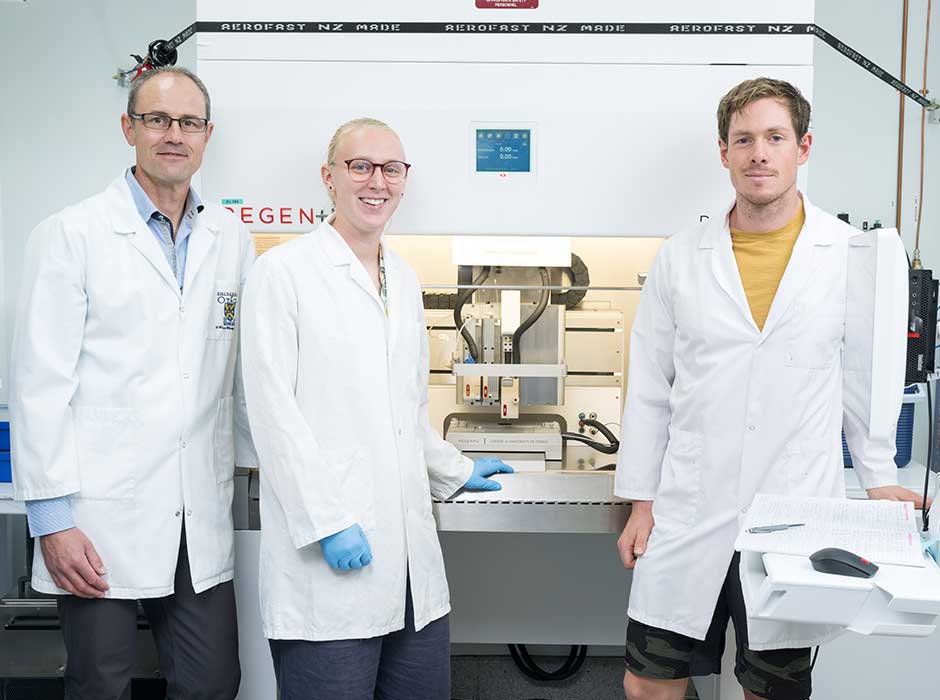
Professor Tim Woodfield (left), with Regenerative Medicine PhD candidates Poppy Buissink and Vincent de Jong, says “I am very lucky to have worked with so many talented emerging researchers … over the years". Photo: Neil Macbeth.
A small team of Otago researchers has a bold ambition: to bioprint harvested human stem cells, enabling orthopaedic surgeons to repair damaged bone joints using a patient’s own cells – and that dream is now within reach.
Founded in 2008, the Christchurch Regenerative Medicine and Tissue Engineering (CReaTE) group, sits within the University of Otago, Christchurch’s, Department of Orthopaedics and Musculoskeletal Medicine.
Led by Bioengineering Professor and CReaTE Director Tim Woodfield, the group’s research has gone from strength to strength – developing bioinks for 3D bioprinting functional tissues and selling those bioink kits and their tech to international research groups and biotech companies. Most recently the group was chosen as an international partner in a major European Union (EU) HORIZON-funded consortia project focused on advancing 3D bioprinting and regenerative medicine.
“Our team of 15 bioengineers, cell biologists, polymer chemists, orthopaedic and reconstructive surgeons and entrepreneurs is truly interdisciplinary,” Tim says.
“We’re working on a range of fundamental and translational research projects we’re very excited about.
"One of our key breakthroughs is the development of photo-crosslinkable bioinks for 3D bioprinting functional tissues. These bioinks are both biocompatible and cell-friendly, enabling us to embed patient or stem cells directly into the bioprinting process to fabricate complex, three-dimensional tissues – such as cartilage, bone, and vascular structures – layer by layer.”
Tim says CReaTE’s patented approach uses visible light to safely solidify the bioinks, a process which is less harmful on cells than the ultraviolet (UV) light normally used in bioprinting, and also safer and more user-friendly in a surgical environment.
“This is fantastic news for our group, recognising not just a decade of hard work, but the strength of Otago’s research in the interdisciplinary fields of bioengineering, bioprinting and regenerative medicine.”
Since many high-resolution commercial bioprinters project visible light during the 3D bioprinting process, it also means that CReaTE’s photo-crosslinking technology can be applied as a platform bioink in many different bioprinting machines used in research and development labs and hospitals around the world.
“These tissues could one day be used by surgeons for improved cell-based therapies and regenerative medicine, for example to repair damaged or diseased joints in patients with osteoarthritis.”
CReaTE’s ground-breaking work is at the forefront of bioink and bioprinting research in Aotearoa New Zealand – being chosen as the sole Australasian partner in the cutting-edge EU HORIZON project is testament to that.
The €8 million (NZ$15m) micro@MACRO (m2M) project, tasked with advancing the field of bioprinting technology for human tissue repair, will bring together leading academic institutions, research centres and companies to create a system for producing personalised, scalable grafts to support the repair of damaged tissue and cartilage.
“This is fantastic news for our group, recognising not just a decade of hard work, but the strength of Otago’s research in the interdisciplinary fields of bioengineering, bioprinting and regenerative medicine,” Tim says.
"By making such a significant commitment, the EU acknowledges that advancing stem cell technology and developing new clinical treatments using a patient’s own regenerative tissue represent the future of medicine. It also recognises that tackling this grand challenge requires advanced biomaterials and bioprinting technologies to automate cell manufacturing and deliver scalable, cost-effective cell therapies."
Them2M project was one of only six bids accepted out of a total of 80 consortia projects submitted to the EU HORIZON call. CReaTE will receive funding support from both EU HORIZON and the Ministry of Business, Innovation and Employment (MBIE) here in New Zealand, for the four-year project.
Trinity College Dublin (Ireland) will lead the research collaborative, alongside the University of Otago/CReaTE, with fellow research teams from universities in Ireland, The Netherlands, Finland, Portugal, Germany and Switzerland, and five consortia partners from the European regenerative medicine manufacturing industry.

A porous 3D bioprinted bone scaffold structure – fabricated using Digital Light Processing (Lumen X Gen3) and light-cured bioresin – which can encapsulate cells for generating bone tissue and vascular tissue. Photo: Neil Macbeth.
Tim’s relationship with the University of Otago started in 1996 when, as a young University of Canterbury engineering honours student, he worked alongside academic surgeons in the Christchurch campus’ Department of Orthopaedics and Musculoskeletal Medicine, engineering devices to test improved muscle strength in tetraplegic patients following tendon transfer surgery, in the hopes of restoring arm and hand function.
His growing fascination with this emerging bioengineering field took him to the University of Toronto in Canada, and the University of Twente in The Netherlands where he completed his PhD. He then completed postdoctoral work at one of Europe’s first tissue engineering biotech companies, IsoTis N.V., focusing on cartilage tissue engineering and 3D printing.
Reconnecting with the University of Otago in 2006, Woodfield set about establishing CReaTE. The group’s quality was soon recognised, attracting funding – including a successful Royal Society of New Zealand Te Apārangi Rutherford Discovery Fellowship – and a succession of talented local and international PhD students and early-career researchers with backgrounds in bioengineering, cell biology, polymer chemistry and surgery.
“I am very lucky to have worked with so many talented emerging researchers. I am also proud to have supervised and mentored 20 early- to mid-career researchers and 43 current or completed PhD students over the years,” Tim says.
CReaTE has been refining its bioprinting expertise, integrating unique hydrogel biomaterials with both existing bioprinters and the latest volumetric bioprinting technology. By layering cells and bioinks, the team creates intricate microenvironments that guide stem cells in generating new tissue.
"Rather than assembling individual cells, we are creating microtissues –small spheres of tissue, each less than a millimetre in size and containing about half a million cells," Tim says.
"We produce thousands of these spheroids at a time, layering them with our 3D bioprinter and specialised cartilage and bone bioinks to build strong, functional tissue.”
He says it’s a truly exciting time to be working at the convergence of regenerative medicine and 3D bioprinting.
"Our vision for orthopaedic surgery is to develop interdisciplinary regenerative medicine strategies – harvesting patient stem cells, embedding them immediately within bioprinted, cell-instructive 3D bio-implants, and reimplanting them within the patient –all within a single surgery, using bioink and bioprinter technology directly in the operating theatre.
"While this represents the ultimate long-term goal – the holy grail of regenerative medicine – it would already be a major breakthrough if reinforced injectable or bioprinted cartilage implants could extend pain-free joint function in patients with degenerative disease, or delay the onset of osteoarthritis by 10 years before the patient required a total joint replacement."
Tim highlights three key benefits for orthopaedic treatment: First, patients would ideally need only one joint replacement in their lifetime rather than multiple revisions. Second, the healthcare system would see a reduced surgical burden, easing joint replacement waiting lists, and third, from a sustainability perspective, medical waste from orthopaedic surgery and implants would decrease, as regenerated tissue could replace large titanium orthopaedic implants.
The next 12 months will see CReaTE’s growth and translational research efforts accelerate even further.
The group will move into the new Christchurch campus building, Wai Ora, upon its completion early next year, making full use of its new, state-of-the-art 3D bioprinting facility.
-Kōrero by Lorelei Mason
This story first appeared in issue 58 of the University of Otago Magazine. Check out the full edition here.
Christchurch Regenerative Medicine and Tissue Engineering (CReaTE)
At the Christchurch Regenerative Medicine and Tissue Engineering (CReaTE) research group we investigate new techniques and technologies for engineering complex 3-dimensional biological tissues
Find out more