
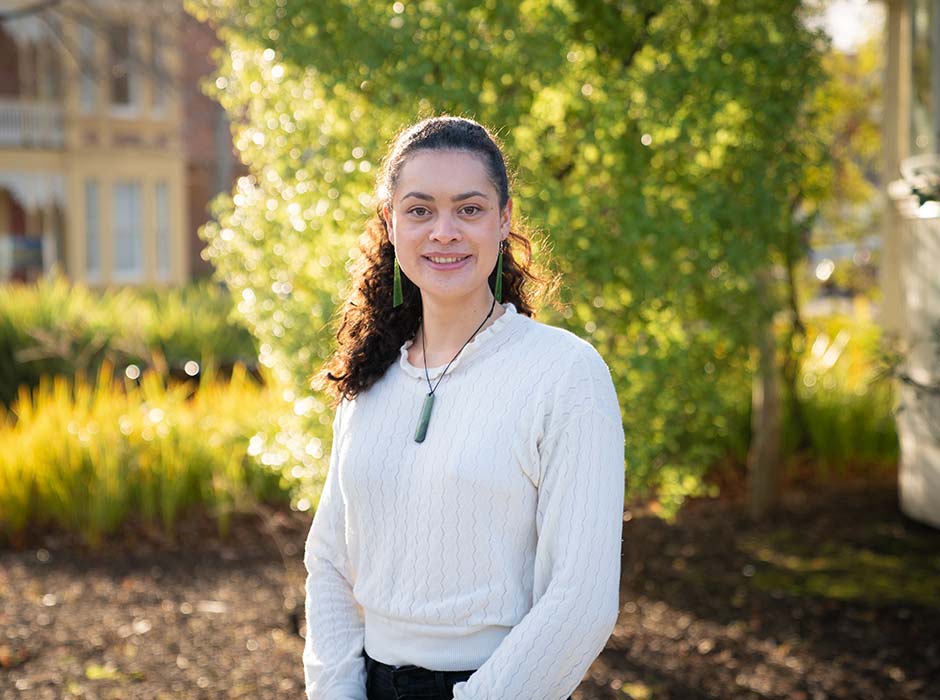
Assistant Research Fellow Dr Jordon Lima was recently awarded the 2025 Otago Health Sciences Māori Postdoctoral Fellowship.
The University of Otago has funded a new project to develop a blood test for bowel cancer, in collaboration with the newly established research facility Mātai Medical Research Institute.
Otago Assistant Research Fellow Dr Jordon Lima has been awarded the 2025 Otago Health Sciences Māori Postdoctoral Fellowship to establish a molecular biology laboratory in Te Tairāwhiti capable of conducting cancer-specific screening tests, building on existing relationships with local cancer care services.
“The recent establishment of Mātai in Gisborne provides an excellent and timely opportunity. I’m thrilled that Leigh Potter, one of the founders of Mātai, has enthusiastically agreed to be my Māori mentor for this project,” Jordon says.
Bowel cancer is currently detected via faecal testing and confirmed through colonoscopies.
Faculty of Biomedical Sciences researchers, led by Dr Parry Guilford in Otago’s Te Aho Matatū -Cancer Genetics Laboratory, are investigating if blood-based tests for tumour-associated DNA can provide a reliable and less invasive option.
This research aims to improve the survival and quality of life of cancer patients by bringing new and more effective options for diagnosis and treatment.
Using the latest DNA sequencing technology to detect circulating tumour DNA (ctDNA), Parry and his team are pioneers in their approach to developing a new test for bowel cancer.
Jordon’s project will build on this.
The study will recruit patients who have already tested positive for bowel cancer. Their blood samples will be tested for tumour-associated DNA and compared with their colonoscopy data, providing a clear diagnosis for the presence of a tumour.
This is a proof-of-concept project, which means it is a small-scale test to see if this type of testing can be done in-community.
“Here in Te Tairāwhiti, we have a strong focus on conducting as much healthcare as we can in-region. Simple DNA testing procedures run with minimal resources in a local laboratory set-up that can detect tumours accurately will be invaluable to our people,” Jordon says.
“If the DNA-based test proves feasible, as preliminary studies have indicated it will, this will mean larger trials to test if it can be commercially developed. This could lead to simple tests for early cancer detection that can be publicly funded and carried out in-communities.
“Potentially, it’s a lifesaver.”
Jordon, who was born in Te Tairāwhiti and completed her studies there, is thrilled to be back working with her community. Her PhD looked at the design of appropriate clinical protocols for circulating tumour DNA (ctDNA).
“I was privileged to return to my Tairāwhiti whānau to live amongst my communities during the final stages of my thesis write-up, which more authentically captured the experiences and ideas around how biomedical research could be improved here,” she says.
“It’s exciting to be able to extend that work.”
Jordon’s Doctoral project used a Kaupapa Māori Biomedical Research approach that required close partnership with the communities she designed the research to benefit. The work she is doing, and wants to continue to do, aims to improve access to cancer care and health by promoting biomedical research that embraces community-led practices.
“This is something the team at Mātai already excels in,” Jordon says.
“Groups in the clinical health, academic, community-driven, local council, and education sectors have been eager to support me in future health research projects and run science outreach initiatives in the region to ensure local governance of the research and appropriate translation of results back to the community.
“Cancer care is far from equitable throughout New Zealand communities. It has been extensively demonstrated that we can use co-design and community-led initiatives to help change that.”
- Kōrero by Claire Grant, Communications Advisor, Faculty of Biomedical Sciences
Translating research into healthcare
Find out more about how Otago's Centre for Translational Cancer Research is bridging the gap between laboratory-based science and treatment in the clinic.
Explore the Centre's research