
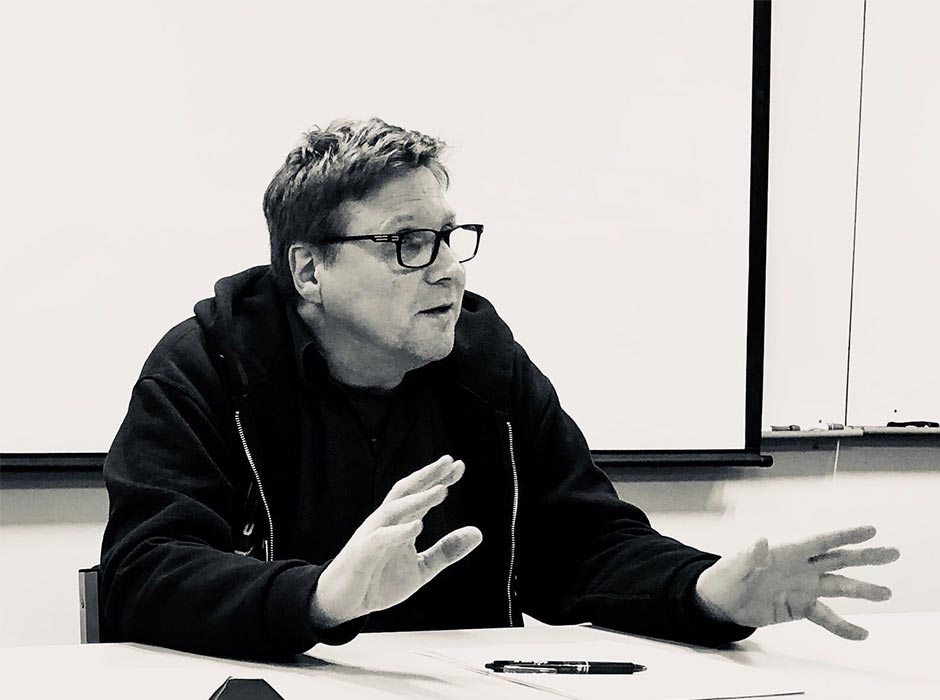
Associate Professor Brett Nicholls sees Adam Curtis’ films as critiquing the operation of state and corporate power. He became interested in his work during the 'war on terror’ period in the early 2000s.
One of the most distinctive and influential documentary filmmakers of the modern era will be the focus of a new book by Associate Professor Brett Nicholls.
Adam Curtis, Documentary Film, and the Technologies of Political Power will be the first full-length study of British filmmaker Adam Curtis and examine how this English filmmaker’s documentaries have shaped public understanding of power, politics and contemporary society.
Curtis is known for examining topics that shape modern life from neoliberalism and individualism to technocratic control and the collapse of reality.
Brett, from the Media, Film and Communications Studies programme, has been granted an Otago Prestigious Writing Grant for this project.
The term ‘technologies of political power’ in the book title is from the French political philosopher, Michel Foucault, and refers to the methods, procedures, and institutional arrangements through which power is exercised over our bodies and our conduct.
“I see Curtis’ films as critiquing the operation of state and corporate power. My work unpacks and evaluates this critique in two ways. The first is the substance of Curtis’ claims. The second is do they work as films,” Brett says.
Brett will analyse Curtis' films and place them in their historical, political, and cultural context, he will also explore the debates and controversies surrounding them.
“I will argue that Curtis’ documentaries help make sense of a world in which news media has given up telling us what is happening and political reality is increasingly fractured.”
“Curtis' films often divide opinion. Critics argue that his associative logic of ‘and then’ makes connections between events that are too broad or speculative. Others believe his films reveal important truths about the emptiness underpinning contemporary politics,” Brett says.
“I will argue that Curtis’ documentaries help make sense of a world in which news media has given up telling us what is happening and political reality is increasingly fractured.”
Brett became interested in Curtis’ films during the 'war on terror’ period in the early 2000s.
“His film series The Power of Nightmares, is a bold critique of the neoconservative regime driving that war. I find other film series helpful for promoting discussion with students. The Century of the Self, for example, provides an excellent account of the history of public relations and advertising, and opens space to discuss key critical concepts in the study of media and communication.”
This book will be essential reading for anyone interested in documentary film, politics, and the representation of political power.
Media, Film and Communication
The Media, Film and Communication programme offers two undergraduate majors: Film and Media Studies, and Communication Studies. We also offer an exciting range of postgraduate study options.
More about Media, Film and Communication