
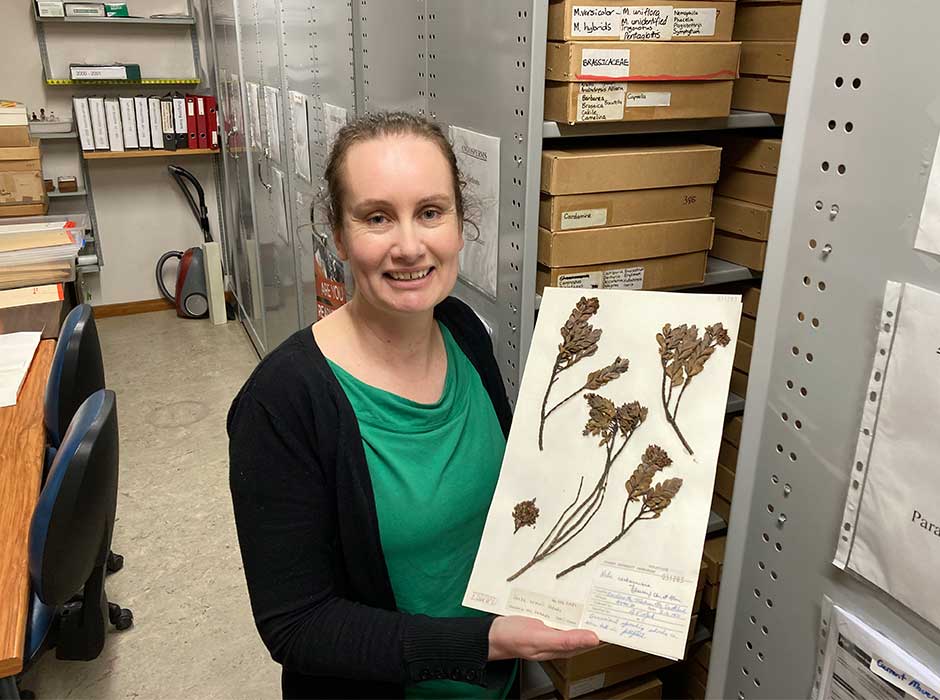
Department of Botany Herbarium technician Fran Muckle holds a type specimen held in the collection. She says the value of the collection lies in its uniqueness. “Each of the specimens represents a moment in time and place, and their artistry is evocative of these and of our innate connection with our environment.”
Details of the botanical treasures of the Otago Regional Herbarium, located in the Department of Botany, are now available to the scientific world with a new digital presence on an Australasian network.
The records and historic notes for almost 23,000 specimens from the Otago Regional Herbarium, code name OTA, are now accessible through the Australasian Virtual Herbarium (AVH) that provides researchers worldwide with information on herbarium collections across Australia and New Zealand.
Professor Janice Lord, Herbarium curator, says this is an exciting step for the Otago Regional Herbarium as up until now it has been virtually invisible to the global taxonomic community.
“Herbarium collections are essential not only for taxonomic and ecological research, but also for tracking trends over time, as each specimen provides a permanent record of a particular place and time,” Janice says.
“Having this information more readily available and accessible online to a greater audience will support its future contribution to our knowledge of Australasian biodiversity.”
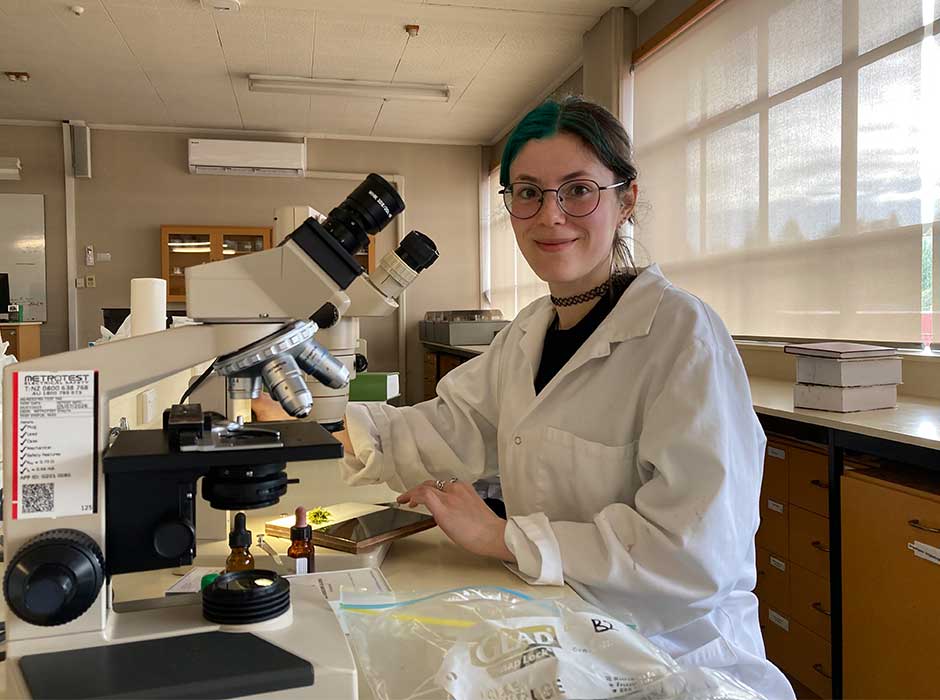
Department of Botany PhD student Jessica Paull.
The Otago Regional Herbarium was founded by Professor Geoff Baylis in the 1950s and has grown to be the largest University-based herbarium in New Zealand and one of the largest in Australasia. It is also fully MPI compliant, meaning it can loan and hold specimens from any registered herbarium internationally.
The Herbarium supports research and teaching at Otago and much wider, and the approximate 80,000 specimen collection features an abundance of lichens, bryophytes and New Zealand alpine plants. Almost a third of this collection is databased and can now be accessed via the AVH. Photographs of type specimens, the original collections from which new species have been described, are also available via the AVH webpage.
Through her PhD research on the fungal associates of mosses, Jessica Paull is contributing bryophyte specimens to the Herbarium.
“Bryophytes need to be brought back to the lab for identification, so they can then be donated to the Herbarium,” Jess says.
“It’s great to have physical specimens in the Herbarium to assist with future identification and analysis. And as tools and knowledge develop, it’s also possible to go back to ‘undescribed’ specimens and identify them, which is fantastic.
“The collections allow the exploration and discovery of broad patterns of ecological distribution and importantly, changes over time.”
Janice says the Department is very grateful to Dr Niels Klazenga of Melbourne’s Royal Botanic Gardens Victoria, whose expertise was pivotal in preparing the database records for upload to the AVH.
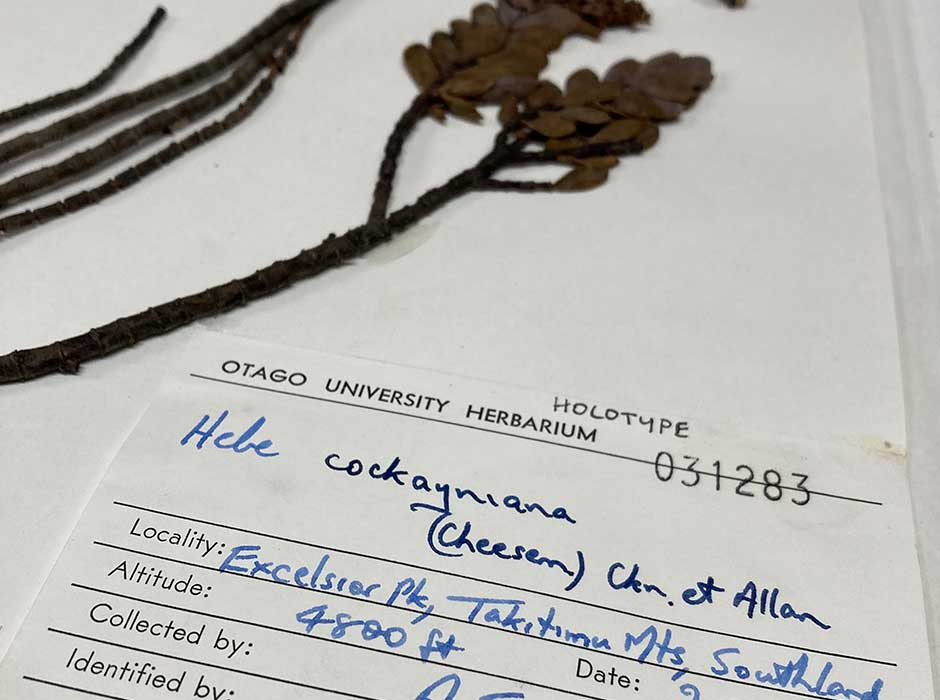
Example of a type specimen collected by Sir Alan Mark, Emeritus Professor, in 1971 from Southland’s Takitimu Mountains.
“We have seen the positive impact of this new online presence immediately, such as receiving more enquiries from researchers.
“One researcher found that Otago has 190 georeferenced orchid specimens they weren’t aware of, so we could send them the detailed information which filled an important gap in their research.”
Janice says it’s these global connections with colleagues in international herbaria that’s facilitated this development.
“The exciting thing is the Australasian Virtual Herbarium links to global biodiversity databases so it’s also helping to raise our representation and contribution on the world stage.
“We have thousands of specimens still to add to our local database and then upload to the Australasian Virtual Herbarium, so are very grateful for any support that helps grow the global visibility of our unique and valuable botanical collections.”
Kōrero by Guy Frederick, Communications Advisor Sciences.
Study Botany at Otago
Because plants provide us with food, fibres and medicines, knowledge about plants is fundamental to our survival.
View