
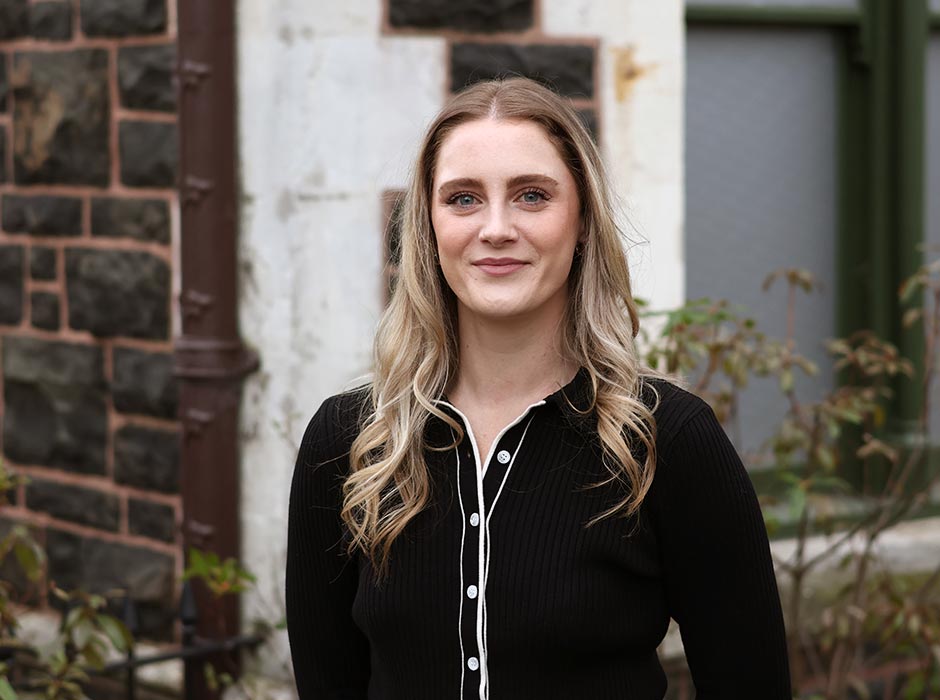
Ashlee Berryman will graduate this weekend with a PhD in Neuroscience. A Neurological Foundation of New Zealand fellowship will now enable her to build upon the research she completed for her thesis: ‘The hidden costs of endometriosis: Novel evidence of cognitive and neurophysiological dysfunction’.
Department of Psychology PhD graduand Ashlee Berryman is on a mission to stop endometriosis pain, and a Neurological Foundation of New Zealand fellowship of $232,198 will help her get there.
With at least 120,000 New Zealanders suffering from endometriosis, one of several conditions that can cause painful menses, it’s no wonder that menstrual periods were once known as ‘the curse’. But it’s a curse that Ashlee is hoping to break.
“I always wanted to do something in women’s health, and I wanted to do something with women and chronic pain,” Ashlee says.
“I have close friends who have endometriosis, which pushed me in that direction when I was looking at my PhD.”
Ashlee says she’s working towards better care, understanding and health outcomes for endometriosis sufferers.
“It’s a big goal – women weren’t even required to be included in clinical trials until the 1990s, so we’ve still got a long way to go. We’re only now unravelling the hormonal changes across puberty, pregnancy and menopause. I kind of struck 'research gold' in that I’m the first to look at certain aspects.”
These aspects include how endometriosis pain impacts cognitive functioning, and how it might be managed with low-cost, accessible interventions that reduce opioid analgesic use.
“People with endometriosis had reported cognitive difficulties such as brain fog and loss of efficiency, and they were taking sick days and missing work and school. I knew I wanted to fix that, but I had to validate it first,” Ashlee says.
Though clear links between pain and cognition have been established with other conditions, endometriosis remained unstudied – until now.
“For my PhD research I had a cohort of around 80 people, and I was looking at their cognitive performance using electroencephalogram (EEG) and near-infrared spectroscopy (NIRS),” Ashlee says.
“I found that women with endometriosis, particularly those with chronic pelvic pain, did show cognitive difficulties, which validates their self-reported experiences.”
“I just want women to be able to flourish at all ages and life stages.” – Ashlee Berryman
Ashlee’s Neurological Foundation of New Zealand funding will empower her to continue her research as a postdoctoral researcher. As part of this work, she will undertake an intervention-based study designed to improve cognitive functioning and wellbeing.
“I’m going to use Transcutaneous Electrical Nerve Stimulation (TENS) devices, which produce gentle electric currents to relieve pain. I’ll be measuring brain activity and how well participants perform on tasks, and how they report pain, quality of life and mood.
“The same women with endometriosis will come into the lab twice – once in low pain, and once in high pain. We’re in a body-protected area where we can use the neuroimaging machines, and I’ve got computerised cognitive tasks that measure things like reaction time, working memory, selective attention and mental flexibility.”
Ashlee speaks warmly of her study participants, who have muscled through chronic pain to participate in the research and help provide hope for others.
“It’s so gut-wrenching to feel helpless and just want to help people,” Ashlee says, reflecting on the times she’s seen her participants battling extreme pain.
“My cohort were so happy to take part in this research and to have their experiences validated. Pain impacts people’s' lives at work and at school. A clinician doesn’t see that, but the person feels it.”
Having spent five years living in North Canterbury, gaining insights into the challenges rural and other underserved populations face, Ashlee is excited by the possibilities of the TENS devices.
“TENS are easily implementable. They can be purchased online for a relatively low upfront cost, so they’re accessible to people rurally.”
With endometriosis in New Zealand currently only diagnosed through surgery, the number of people with the condition is likely to be higher than reported, meaning Ashlee’s research could have a far-reaching positive impact.
“I just want women to be able to flourish at all ages and life stages.”
– Kōrero by Kathryn van Beek, Communications Advisor | Kaiarataki Pārokoroko
Psychology at Otago
Whether your goal is to help people, influence change, or pursue research, studying Psychology gives you the frameworks and tools to make sense of human behaviour, and use that understanding in your career and everyday life.
More about Psychology