
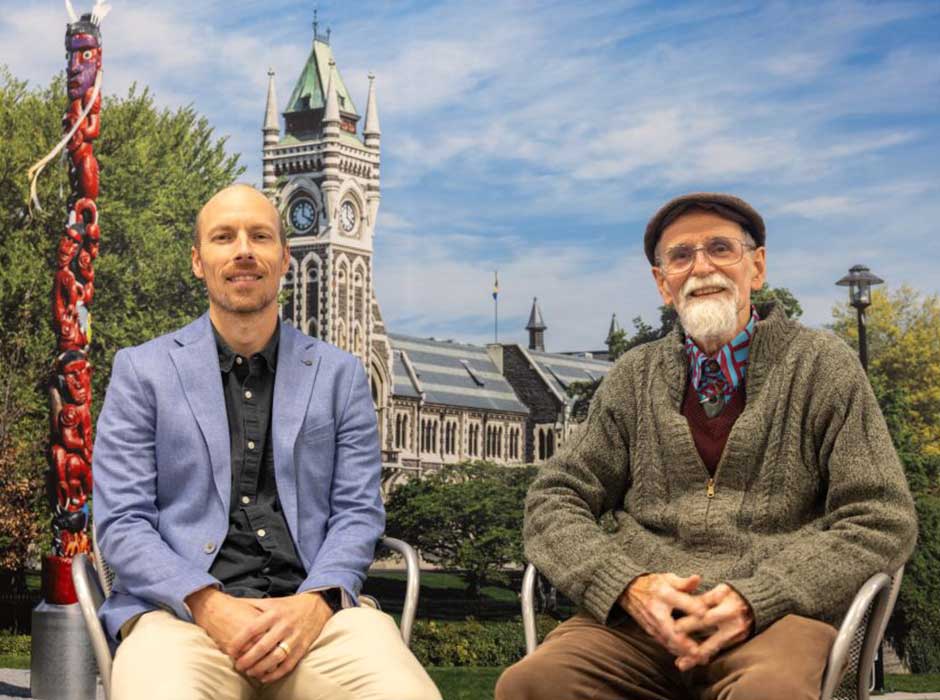
Otago alumnus Dr John Malcolm (right) reflects on the changes at Otago since he was a medical student, his family connections to the University, and what he enjoyed most at the medical school’s anniversary – including catching up with his nephew, Otago School of Physiotherapy lecturer Dr Ewan Kennedy (left).
The question “are you still practising medicine?”, engenders a wry smile and comment from Otago alumnus and semi-retired paediatrician, Dr John Malcom. “I hope to get it right soon.”
John, who came back to Otago for the Medical School’s 150th anniversary, retired clinically in 2020, but has continued with some research and support roles. He practised medicine for 50 years, the last 36 of which as a paediatrician for Hauora a Toi, Bay of Plenty District Health Board, after Waitematā and Lakes District Health Board.
John says he is “still paying the medical council”, as a Clinician Emeritus appointment enables him to continue some research, mentor other health professionals and hold advisory roles in Mataatua and Manawa Taki rohe.
John is well-known for his contribution and dedication to rural and Māori health, particularly that of tamariki, and for his research and community-based work on the prevention of rheumatic fever. He has received many accolades during his career, including the Auckland University, Dennis Pickup teaching award and the prestigious Royal Australasian College of Physicians Rural and Remote Medal in 2015, for 25 years' service in the Bay of Plenty region.
He is also the grandson of Otago’s first full-time Professor of Physiology, another John Malcolm, who was appointed in 1905, travelling from Scotland to take up the post.
For John, coming back to Otago for the anniversary was all about “catching up with people and their research life’s work, rather than going to the big evening functions”.
What was it like to be in Dunedin again?
My parents, Donald and Margaret, lived here for a large part of their lives after working in Tauranga, the Manawatū and Dunedin, then retired here. I'd come down to visit them more as they were aging, to see them, my sister and family, but I seldom saw Otago University.
So it’s been an opportunity to take a fresh look at the university, feel the wind blowing, crisp air, the library and lots of new buildings, all nicely interwoven.
The city is rather pedestrian-friendly and cycling-friendly, with paths, lanes, the Leith, and things like that, with a bent memory lane of Malcolm Street past the Captain Cook billiard tables and the site of Joe Tui’s fish and chip shop, with new hopes behind the boards of the new hospital building. I have a professional interest as I was a plasterer’s labourer on the old Queen Mary and the Savoy.
What struck you when you arrived back on campus?
The campus is amazing. Going to the Business school for the Pōwhiri and seeing Ross Hemera’s dangly suspended forms inspired by rock carvings, like a set of mobiles, was neat.
And the language, to have Te Reo in amongst the campus is a massive shift, because Te Reo was not exactly ostracised, but we learnt Te Reo as a worker’s education or university extension course from Piri Sciascia and Pieter de Bres (Joris’ father), as did Ranginui Walker teaching in Tamaki Makaurau at the time.
I listened to Edward Ellison giving the mihi to us manuhiri. I could see his father George in him, and saw and heard his welcome as George had welcomed us as students – when George Asher and Allan Ngaparu from Otago University Māori Club were arranging a hui held at Ōtākou Marae. I enjoyed both the present and the memories, [it was significant], seeing some of the people. I also caught up with Robert and Mere Montgomery, and John Broughton at St Paul’s Cathedral and a lower Stuart St café afterwards.
What did you enjoy about the anniversary?
Seeing those researchers give their rapid talks. Just rattling off massive discoveries, while keeping our attention, some having sound bites in amongst picturesque powerpoints. Speakers included Prof Dawn Elder, every slide immaculate, with photos, with highlighted little phrases of reflections and with her humour.
There were some wonderful people and projects, it was just lovely to see, and so many diverse Otago projects, the combined effect a statement towards equity and appreciating people for all their talents.
There was a sense of honouring other people's achievements; I didn't get the sense of academic survival based purely on pushing their own success or where they fitted in the big picture. There was almost a modesty that went with it – it was heartwarming.
What do you remember about your own time here?
My grandfather, John Malcolm, Professor of Physiology appointed in 1905, did well here, but for me there was also a weight of expectation that went with that. It was a bit subconscious, I probably didn't realise it at the time.
What I particularly remember was failing, getting distinction one year in Biochemistry and failing the next year, because I over-focussed on political issues, particularly social justice and racism.
The people I waylaid myself with, I got my political education from them – Malcolm (later Waiariki Polytech) and Elizabeth Murchie, author of Rapuora: Health of Māori Women, ex-president of Māori Women's Welfare League, and Roger Smitheram with the Boilermakers Union, especially Joan and Peter Sutton, educational psychologist and banjo player, who later ended up leading Amnesty International, in Nelson.
That year I got more education outside the University than within, but I failed my subjects. And the best thing about that was Professor Blennerhassett gave me a second chance sitting specials, as did Arthur Veale, my empathetic mentor. They had enough faith and belief.
I studied all the summer holidays, survived specials, and I went from E grade to C grade to B grade by the time I was finished. So, I'd summarise that there was what I'd call pastoral support, not letting students fall through the net. So that's my really positive memory, that they were not just there for the brilliant. I was given more than a second chance.
Otago advertised a Wellington Clinical School Epidemiology fourth-year summer studentship with Dr Ian Prior, Clare Salmond and John Stanhope, which took me to Tairāwhiti, Rotorua and Ruatāhuna, and they led me to my first academic paper, within the Rotorua Lakes High Shool study, sowing the seeds for a lifetime interest in evidence in medicine, and public health.
While most Otago classmates sought United States holiday attachments, my clinical focus was sharpened with attachments in the Waikato, to Dr Martin Wallace, nephrologist and Dr Ben Rose rheumatologist; Ben’s spinal manipulation lesson helped me try to assist forestry workers in one of 10 locum GP posts; in Murupara 1977. Otago taught me to learn to find my niche.
What about the differences in teaching between then and now?
I felt a greater sense of engagement now than then. I couldn't see the relevance, stupidly, of some of the things I was being taught. It was probably my fault as a teenager not understanding how much I needed to know the pathology.
I could see the benefit of the anatomy, and I loved the anatomy, because I could see the connection. I loved the microbiology then and later the practicums with tropical medicine in Liverpool School of Tropical Medicine after working three years in Jamaica; a bit back to front career wise.
So, the difference between then and now, I think the lecturers presenting today make their subjects alive.
I remember sexist surgeons throwing implements in theatre and being demeaning to women and visible minorities in the class. And sometimes I think I was a bit overwhelmed by their attitude rather than the content they were teaching. I hadn't learned selective listening.
But others were amazing, like James Robinson, who taught renal physiology. He did diagrams in chalk on the board, built up his pictures in steps, and they were easy to follow. But others, they were just words, I don't think they did as well. They should have used pictures.
Suzanne Pitama [at the anniversary presentation session] got everybody to stand up who had some characteristic, such as if they were lecturers. She got people out of their seats, and got the audience engaged. Suzanne then unveiled a korowai, which was then passed from Peter Crampton, on to a younger woman, and then on to a current student.
And the symbolism of that, and the stories, and a waiata at the end; their teaching skills were well demonstrated. I found every speaker exciting.
What is important to you about the anniversary?
I paced myself, gave myself time to catch up with and listen to people speaking rather than going to the big evening social functions. I focussed on the lecture series. Just great compliments to Dawn Elder and colleagues for a beautiful programme, which was the bait that hooked me.
I also had the pleasure of meeting Mere (nee Meanata) and Robert Montgomery, who I knew through Otago University Māori Club. I visited Ewan Kennedy, my nephew, one of my late sister Anne’s sons, and Marion his wife, and kids. And Dr Lela Pasisi-Yap who was a registrar with us in Whakatāne, who went off to Toronto Sick Kids and came back as a neonatologist, to Dunedin Hospital.
Your family has a long and special connection with Otago
Our grandfather, John, he had a weight of expectations of research. They said he came to Edinburgh with a sack of spuds and a sack of herrings from Caithness at the north of Scotland, his mother Ann Swanson from Orkney, with the support of his three sisters who were teachers.
He won a gold medal at Edinburgh University, worked in research there then came with his rats for research and his ingenuity and able lab assistants at the Otago Medical School. The early smoked drums were on display at the 150th as well as the oscilloscope and later technology which followed. As a family, my sister Margyjean and cousin David have been looking at his letters in the Hocken, to see what we can learn from them.
From Otago, John Malcolm sent remittances – that a lot of Pacific people still know well (Samoans as fa’alavelave). He sent money back to his family for them to build a house they called Māori Haa in Dunnet, which I visited while working in Aberdeen after time in Auckland, the central North Island, Montego Bay Jamaica. Edinburgh, Glasgow, Liverpool and Manchester.
But he was said to have not fulfilled the promise he had for research because he worked in difficult times and focused on teaching. Physiology was broad and achievements included finding cobalt deficiency in Southland farms, the toxic effects of tutu flowers on cattle and the nutritional qualities of local fish.
At times there’s been some demeaning of university people who are not productive in both research and teaching. I heard such comments from his son, my uncle John Laurence Malcolm, who studied Sloths in Brazil and later kiwifruit in Ōhaeawai, Tai Tokerau
John Laurence Malcolm, after working as senior lecturer with John Eccles from 1942 to 1947 at the University of Otago, became the Professor of Physiology at Aberdeen [in 1953]. He was highly productive in his research, and I don't know if that was at the cost of teaching, but I think it's a very difficult balance. He returned to the University of Auckland in 1975, teaching and researching neurophysiology until 1980.
David, his son, taught and engineered wind turbines and daughter Robyn taught English as a second language from Sierre Leone, to Sarawak, India and Sudan.
My grandfather’s earlier work at Otago with Dr Muriel Bell was highlighted at the anniversary, for example the understanding of goitre and the need for iodized salt, and Duncan Adams’ work on long-acting thyroid stimulator followed.
John and Vicky Malcolm’s daughter Frances, our aunt, was dux of Columba College and as a dietitian worked in Otago, the West Coast, Kaeo, Kamo a dedicated life of service.
My father’s MD was in neurology, but respiratory medicine including Tuberculosis (TB) was his challenge when he came back from World War II, after, as medical officer, being wounded in Trieste. His superintendent in Palmerston North said that TB was going to be treated effectively with streptomycin. So he was advised to retrain as a paediatrician and neonatologist, and hence started the neonatal unit in Palmerston North, before starting the second in Dunedin.
He collaborated with Dr Patricia Buckfield neonatally, such as assembling their first Lusco ventilator. She is honoured now, thank goodness. She later invented a developmental assessment tool at Kenepuru Porirua, it reflected her understanding of developmental needs, after roping in two of her Dunedin registrars, Dr Graeme Barnes and John Clarkson, to code 6x4 inch cards detailing the cohort that was to be the original 1000 infants, the seed for the Dunedin Study.
John Clarkson became a community paediatrician here in Dunedin and Graham Barnes studied rotavirus here then became a paediatric gastroenterologist, who with Ruth Bishop trialled the first rotavirus vaccines – those were the spinoffs, the joy seeing the contributions of some of the people they taught.
You can't see their output purely in terms of the papers they produced. I think that some of the success of these people was not just in what they wrote themselves, it was who they helped, how they mentored and those they inspired from afar.
So I'm quite pleased that our family is part of that. My sister Dr Margyjean Malcolm practised then taught on community service at Otago Polytech, and Unitec before that. Our late elder sister Dr Anne Malcolm studied Biochemistry under Prof George Emerson, with one of her sons, Dr Ewan Kennedy, now a lecturer in Physiotherapy at Otago University, (the fourth generation teaching at Otago), and her other son Dr Grant Kennedy is an astrophysicist now assisting his immunologist partner with the mathematics.
And tell us about some of your own research
As an honorary senior lecturer, attached to both Auckland and Otago Medical Schools for many years, we appreciated and taught students from both. We framed projects that addressed their curriculum, to which we contributed, which helped us and the local Whakatāne region.
For example, for one rheumatic fever paper, a retrospective cohort study, on Hauora-led school-based programmes in the Bay of Plenty, we supervised one main summer student and others, who each studied one component of that evaluation. We then put it all together, wrote it up and it was accepted in Paediatric Infectious Diseases.
It has been cited, and stood up well to peer review, including systematic studies for its rigour. It helped affirm the role of Hauora-delivered, school-based programmes, for rheumatic fever, with primary care support in the Bay of Plenty and their foundation in the partnerships involved.
More recently, in February 2025, NZMJ published our observational study which saw rheumatic fever rates decline, a paper with nine co-authors representing seven parallel streams including nurse-led skin clinics, and Hauora-led school-based programmes, that treated pharyngeal strep A sore throats and Kiri Ora Healthy Skin programmes which saw declining skin infection admissions, community scabies and rheumatic fever. Acute rheumatic fever rates declined in the study period for Māori and Europeans under 30 years, especially those aged 5-14 years. These paper’s findings support the evidence for ethnically-focused, needs-based programmes.
There’s another paper in the pipeline with local Hauora, a partnership with Ngāti Awa, but that’s another story. Recently my grandfather’s tutin research came back to me when a young adult patient told me of his beekeeping hobby avoiding the tutu flowering season, and as I listened to an adult Rongoā practitioner who sold me a tutin balm like deep heat!
I appreciate the roles my time at the Otago Medical School played in my life and for so many others.
Faculty of Medicine
Our education programmes emphasise equitable health outcomes and a commitment to Te Tiriti o Waitangi. Our graduates provide high-quality, patient-centred, evidence-based care here in Aotearoa and around the world.
View