
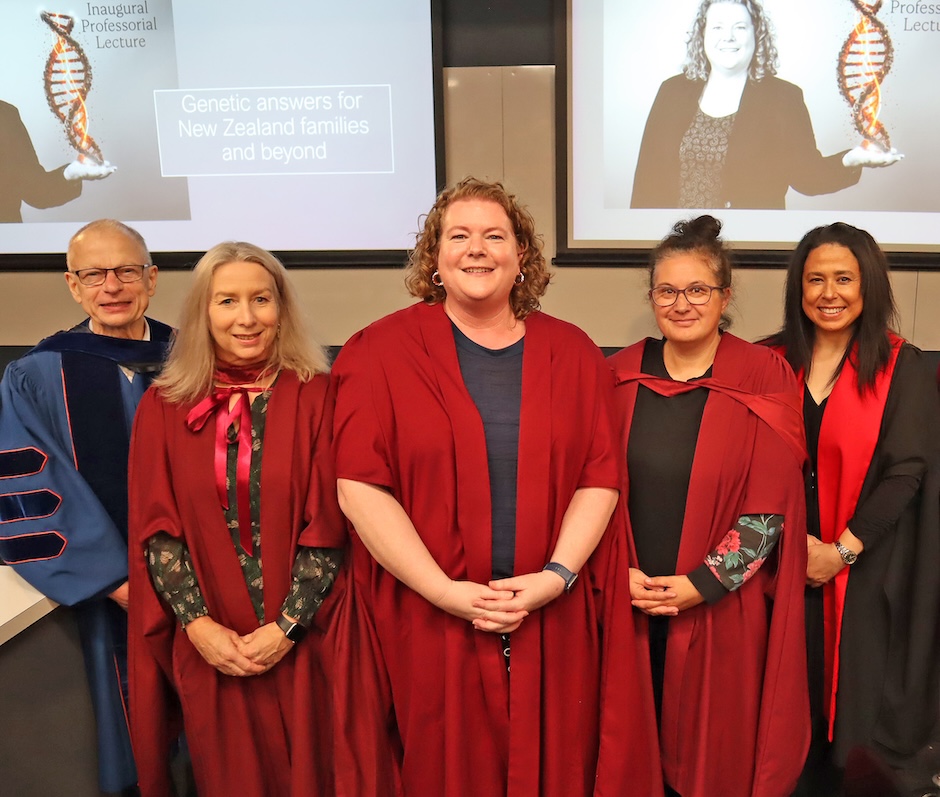
Professor Louise Bicknell and some of the academic dignitaries that attended her Inaugural Professorial Lecture. From left, Professor Julian Eaton-Rye (Head of Department of Biochemistry), Professor Julia Horsfield (Head of Faculty of Biomedical Sciences), Professor Louise Bicknell, Associate Professor Justine Camp (Pro-Vice-Chancellor Māori, Division of Health Sciences), and Professor Dianne Sika-Paotonu (Deputy Vice-Chancellor, Pacific).
The Department of Biochemistry celebrated Louise Bicknell’s promotion to professor at her Inaugural Professorial Lecture (IPL) earlier this month, marking a stellar academic career defined by a deep love of genetics and a resolute commitment to supporting others.
IPLs are special public lectures given by academic staff who have been recently promoted to professor. They provide a platform for new professors to reflect on their academic journey and the research that has shaped their careers, while also providing an opportunity for colleagues, students, whānau and collaborators to celebrate their success.
Originally from a deer farm in Hawke’s Bay, Louise described a grounded childhood full of sports, music, study, and the steady encouragement of a supportive family. She first came to Otago University as a bright school leaver intending to complete the Health Sciences First Year and try for medical school, as many students do. It didn’t take long, however, for genetics to capture her imagination. Halfway through that year, the concept of the human genome - with its three billion ‘letters’ (nucleotide bases) of coding and complexity - had her completely hooked.
Her timing was perfect. The Genetics Programme had just been established at Otago, and Louise joined it, becoming one of the first students to graduate with a BSc (Hons) majoring in genetics.
Her PhD, completed with Professor Stephen Robertson in the Department of Paediatrics and Child Health set the tone of her research career in several important ways. Louise developed her skills as a “DNA detective”, learning how to track down gene variants that underlie human health and development conditions. During this time, she worked closely with a Māori whānau affected by a rare neurocutaneous condition, an experience that highlighted the human impact of genetic research. Alongside her doctoral studies, Louise also volunteered at the Otago Community Hospice, supporting people with terminal illness and their carers. Together, these experiences helped shape a central purpose that continues to guide her work: the importance of using science to support people and families in need.
For the next phase of her career, Louise headed overseas to the University of Edinburgh for a postdoctoral fellowship with Professor Andrew Jackson at the MRC Human Genetics Unit, where she studied genes that influence human growth.
Her postdoctoral years were exceptionally productive. Louise identified disease-causing variants in a gene called ORC, showing that they were responsible for a form of primordial dwarfism, and later linked ORC1 variants to Meier-Gorlin syndrome, a rare disorder characterised by short stature, small ears and absent or underdeveloped kneecaps. ORC1 is part of the Origin Recognition Complex, a fundamental cellular system that determines where DNA replication begins prior to cell division, highlighting how disruptions to core DNA processes can profoundly affect human development.
Her work resulted in two papers published in Nature in 2011 - published on the same weekend as she got married.
Louise and her husband also welcomed identical twin boys, born while they were still living in Edinburgh, with Louise continuing her research alongside early parenthood.
In 2015, Otago was lucky to welcome Louise back, returning on a Rutherford Discovery Fellowship from the Royal Society Te Apārangi and establishing the Rare Disorder Genetics Lab. Since then, her research has continued from strength to strength, supported by prestigious funding grants from the University of Otago, the Marsden Fund, the Neurological Foundation, and the Health Research Council of New Zealand. In 2020 she was a joint recipient of the University of Otago Rowheath Trust Award and the Carl Smith Medal, and in 2021 she joined the Department of Biochemistry as a Senior Lecturer.
Through the work of the Rare Disorder Genetics Lab, Louise and her team deliver impact on multiple levels. Although cures for many rare genetic conditions are not yet possible, the lab’s research deepens understanding of how the human body develops and functions at a molecular level, building knowledge that underpins future advances in healthcare. Just as importantly, their research provides families with long-sought answers about the causes of their child’s condition, helps connect families who may be scattered across the globe, and offers clearer information about what life with a particular condition may hold.
Louise’s research continues to have many positive impacts. The Rare Disorder Genetics Lab is large, productive, and very supportive research group, mentoring and training a talented cohort of postgraduate students and early career researchers. In addition, Louise has recently played a key role in establishing a close New Zealand association with the European Rare Diseases Research Alliance (ERDERA), a major Horizon Europe initiative. This collaboration aligns Aotearoa New Zealand with an international effort to prioritise research into new treatments, prevention strategies and improved diagnostic pathways for people living with rare health conditions.
Louise’s IPL was both a celebration of scientific excellence and a reminder of the profound human value of research driven by curiosity, compassion and connection.
Find out more about Louise’s research:
Professor Louise Bicknell's Inaugural Professorial Lecture
Check out Professor Louise Bicknell's Inaugural Professorial Lecture, titled "Genetic answers for New Zealand families and beyond"
No transcript available. Please use the Show transcript feature in the Youtube description.
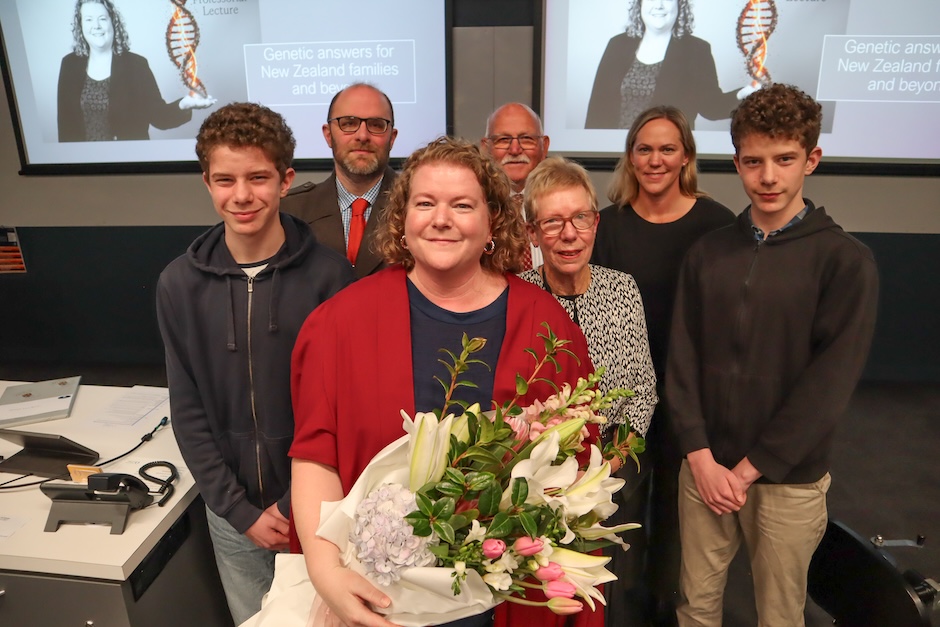
Professor Louise Bicknell stands surrounded by her family after her Inaugural Professorial Lecture.