
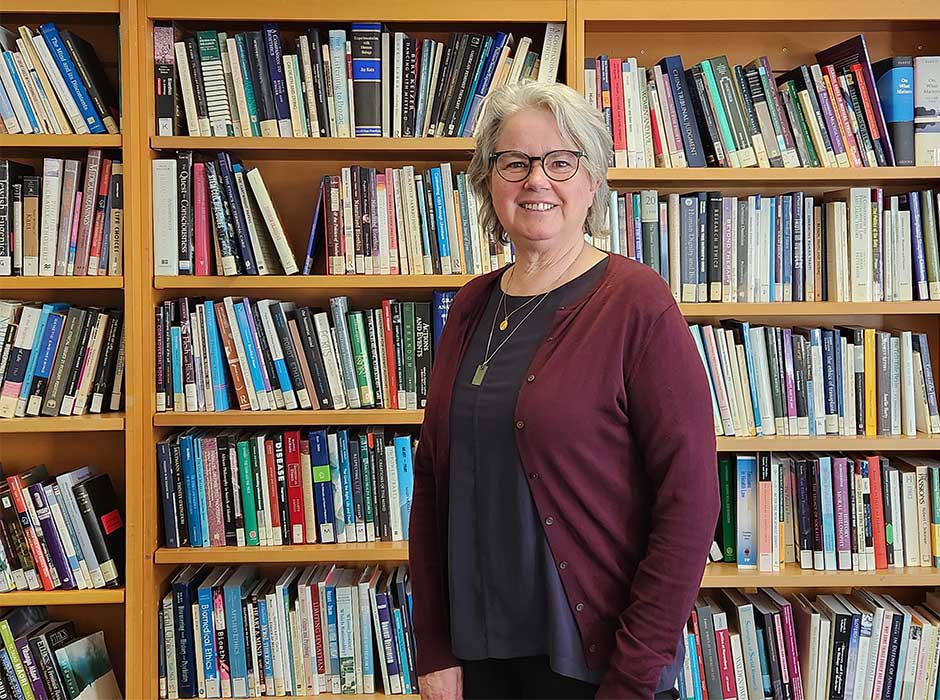
Retiring Professor Lynley Anderson says medical ethics and professionalism are the bedrock on which health care is built.
After 30 years of working in bioethics at Otago, Professor Lynley Anderson is no stranger to controversial and complex issues.
Lynley is a specialist in bioethics and professional development in healthcare education and sports, based in the Faculty of Medicine – Dunedin. Her research has included the topic of trans women in elite sport and the ethics of athletes competing in international sport during a pandemic. She also has a strong focus on the ethical and professional development of medical and other health care students, including the experiences they have in clinical settings.
Lynley, who retires on 28 November, says a highlight has been the work she has done to support clinicians, through the hefty number of codes of ethics, guidelines and policies she has prepared and contributed to during her career.
“It’s about making a difference for clinical practice and, therefore, for the experiences of patients,” she says.
As well as being a teacher and researcher, Lynley has held several leadership positions over her career, including being Head of the Bioethics Centre (now the Department of Bioethics) from 2017-22, and Deputy Dean and also Acting Dean of the Dunedin School of Medicine (now the Faculty of Medicine – Dunedin).
Among other roles, she also chaired the Ethics Committee of the New Zealand Health Research Council and was the founding co-editor of the Journal of Bioethical Inquiry.
Brought up on a South Otago sheep farm, Lynley trained as a physiotherapist at the University of Otago. She had great teachers, but as a student in hospital wards she was unprepared for issues such as sexualised behaviour from patients, and how to cope with patients who were suffering or dying.
“I wanted to do the right thing, but it was very bewildering to work out what the right thing was.”
Those experiences sparked an interest in ethics and Lynley began postgraduate study in that subject and joined the Bioethics Centre as a Junior Research Fellow in 1995.
When she finished her PhD on elite sports medicine ethics in 2005 she was the first in Aotearoa New Zealand to tackle the topic, and one of only a handful worldwide.
That research led to Lynley writing a code of ethics for the Australasian College of Sport and Exercise Medicine. She has also written codes of ethics for other organisations, including the Physiotherapy Board of New Zealand.
Lynley is the convenor of professional development for second and third-year medical students, and she also teaches senior medical students, as well and physiotherapy, dentistry and oral health tauira.
She is part of a team who instigated an interprofessional education programme on professional ethics for health sciences students. She is the principal investigator on research into unacceptable behaviours experienced by clinical students from patients, staff and peers, and is involved in research exploring medical students' experiences of bullying, looking for solutions to assist students.
“There’s still a lot of work to be done to find the best ways to support health professional students. These are global, not just local issues.”
Lynley says for students to flourish they need care and protection, ethics training, professionalism training and “guardrails”, such as codes of ethics or standards.
One of the achievements Lynley is most proud of is her part in preparing the Code of Professional Conduct for Medical Students at the Universities of Auckland and Otago, approved in 2010.
“I’m really proud that this covers all medical students across the motu, so there is consistency.”
Lynley is looking forward to retirement, although she will continue to be involved in some research. She plans to further her interest in print making, travel and spend more time with whānau. She also wants to do some conservation work.
However, Lynley readily admits she will miss her colleagues, especially long-standing friends from Bioethics.
“This place has been phenomenal. So many good people have stretched my thinking and have also cheered me on. They genuinely celebrate your success and you celebrate theirs.”
- Kōrero by Andrea Jones, Team Leader, Divisional Communications
Bioethics Centre
Shape the future of healthcare and bioscience. Science, technology and healthcare are hugely powerful tools that bring ethical and legal challenges and opportunities.
View