
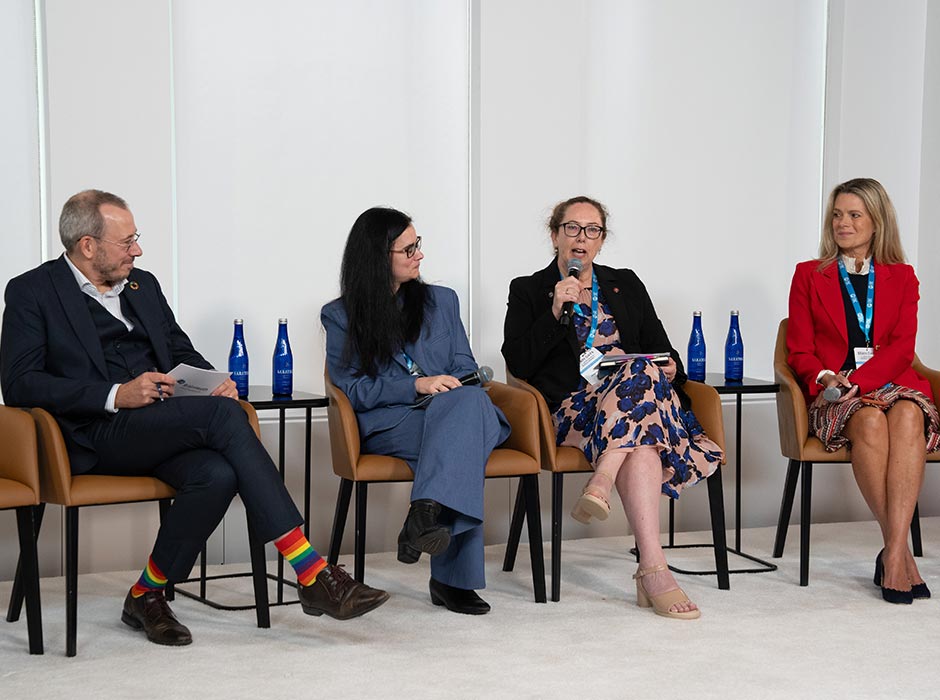
Panel discussion at Brain Days, 81st UN General Assembly. From left to right: Panel moderator Frédéric Destrebecq (European Brain Council), Catherine Marquer (French National Research Agency, ANR), Professor Louise Parr-Brownlie and Patricia Conrod (Canadian Institutes of Health Research).
Brain disorders are a global issue, affecting billions of people around the world irrespective of socio-economic status, and costing the global economy trillions of dollars each year.
Co-lead of the Horizon Europe – Brain Health Partnership in New Zealand (EP-BH-NZ) and Department of Anatomy Professor Louise Parr-Brownlie (Ngāti Maniapoto me Te Arawa) says that these facts teach us a profound lesson – no single nation can solve the challenge of brain health alone.
Speaking in the opening panel discussion of Brain Days at the 81st United Nations General Assembly (UNGA81), Louise advocated for the need to embrace global collaboration and partnership as a way forward, diving into the European Partnership for Brain Health (EP BrainHealth) as a model for international scientific cooperation.
Brain health deserves a place alongside other great global challenges that require international cooperation, Louise says.
“Brain health is fundamental to human potential. Yet today, neurological and mental health conditions affect billions of people worldwide and are among the leading causes of disability and loss of wellbeing globally.”
The statistics closer to home are sobering.
“About 47 per cent of New Zealand’s population is living with a brain condition. The lost opportunities for individuals and society add up to over 5 per cent of our GDP.
“To change that statistic, we have to collaborate on the global stage.”
The scale, complexity and burden of neurological and mental health conditions exceed what any single country, discipline or institution can address alone. This is where a partnership like EP BrainHealth can make a substantial difference, Louise says.
“The European Partnership for Brain Health brings together 64 funders from 36 countries to focus expert researchers, clinicians, and policymakers’ efforts in a shared endeavour to prevent, diagnose, treat, and manage brain conditions, while recognising that maintaining brain health is a global imperative.”
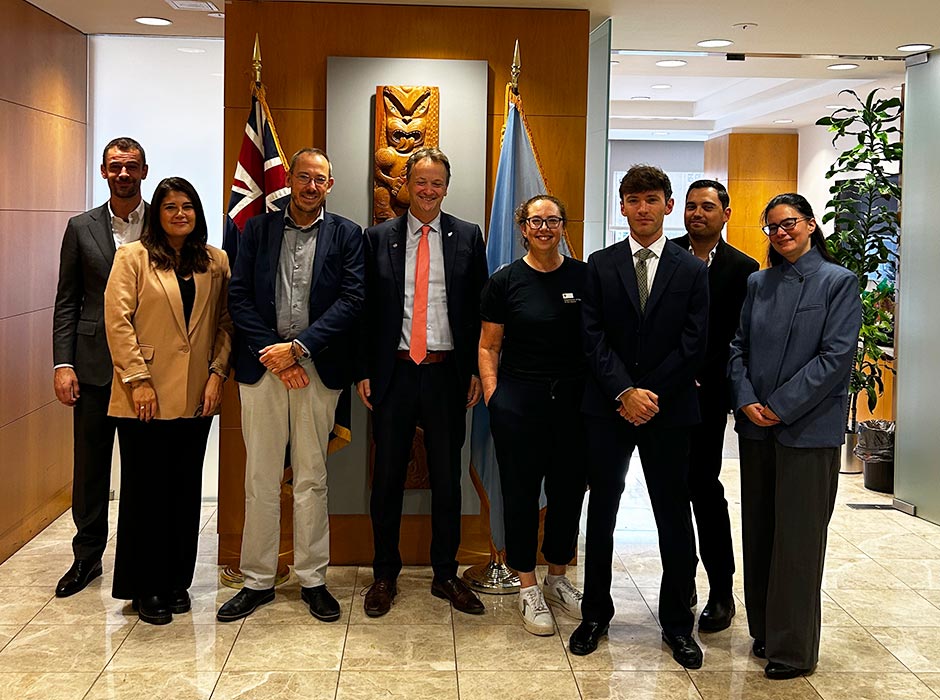
Professor Louise Parr-Brownlie (centre right), Deputy Permanent Representative of New Zealand to the United Nations H.E. Anthony Simpson (centre) and European Brain Council Executive Director Frédéric Destrebecq (centre left), accompanied by the EP BrainHealth roundtable delegates.
At the panel discussion, Louise also shared Aotearoa’s experience of being part of EP BrainHealth, highlighting the practical lessons that could help the Partnership build relationships with countries and regions with different research capacities, health-system structures and priority needs.
“Irrespective of the size of our economy or funding, excellent brain research has always been done in New Zealand. The Partnership model allows us to leverage this and participate from a position of strength.
“We can lead in niche areas and have the flexibility to contribute to a specific area or specific part of the research ecosystem, be it fundamental data, clinical, or at the innovation stage.
“We can also engage in and support research that aligns with our values as a nation, particularly equity and responsibility to deliver for all.
“The outcomes from being part of a collective are much greater than what we can do alone, especially as a smaller and geographically isolated country.”
Being a small country also means the degrees of separation across the sector are small, Louise says. The benefit of which was being able to draw on relationships to host the EP BrainHealth roundtable discussion following Brain Days, at the Permanent Mission of New Zealand to the United Nations.
The roundtable – titled ‘Fostering global collaboration for brain health through science diplomacy’ – marked the first in a series of events organised in the framework of the EP BrainHealth Global Outreach activities.
Representatives from diplomacy, research funding, development finance, philanthropy, and academia attended.
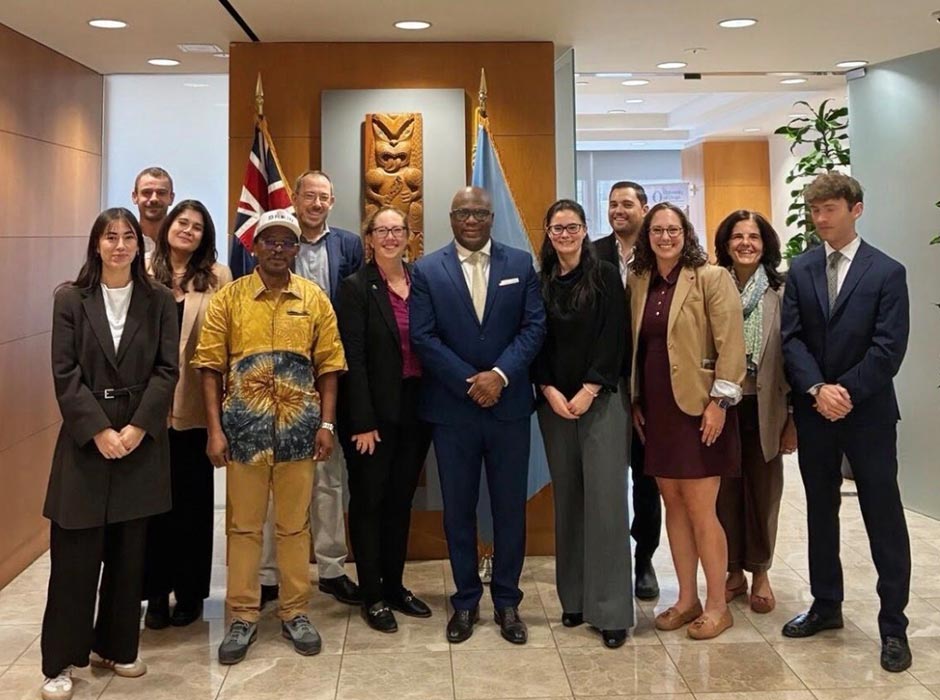
Professor Louise Parr-Brownlie (centre left) with delegates at the EP BrainHealth roundtable.
Louise presented a keynote address, exploring how international collaboration can accelerate brain-health research and deliver equitable outcomes.
“The scientific knowledge generated in one country can make a difference in another.
“Data collected across continents reveal insights impossible to discover within national borders. And when we work together, we accelerate the discovery, and we accelerate hope.
“That is why international collaboration in brain health is essential.”
Brain health is much more than science, she says.
“Investment in brain health is not healthcare expenditure – it is an investment in human capability, productivity, social cohesion and sustainable prosperity.
“It is also important to remember that scientific innovation does not automatically reach everyone equally and many populations continue to face barriers to access to diagnosis, treatment, specialist care, participation in research, and access to emerging technologies.
 “Unless we address these differences intentionally, scientific progress can widen existing inequalities.”
This is where international cooperation becomes a force to deliver equitable outcomes, Louise says.
“New Zealand’s participation in international brain health initiatives reflects a belief that solutions emerge when knowledge, cultures, and perspectives come together.
“It reflects our commitment to collaboration, inclusivity, and ensuring that advances in brain health contribute to equitable outcomes both locally and globally.
“If we can align our efforts across borders, disciplines, sectors, and cultures, we have the opportunity to reduce brain disorders and unlock human potential on a scale that benefits all nations.
“That is a future worth pursuing together.”
Brain Days at UNGA81
Brain Days at UNGA81 was convened by the European Brain Council in collaboration with global partners, under the theme ‘Towards a UN Resolution for the Brain’.
This two-day event in New York was structured around two interconnected pillars, exploring global collaboration in brain health research and innovation – including funding, science diplomacy and international partnerships – and the broader societal and policy dimensions of brain health, including brain capital, prevention, resilience and pathways towards greater recognition at United Nations level.
Building on discussions initiated in previous editions, the event aimed to not only showcase progress, but to create a space for active discussion and catalyse concrete next steps for collective action. Read the event report.
Following the event, EP BrainHealth released a joint statement, calling for sustained international collaboration to advance brain health as a global priority.
~ Kōrero by Sandra French, Adviser, Internal Communications