
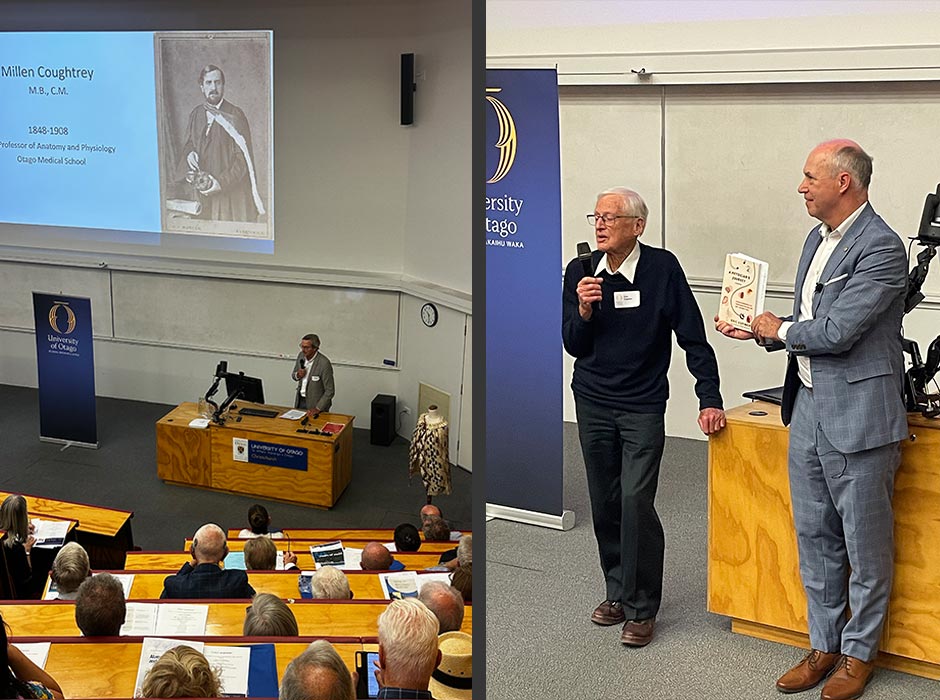
Left: UOC Class of '73 alum Dr Rick Acland speaking at the Otago Medical School 150th event in Christchurch Ōtāutahi. Right: Emeritus Professor Eric Espiner speaks to guests while UOC Dean Professor Lutz Beckert holds Eric's book.
Amongst the reminiscence, there was much warmth and celebration as 120 teaching, research and professional staff, along with alumni and students gathered to honour the University of Otago Medical School’s 150th anniversary at the Faculty of Medicine – Christchurch Ōtautahi campus last week.
Guests assembled for an event of lectures and talks, interspersed with a morning tea; to reflect on the past and present contribution the University of Otago Christchurch Medical School has made over five decades of teaching and research.
The gathering was especially poignant for those who attended from the pioneering ‘Class of ‘73’ – the first medical students to undergo their three-year clinical training in the newly established (and then-named) Christchurch Clinical School in 1973.
In his introductory welcome, Faculty of Medicine – Christchurch, Dean Professor Lutz Beckert hailed the bright young medics from that inaugural intake who “blazed a trail for others to follow”.
“You have devoted your lives to serving others and have left a legacy which strengthens us all, leaving large shoes to fill, helping set high standards for excellence in teaching and research,” Lutz said.
Former Acting Otago Medical School Dean, Professor Tim Wilkinson reflected on the School’s proud history as the second oldest medical school in Australasia (Melbourne being the first in 1862), remarking on the huge advances in medical teaching in the 150 years since. He emphasised the strength of its current rural medical education, with students now placed in 57 communities and 130 practices nationwide.
Tim opined how in the future, OMS might benefit from increasing the flexibility of how students learn medicine – graduating when they are actually ready, not necessarily to a strict timeframe. He also raised the prospect of AI as a means of ushering in greater flexibility and individualised learning.
Class of ’73 alum, retired anaesthetist and former head of the Burwood Spinal unit, Dr Rick Acland, spoke of his historical family links to both the Otago Medical School and Christchurch campus.
His great-grandfather Professor Millen Coughtrey was appointed the first Professor in Anatomy and Physiology at Otago, later opening the Christchurch Clinical School back in 1974 (alongside then Prime Minister Norman Kirk).
The British-born, University of Edinburgh Medical School-trained butcher’s son (and Franco-Prussian war veteran) emigrated to New Zealand in 1873. He was hired to teach at the new Otago Medical School aged just 26, and introduced examinations and cadaver dissections, highlighting the importance of the microscope in learning, and the benefit of rural and community medical teaching.
Rick quoted from Millen’s written application form for the post of Anatomy Professor, where he stated he could “claim without stretching due modesty” to “not only use the scalpel, but the pencil and modeller’s tool”. The then-University Council noted that he was “a bluff personality, not without vanity and fond of display” ...with something of a “waltzing gait and full of chaff”.
Millen presented the very first medical graduation address at Otago Medical School in 1887, established the New Zealand Medical Association in 1875, and later opened a private hospital and sanatorium in Dunedin’s St Clair.
Fellow Class of ’73 alum, Christchurch oncologist Dr Chris Atkinson, also reflected on his time as one of the first 43 medical students to attend the Christchurch Clinical School. He said inaugural Dean, Professor ‘Gentleman George’ Rolleston (1973-1981) showed true leadership and real enthusiasm in welcoming the new cohort – an ambition many decades in the making.
"The teaching staff were all committed fully to our learning and to making the School a success. Many staff later became friends, with their high standards and duty of care inspiring most of us to remain and advance our careers here in New Zealand,” Chris recalled.
More than 50 alumni and guests from the inaugural Christchurch Class of ’73 had been generously hosted the evening prior at the Fendalton home of George Rolleston’s son, Humphrey, and his wife, Debra Rolleston.
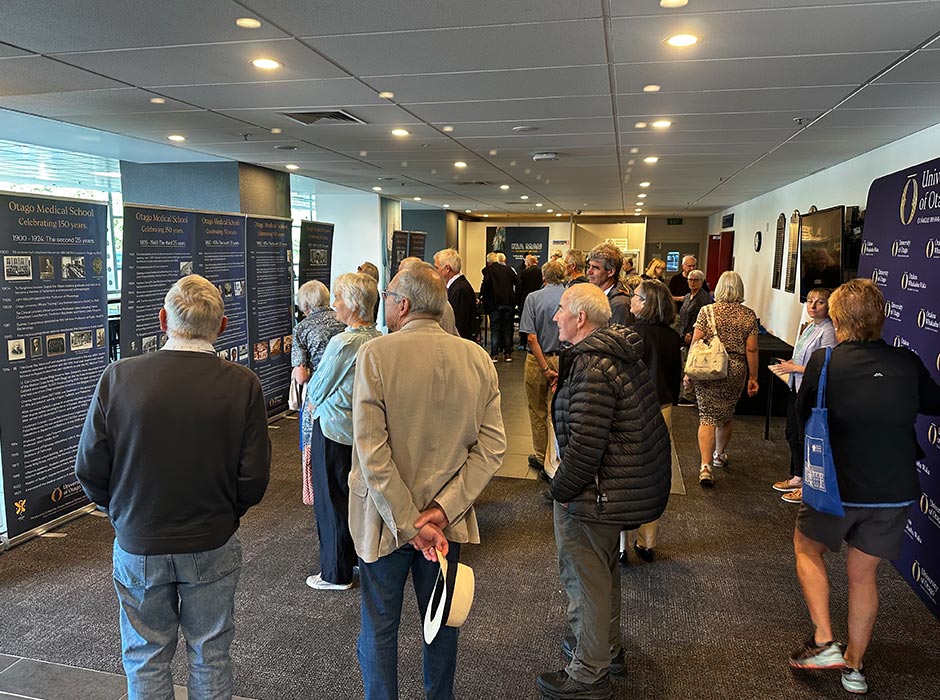
Guests reading the history boards at the UOC Otago Medical School 150th event.
Emeritus Professor and endocrinologist Eric Espiner, still working in the Department of Medicine in his early 90’s, gave an enlightening talk about the early days of clinical research at both Christchurch and Princess Margaret Hospitals. Eric’s recently published memoir, A Physician’s Journey, documents the extraordinary research advances newly graduating medical students such as himself were part of under the original, superb leadership of Professor Sir Don Beaven.
“Don brought science into medical teaching, possessing the vision and ability to inspire others, with his work in developing assays to measure clinical hormones, changing the treatment of cardiovascular disease worldwide,” Eric recalled.
Three further speakers took to the Rolleston stage following morning tea, including one of only five women medical students in the initial Christchurch clinical Class of ’73 cohort, Adelaide-based Psychiatrist Dr Fiona Hawker.
Fiona recounted the positive yet sometimes perilous realities of being a young female medical student in a conservative city back in the 1970s.
“I found my time here very enriching. I managed to keep my head down and many issues went over my head as I focused on my studies, but I do recall times when we women were the butt of jokes, made to feel uncomfortable and belittled. While it was suggested to me that other fields apart from psychiatry may be more ‘suitable’ for a female, I persevered, training in London, the US, and Wellington,” she recalls.
Current Associate Dean Research, Professor Logan Walker, presented a modern-day snapshot of the wonderful research mahi currently underway on campus, highlighting, as one example, the extraordinary advances in his own field of genetic health – from chromosomal karyotyping in 1971 to DNA decoding and sequencing today.
“This huge, powerful revolution in genetics now influences all areas of health, allowing us to search for genetic mutations causing disease. With the advent of AI, we can now seek to research the potential of precision and personalised medicine, collaborating with others to establish international networks of data,” Logan enthused.
He listed the significant success of Ōtautahi campus researchers this year in achieving grants and awards - despite the current strained funding environment – with five Health Research Council grants, MBIE, Heart Foundation, and Canterbury Medical Research Foundation grants, as well as Beaven, Liley, and Fulbright awards.
Newly appointed Head of the University of Otago - Faculty of Medicine (and former Christchurch campus Dean) Professor Suzanne Pitama gave the closing remarks, heralding the many firsts at the Medical School in science, social progress, health equity, indigenous health, and medical leadership.
Suzanne associated a whakataukī (proverb) as a means of framing the Otago Medical School’s next 150 years – namely, progression and building on the strength of the past to seek clarity and wisdom in the present, pursuing excellence into the future.
“We have chosen to represent this whakataukī through the symbol of a kākahu – a woven cloak – because it speaks to the depth, care, and intention that have shaped our journey as a medical school and university,” she said.
The kākahu was commissioned through the generous support of Otago Medical School alumni and woven by renowned local weaver Ranui Ngārimu (Ngāi Tahu).
“To our alumni we offer heartfelt thanks. This kākahu carries your aroha, commitment, and enduring connection to this place. Our legacy has been woven over generations, with intention, planning, resources, and capability, through leadership, innovation, vision, and service.
“As we look forward, the kākahu also becomes a symbol of our future.”
- Kōrero by Lorelei Mason
Ōtākou Whakaihu Waka, Ōtautahi
Research and study in Christchurch for a career in medicine and health science.
Find out more