
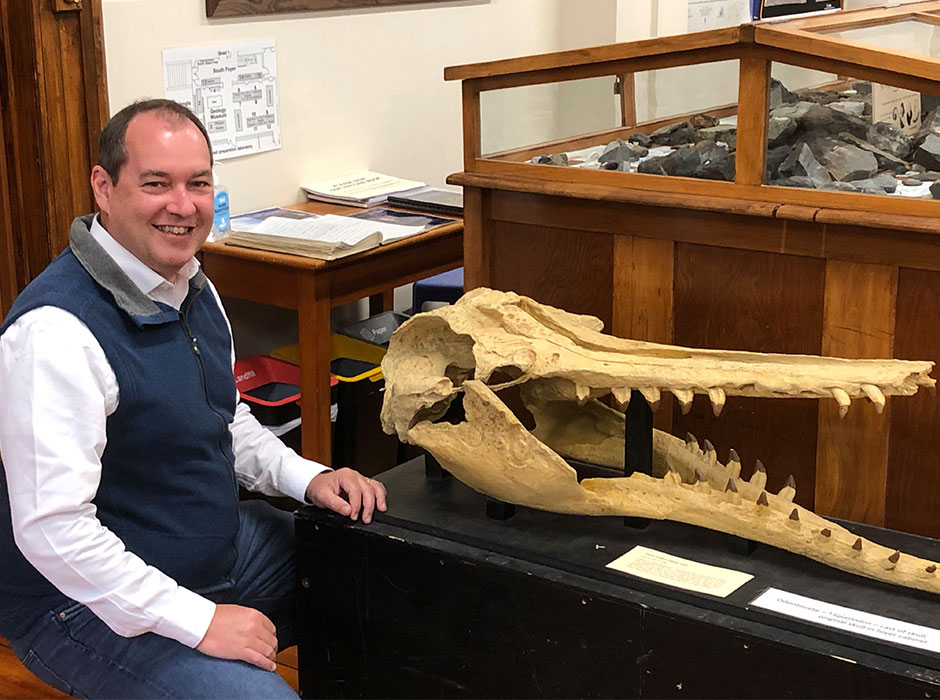
J A Valentine Visiting Professor David Lusseau, with an ancient marine mammal fossil, at the Geology Museum. David is keen to engage with Otago staff and students on managing sustainable marine tourism.
Chatting to two colleagues prompted Denmark-based Otago alumnus, David Lusseau (PhD, 2004), to apply for the 2026 J A Valentine Visiting Professorship.
His colleagues at the University of Otago - Ōtākou Whakaihu Waka Department of Tourism, Professor Anna Carr and Department of Marine Science Associate Professor Will Rayment, encouraged David to apply.
Hosted by the Otago Business School and the University’s Department of Marine Science, David is a Professor of Marine Sustainability at Denmark Technical University (DTU).
He says he’s very excited about the professorship, as he has worked a decade in Aberdeen in Scotland, followed by five years in Denmark without a break.
“I’ve finally had some breathing space and I was very keen to come back to Otago and I think in terms of wildlife management and tourism we can learn a lot from New Zealand.”
Originally from France, during his four years at Otago in the early 2000s, David worked a rotating cycle of a month in Milford Sound, followed by a month in Doubtful Sound and a month on the Dunedin campus.
During his PhD he says he had “fantastic guidance” from his supervisors, former Otago Tourism Professor James Higham and Emeritus Professors Liz Slooten (Zoology) and Steve Dawson (Marine Science).
“I came to Otago as New Zealand is the best place to study sustainable management of wildlife tourism. I wanted to study the work of the Department of Conservation in understanding the place of people in nature and the place of nature in societies and finding ways to make it work.”
Otago holds a special place in David’s heart, as he met his future wife Susan Maersk-Lusseau (MSc, 2003), in a lab at Otago and they were married in the Dunedin Botanic Garden in 2001.
Susan has travelled to New Zealand with David and works at DTU as a Senior Consultant at the National Institute of Aquatic Resources.
While back at Otago, David will catch up with Associate Professor Will Rayment about his extensive marine mammal research.
“Will has largely taken over much of the long-term study sites on marine mammals that I was part of 25 years ago. And so we’re talking a little bit about Fiordland dolphin population dynamics.”
David is also catching up with Tourism Professor Anna Carr to compare case studies across Europe and New Zealand around the management of wildlife and nature resources.
He says he has arrived, “with a keen interest from my perspective to better understand how both nature restoration and wildlife tourism is run from a community-based perspective in New Zealand, to contrast with the very top-down approaches we have in Europe. And how this can be better applied within European regulations to some of the communities we have there for both fisheries and tourism.”
He says New Zealand has recently signed up to Horizon Europe, a research innovation programme which is based in Brussels.
“This allows New Zealand researchers and organisations to lead or join and receive direct funding on equal terms with European counterparts for global challenge projects.
“I’m very much looking forward within this space to see how we can collaborate between Otago and our research institutes in Europe.”
David will be presenting two seminars during his month back at Otago. One is on his work in Europe on marine protected areas and the challenges they face.
“In most cases there is a line drawn on a map and there is little planning about what to do with it. So we can find ways to decrease the risk to biodiversity within the designated area, instead of keeping on designating new areas. We are making the best use of what we already have.”
David says his other seminar is presenting to a Tourism class on the work he has done on governance and management of nature.
“It’s trying to understand how we are managing wildlife tourism, how it started from a conservation-orientated question to now [when] we are actually trying to find ways to manage it across many different regions. How do we make sure that we find sustainable solutions to wildlife tourism challenges?
“So, for the past 10 years we’ve been working with social media companies to look at the online footprint of people seeking interaction with nature. We’re trying to use this data to predict where people are going via Google searches and visits to Wikipedia and other sites.”
David says while working via email, phone and on Zoom and Teams are good he is looking forward to the direct interaction with Otago staff and students.
“It’s really good to have this kind of fellowship to come and say let’s think about stuff and see what comes out of it and these are often the most productive collaborations.”
J A (Jim) Valentine was a prominent Dunedin businessperson and community leader, who was the Chairman of construction company Naylor Love for 16 years.
His legacy is defined by his contributions to New Zealand’s construction industry and his support for higher education.
Under his chairmanship (ending in 1995), Naylor Love grew into one of New Zealand’s leading construction firms.
The J A Valentine Visiting Professorship was established in 1990, following a gift to the University's Development Appeal. It was designed to promote excellence in Business and Marine Science, reflecting Jim’s interests in the economic and natural resources of the Otago region.
-Kōrero by Kerry Dohig, Communications Adviser Development and Alumni Relations Office