
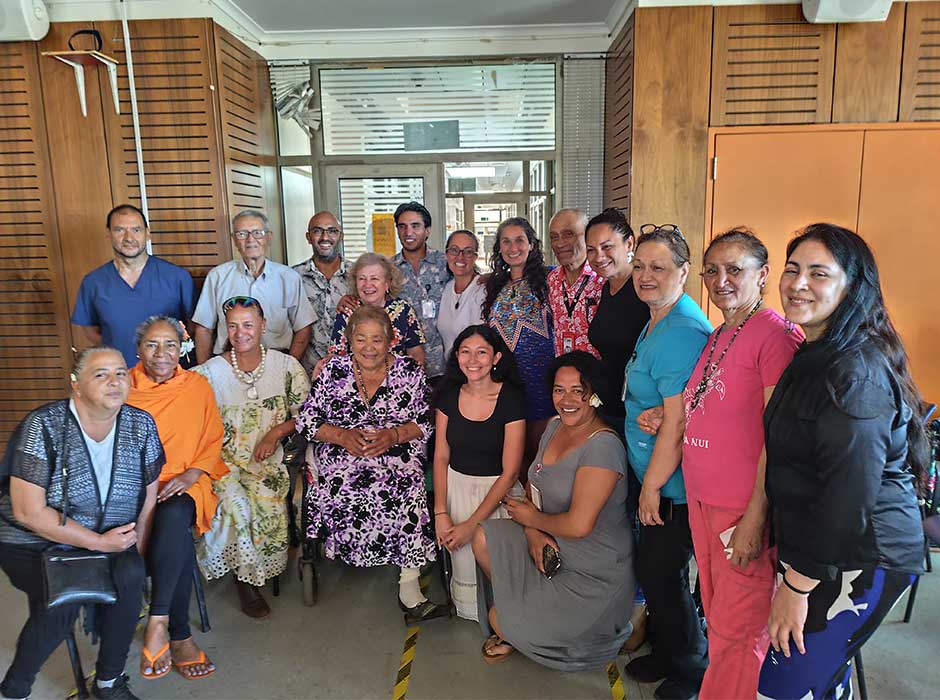
Some of the people that attended presentations by Associate Professor Esther Willing and medical student Sara Arquipa Southerwood at Hospital Hanga Roa on Rapa Nui last November.
Next June, eight tauira will find themselves landing on Rapa Nui/Easter Island for a month thanks to a Prime Minister’s Scholarship won by two Otago academics.
Dr Moira Fortin Cornejo and Associate Professor Esther Willing (Ngāti Toarangatira, Ngāti Koata, Ngā Ruahine, Ngāi Tahu) won a Prime Minister’s Scholarship for Asia and Latin America that enables them to pay for the tauira to travel to the remote Pacific island.
Moira, Languages and Cultures, and Esther, Director of Kōhatu Centre for Hauora Māori, are excited that this scholarship gives them a chance to work together across the Humanities and Health Sciences divisions.
The pair visited Rapa Nui last November. While Moira, originally from Chile, had lived in Rapa Nui for 12 years previously, it was Esther’s first visit.
During this visit Esther engaged with staff at the local hospital and with members of the Indigenous medical practice along with Māori-Bolivian Medical student from Otago, Sara Arquipa Southerwood.
Esther says Rapa Nui might geographically be the Pacific island furthest from Aotearoa but culturally and linguistically, she feels that it’s closest to Māori.
“For me, as a Māori academic at the University, going to Rapa Nui for a month was a real privilege, because our cultures are so similar, our language is so similar, more similar than any other island I’ve visited in the Pacific,” Esther says.
“It was a really amazing experience… it felt like visiting my cousins that live far, far away.”
Moira says while Rapa Nui and Aotearoa have a strong relationship, during their visit the pair saw an opportunity for connections to be made between Rapa Nui and Otakou Whakaihu Waka. She particularly sees potential in terms of health, language and performing arts, as well as governance, sustainability, archaeology, and tourism.
“We're trying to create opportunities that will benefit our students at the University, but also, strengthen that connection between Rapa Nui and Otago because there's real benefit, from that relationship in terms of future study options,” Esther says.
Moira says about 8,000 people live on Rapa Nui, and roughly 4,000 of them are Rapa Nui, with the other 4,000 being Chilean and other nationalities from all over the world. The Prime Minster’s Scholarship enables tertiary staff and/or students to travel to either Asia or Latin America.
“Colonially and politically, Rapa Nui belongs to Chile, so it belongs to Latin America. So we could apply to go there through the scholarship,” Moira says.
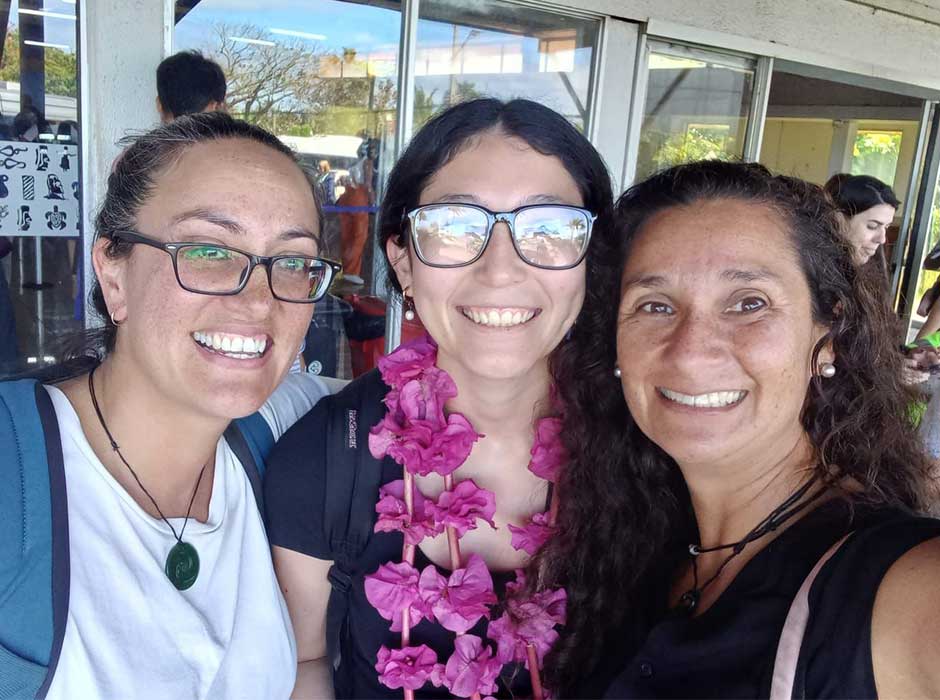
From left to right, Associate Professor Esther Willing, medical student Sara Arquipa Southerwood and Dr Moira Fortin Cornejo at Mataveri Airport, Rapa Nui last November.
During summer, tourists visit Rapa Nui to see the amazing archaeology and performing arts, she says. Going in June means the group will get to not only celebrate the Rapa Nui version of Matariki but also take advantage of the tourism off season and interact directly with the local population.
Throughout June, tauira and the support team will host kōrero and talanoa sessions with different Rapa Nui institutions open to the whole Rapa Nui community to attend.
“We envision we will discuss a specific topic every three days, more or less. So when we engage with tourism, for example, we’re going to invite the people that deal with tourism in Rapa Nui– the tourism chamber, tour guides, students of tourism at the only school that offers a technical qualification – to come and engage with us,” Moira says.
“If there was a student who is studying tourism here, they could give a presentation on tourism in New Zealand and/or tourism from a Māori or Pacific perspective.”
These sessions will be determined by the expertise and knowledge of the tauira.
“We want to acknowledge that people have multiple skills, so they might be studying medicine but they may also be interested in music or governance,” Moira says.
Esther hopes tauira will not only share knowledge, but also learn from the community.
“So they start thinking ‘oh, that was a good idea, how can we translate that into our context?’ Or maybe just pondering about different ways of dealing with the same issues.”
The scholarship covers the cost of flights, travel insurance, accommodation and a small stipend for all the tauira. Tauira will be accommodated in homestays with Rapa Nui families to facilitate whanaungatanga. Moira and Esther are working with Ivonne Toki Pont, based in Rapa Nui, who has been a crucial member of the team helping organising the whole trip.
All Otago students, undergraduate and postgraduate, from across all divisions, are invited to apply for a spot on the trip to Rapa Nui. Māori and Pacific students will be prioritised, and students who speak Spanish will have an advantage.
Moira says selection will not be based solely on student’s grades but also their aspirations.
“Grades don’t necessarily assess everything else that students can contribute with.”
The application process will see tauira submitting a video of themselves talking about why they would like to go, what they think they can add and what they hope to gain from the experience.
Tauira need to demonstrate a willingness to learn some of the languages – Rapa Nui and Spanish, because Moira and Esther hope the trip will highlight the benefits and opportunities that come with being multilingual.
Tauira will also need to believe in the Kaupapa of why they’re going there, which is building relationships.
Esther and Moira will create a shortlist to interview, before deciding on the final eight. There will be a waitlist, as well.
Applications open in August for about a month, and selections will be made by the end of the semester to allow students time to plan their studies, travel and finances, as well as getting a passport if need be.
“We really want to be able to select the students before the end of the semester so that they have time to adjust, talk to their whānau and save some money over summer,” Esther says.
The selected tauira will attend two wananga prior to the trip, and another for a debrief once they return. There is also a possibility they will need to speak about the trip at future events.
Māori ki Te Kura Hauora o Ōtākou
Otago Medical School supports learning in Māori health to develop a medical workforce that meets the particular health needs of tangata whenua.
Find out more