
Monday 17 August 2020 12:00pm
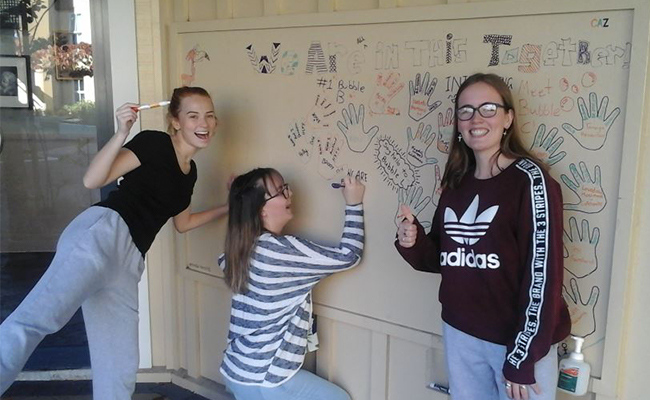
Caroline Freeman College residents Jemma Swain-Graham, Gabriella Kircher and Shona Gladstone add their ideas to the "doodle wall".
After caring for hundreds of teenagers locked down together and stopping colleges becoming cruise ship-style headline-makers, our college staff are now packing two semesters’ events into one, so students do not miss out during their flagship first year.
“I’m very conscious that the kids who live here need to have the best collegiate experience they can have … the ball, sport, open mic night, the portrait painting competition, Rocky Horror …,” Caroline Freeman College Warden Chris Addington says.
“We want our students to walk away with fantastic memories and great friends,” adds Carrington College Head of College Ali Norton.
Another task is also underway for Studholme College’s new warden Johnny Nu’u, whose first day of work was also the first day of Covid-19 lockdown. He is furnishing the warden’s house he lived in for the five-week lockdown with wife Natalie and 16-month-old-daughter Zoey.
Clothes and all
Johnny says, with an amused smile, that he even had to borrow clothes from the college – lost property and branded hoodies – after only packing enough to last until the rest of their things arrived from Auckland.
He was not meant to start work until April but students “needed our support and it was all new for everyone and was all hands-on deck”.
However trying that all might sound, this easy-going and welcoming Otago-trained former lawyer says gently he is thankful for inheriting a culture of friendliness, care and community that students feel comfortable in – from former warden Ziggy Lesa and Senior Tutor Rachael Carson.
Support for all
Johnny believes starting early at the college was best for his family as well: “Collegiality was what we came here for. I guess it reinforced that we made the right decision coming back.”
Support started before they moved in, when the people running their initial motel loaned them a highchair, port-a-cot and toys for their new home without knowing how long lockdown would be.
“That doesn’t happen everywhere. There has to be something about this place, a charitable spirit. Things that are lost when you move to those bigger cities sometimes. Maybe I’m glamorising the whole thing, but that’s how it feels,” Johnny says.
College staff also loaned the Nu’u’s towels, and their new lounge suite and bed arrived just before lockdown.
“It was just a crazy time. But it did really show the trust and confidence and solidarity within the colleges,” Johnny says.
The kick-off
Ask Ali about how the pandemic started for Carrington and one of her rich laughs fills the room as she cheerfully tells a story against herself in her Canadian lilt, titling a head bearing her glasses’ trademark aqua frames.
“I remember very clearly at our parent orientation in February – right before everybody arrived – a parent asking: ‘are you worried about this virus and what it might do?’ And my response was ‘no’. He was a doctor.”
“We knew the University was making a plan in the background, but we didn’t know that would happen, she says. “It seemed so out of the box, not only that it was in New Zealand, but that it was the whole world.”
Suddenly, colleges had to follow new guidelines from the Government and Ministry of Health while interpreting how they would work in their environment, which varies from college to college, dining room to dining room, Ali says.
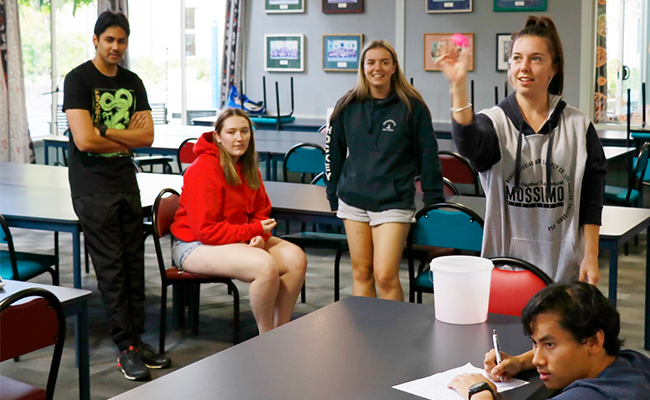
Residents found ways to entertain themselves in their lockdown bubbles.
Levelling
Moving through the pandemic levels was “a stressful unknown time for everybody because we were having to make significant changes. For quite some time, every time I was going out to address our students, it was to introduce more stringent regulations that were making their world smaller.”
Staggered dining room sittings for social distancing and banning visitors at level 3 coincided with a flood of questions about whether the colleges would stay open: “The word was that we would, but no-one knew exactly what that would look like,” she says.
When lockdown was announced, parents began phoning: “’I really want my student to come home and they don’t want to’. ‘I think my student should stay rather than going on multiple flights, what do you think?’”
College leaders could not sway them either way because “it had to be the best decision for them … and I didn’t have a crystal ball”, Ali says.
Locking down
Ask Chris about lockdown and he is a pleasant whirl of joyous storytelling and candid reflections, all delivered with a natural flourish from a language-lover with English degrees.
The timeline was tight. In early March, “we saw it coming when they shut the border in China. We had five kids who were destined to come here. It was ‘are they coming, or are they not going to come?’”
By mid-March, Chris was calling all his students together to calm everyone down, by saying how the college was combatting the pandemic and what every student could do.
Not even a week later, “panic set in” when the country learned New Zealand would be locking down in two days. As Chris rhymes in a ballad for his college’s Facebook page:
“In March of 2020, COVID-19 came to town,
Then Ashley and Jacinda said, ‘it’s time to lock it down,’
All asked themselves the question,
‘Should I go? Or should I stay?’
No matter where I am, I’ll feel like such a castaway.
After debate, were 91 who said, ‘we’ll take this cruise,
Here on the good ship Caroline, what have we got to lose?’
At midnight on the 25th, the warden locked the gate,
Propped up five bears to guard against attempts to penetrate.
We were bubble-organised, our groups ranged from four to ten,
And bubble mums appointed, though some of them were men …”
Launching into lockdown with about 40 per cent of the residents involved student bubbles and their student leaders – affectionately known as Bubble Mums – having to go to “the dining room as a bubble, book the drying room as a bubble, the sport court, the library…”
“For me and for the other staff, the care of 91 of New Zealand’s young people was in our hands and God forbid it (Covid-19) got in here … we could really have some serious complications.”
Building bubbles
Mentioning bubbles and social distancing sparks the feeling college leaders across our University, like all good ‘parents,’ have the philosophy some things that happen in a family stay in the family.
That some bubbles drifted happily along, some were fragile, all were foreign concepts, and that the almost limitless hues light can cast on a bubble’s surface were also found inside the bubbles and how students reacted to them.
Ali says creating and maintaining bubbles among her 80 remaining students were the biggest challenges because bubbles were introduced mid-way through the pandemic response and had to be geographical, so each bubble could have its own bathroom.
“It was difficult for some students. Their best friends were in another building. They didn’t have the autonomy they were used to.”
Movement had to be restricted so areas could be cleaned after bubbles, to prepare for the next bubble. Every college needed bubble charts, to choreograph their bubbles’ movements, and know where they all were at any time, which created a large administrative load.
At Carrington, the delicacy of that bubble dance was possibly most obvious in the dining room, where the layout changed multiple times to reflect changing distances individual students had to stay from each other and then bubbles had to stay from each other, to stop them intersecting.
“I’m so used to the dining room being the hub of the college and it could only have 24 students in it at any one time and these massive distances between people,” Ali says.
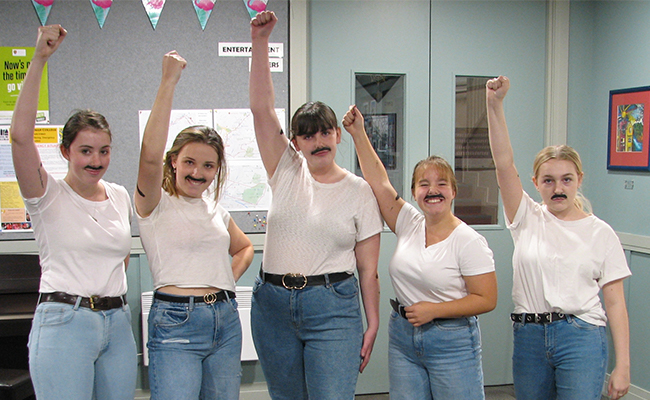
Caroline Freeman College residents Mykilah O'Sullivan, Lucy Tompkins, Becky McEwan, Magdali Feldtmann and Isabelle Sherburd dressed as Freddie Mercury.
Student scenarios
But at all the colleges, locked down students made new bubble friends, studied, took on each other’s bubbles in pentathlon, competitive jigsaw puzzling, poem writing, did online quizzes and competitions, had scavenger hunts, created a Survivor competition, had card nights, did jump jam, made astonishing ballgowns from newspaper to mark missing the college ball ...
At Studholme, the student College Community Leaders who stayed kept an eye on the people on their floors – whether in the colleges or at home – then let Johnny and Rachael know if anyone was struggling so they could get in touch.
“It was all about saying ‘this is not easy,’ just being real about it. We’d remind them about the support services that are there … remember Student Health is doing telehealth …,” Johnny says.
Chris was impressed with the concern his student ‘mums’ showed making sure everyone felt noticed and included in their bubble.
All the while, students were also adjusting to on-line learning, and did so well their colleges leaders are proud of their results.
Leading the way
As lockdown started, Chris and his “amazing” staff followed two mantras he had spotted online:
“Remember it’s not the kids’ fault. Don’t blame them. They didn’t ask for this.”
“Don’t make perfect the enemy of good, and good the enemy of good enough.”
“We knew from the beginning it wasn’t going to be perfect. We would try, but we wouldn’t beat ourselves up if it wasn’t. We had no rule book, and it kept changing,” Chris says.
“I had kids in my office bawling their eyes out saying, “I’ve got to go,” and I was saying, ‘we’ll talk it though, make it work for you’ … to their credit, we made it work.”
Some students needed reminding about how to behave and a bit of miscommunication was thrown in from various places, but “at the end of the day, we all survived, everybody got fed, we had some laughs and we shared an experience that’s quite unique”.
“I’d give us a solid B+ – but I’m a bit hard on myself, other people may say it’s better than that”.
Johnny says when students embedded in the constantly changing and largely unknown Covid landscape asked lots of questions, honesty was important: “I wasn’t going to make stories. I’m not going to tell you if I don’t know, but I’ll find out”.
While helping students work out the rules, then reminding and encouraging them to follow those rules, creating a sense of responsibility for their family and community was meaningful because that is the landscape most first-year students have known until now: “You’re here (in this situation), everyone’s here, your grandparents, your young cousins, your parents …”
“We’re going to all be together at the end of it so what’s it going to look like? How are we going to support each other?”
And Studholme students obviously appreciated the care they received because “at the end of it, they gave us boxes of chocolates to say thank-you,” Johnny says.
Ali says: “We didn’t have people saying to us they regretted staying. We also had people tell us they were jealous of their friends who did stay and couldn’t wait to come back”.
Both students and parents were “really appreciative, and that was really reassuring”.
Once more?
Would college leaders do it all over again?
Johnny is adamant he would. Chris believes: “It’s one of those things you do once in your life and talk about it for the rest of your life”.
“I’m glad that it’s over and I feel an enormous sense of privilege that we’re in a country that has dealt with it amazingly well. I have the greatest respect for Jacinda and Ashley,” he intones, perhaps pointedly, in his Californian accent.
One of his students has such immense respect, a life-sized cut-out of Director-General of Health Dr Ashley Bloomfield embellishes his room.
Returning students
Ali says while returners and students who stayed were probably a bit anxious about whether the college would be the same after lockdown as before, excited anticipation definitely built up on both sides.
Some students had been studying together or hanging out in their hometowns even if they did not know each other, just by putting out a message on social media asking if anyone else from Carrington was in the same place.
She posted a message on the college’s Facebook asking everyone to be a connecter who introduces new friends to old and notices if anyone is by themselves.
Some students arrived at 9am on the Level 2 day they were first allowed back, others drifted in closer to exams, and some went home for a while, so “everybody’s kind of running their own race,” Ali says.
At Studholme, Johnny said to students that “we were the Covid 35 but don’t forget it’s the Studhome 185.”
Now, “I tell you they haven’t missed a beat”.
He has been particularly proud to see students who had forged friendships pick them up again immediately – “they only got to know each other for about four weeks before lockdown”.
Chris says now more students are back, the others are glad to see new faces, and “I don’t think anybody felt bad that they went home or bad that they stayed here”.
At all colleges, staff did their best to keep links with students at home alive and to keep in touch with parents, through newsletters, the college’s social media and live streaming.
Huge thanks
Every college leader is exceedingly thankful no students fell ill with Covid. Ali says: “We came out of it healthy and alive, really healthy, no ‘flu or anything.”
The leaders are also very thankful for their staff – not wanting to name names in case they miss anyone – Unipol’s help with activities, Student Health’s medical advice, the support from Incident Controller Andy Ferguson and the leadership of Senior Warden Jamie Gilbertson and Campus and Collegiate Life Services Director James Lindsay.
“James and Jamie were constantly checking on staff, every day via Zoom at 9.30am, all the wardens … is everybody okay, how are the kids going psychologically …?” Chris says.
Johnny is impressed the duo provided the vital powerful, strong leadership, telling college leaders “’we have to make some decisions that have to be made and want you guys to come with us. It’s not about right or wrong at the end of the day, we’ve got to do what we’ve got to do’.”
Proud
Jamie is proud of a team of college and UniFlats leaders, staff and helpers who quietly did what needed to be done every day, every night and every weekend.
He says they patiently, innovatively and successfully managed unique and rapidly changing times extremely well – with kindness, care and sensitivity – while working under the extraordinary pressure of a civil emergency.
“We were like meerkats. We were totally aware there was no relaxing at this time. You had to be there to fully understand what that experience was like in the colleges. It was an exercise in resilience. People learned a tremendous amount about themselves and many things,” Jamie says.
He is also thankful for students “who came with us on this journey. The students who we service came through and we can be proud of them. The students were great to be with”.
“We were all in one of the best places we could be, in our University,” with all the specialist knowledge it can provide about pandemics, disease and hygiene.
And people even managed to have fun along the way, Jamie says
Not normal
Now, Ali is thankful for the new normal: “There were times standing in the dining room and looking at everyone spaced out at these tables – knowing that was only a quarter of the people in the college at this time – when I thought ‘are we ever going to have everyone in this room again this year?’ Now it is full of people and everyone is talking and laughing, it feels a bit surreal and nice, really nice.”
For Chris, shifting the furniture in the dining room back to the normal configuration was “almost a spiritual experience”.
Why
So, what drove these leaders to do such vocational jobs that take over their lives?
Johnny says: “At the end of the day, students are here to get a degree but if you don’t look after their welfare, how are they going to perform?”
You arguably have to look no further than him for what drives leaders and staff to support our students. Johnny’s years at Otago produced a law degree that is the foundation for his career, and he met his wife while living at Studholme as a student, creating the foundation for his family.
“It’s pretty epic,” Johnny says.