
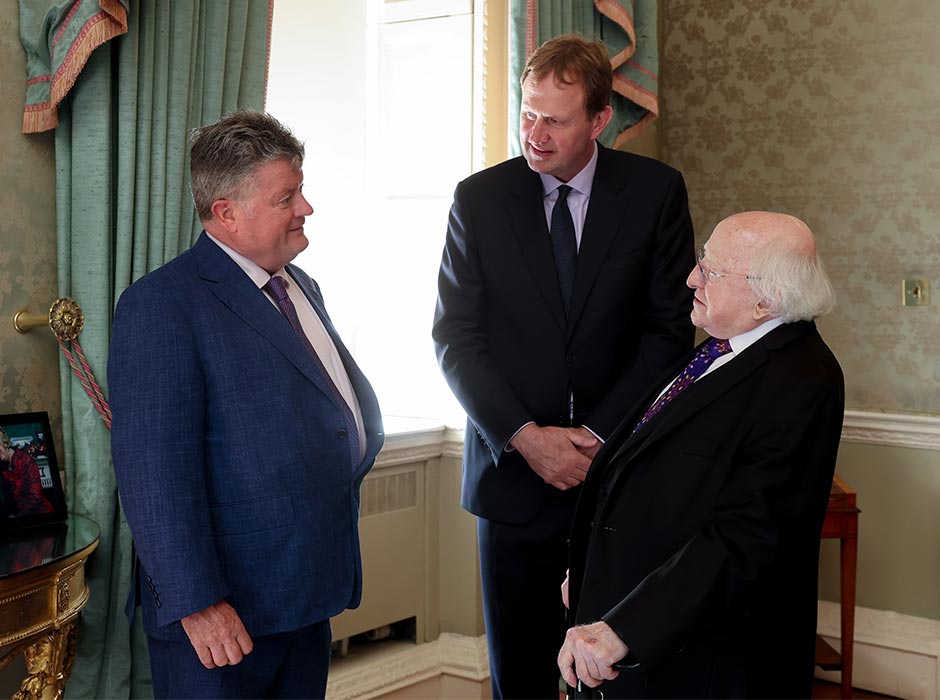
Liam Kennedy (left), with Irish Minister of Justice Jim O'Callaghan (centre) and former Irish President Michael D Higgins, at Liam's High Court appointment celebration at Áras an Uachtaráin (the official residence of the President of Ireland). Liam sees much in common between the Irish and New Zealand legal systems.
Former OUSA President, Irish High Court Judge Liam Kennedy has spent more than 30 years working in the Irish legal system.
He says there are many similarities between the Irish and New Zealand legal systems, both being developed through colonial rule.
Traditionally, comparisons are drawn with the Canadian, Australian, UK and other Commonwealth countries, but it has always struck him that the NZ and Irish legal systems arguably have more in common.
“Ireland and New Zealand have a very similar heritage and culture in many respects, including their colonial experiences, their population size, their rural and historical roots, their attitudes to many issues. For example, nineteenth century legislation introduced in New Zealand during the land wars to suppress the Māori, was copied word for word from Irish legislation introduced after the 1798 Irish Rebellion.
“We have similar challenges – there are many parallels between the plight of the indigenous traveller population in Ireland and the Māori population in terms of social deprivation and over-representation in prison statistics.”
Liam sees NZ cases cited in Irish Courts, where they are well regarded, reflecting the common philosophical and jurisprudential approach to many issues.
“The greatest differences arise from Ireland’s written constitution and our membership of the European Union (EU) – EU law is paramount and I am regarded as an EU Judge as well as an Irish one.”
Liam joined one of the biggest law firms in Ireland, becoming a litigation partner. He served for many years on the council of the Irish Law Society. He was also involved in promoting Ireland’s legal expertise internationally. His expertise was recognised when, on the recommendation of the then Judicial Appointments Advisory Board, the Irish Government nominated him a Judge of the High Court and he was presented with his warrant of appointment by the country’s President.
He loves his new role, he says.
“It’s challenging, you’re learning something new every day. Before I was focusing on my clients’ interests but now I enjoy taking a broader perspective.”
Liam’s parents were well-known journalist John Kennedy – who for 22 years edited the NZ Tablet, a weekly Roman Catholic periodical published in Dunedin from 1873 to 1996 – and English and Māori teacher Colleen Kennedy.
He attended St Paul’s High School (now part of Trinity Catholic College) before going to Otago to study (as did his six siblings). One of his school friends was doing The Legal System and Liam decided to try it, along with History, Economics and Philosophy.
“At the end of first year, it was a close-run thing between arts and law, but I thoroughly enjoyed The Legal System and was invited to join the honours programme and the rest is history.”
During his studies he mainly lived with his family in St Clair. He enjoyed the lively teaching on campus in the early to mid-eighties.
“One of the legends was Professor Mark Henaghan, he was fantastic. He cared about all his students and his encouragement got so many people through Law School. He had an infectious sense of humour and he had great bonds with his students.”
Liam also remembers many other great lecturers, such as Professor John Smillie and Senior Lecturer Nigel Jamieson, with affection.
“The analytical and writing skills John drilled into me have served me well in NZ, London and Dublin, while Nigel always had a unique way of seeing the world from a different perspective.”
Liam joined student politics in various roles. When he ran for OUSA President in 1985 his campaign poster featured a picture of US President John F Kennedy under the caption, “Kennedys make great Presidents”. It “attracted a lot of graffiti” but it did the job and he was elected.
Liam says his most unusual role arose from being given the “thankless task” of updating the OUSA constitution. One long hot Saturday he whimsically added a few clauses to see how long it took anyone to notice. The revised constitution was duly displayed for weeks in the Union building and Liam expected someone would notice and object to his “gratuitous additions”.
He planned to have the clauses read out and then deleted at the meeting before the constitution was enacted. However, the only other person who read the crucial provisions was a friend, who decided to double-down – he persuaded the meeting they needn’t bother reviewing the “legalese”. It was put to an immediate vote and carried unanimously.
The amendments made Liam "King of the OUSA", giving his direct descendants "supreme control" of the association in perpetuity.
“I later graciously agreed to amendments to return the constitution to a more traditional model.”
After Otago, Liam spent three years working in Wellington and then decided to do his OE in London, planning to travel for a couple of years, but he met his Irish wife, Eleanor, while working there. She was a nurse, from County Cork.
“Back then, in the early nineties, Ireland was struggling economically, so it was unusual to immigrate there – everyone was going the other way and there were no non-Irish lawyers.”
Liam says when they married, they liked London, but wanted to give Ireland a try.
“Back then, in the early nineties, Ireland was struggling economically, so it was unusual to immigrate there – everyone was going the other way and there were no non-Irish lawyers.”
Liam says part of the move was good fortune, as his London experience positioned him perfectly for several major cases that one of Ireland’s leading law firms was tasked with.
When he hadn’t been in the country long, he says many people would see his name and assume he was Irish – they would be surprised when they heard his Kiwi accent.
Liam remains proud of his Dunedin routes and Otago education.
“I loved my time as a scarfie and my Otago legal education always left me in good stead, firstly in Wellington and then in London and Dublin. The legal systems have common roots – it’s like when you pick up a rental car on holiday and some controls may be different, but the fundamentals are the same.”
It turns out that he is only the second Kiwi to become an Irish High Court Judge. His friend, Ms Justice Teresa Pilkington, was born in NZ to Irish parents working in NZ at the time, but the family moved back to Ireland when she was three-years old.
“So she beat me to the punch, but I am the first NZ Law graduate to be appointed to the Irish High Court so I will settle for that.
“Teresa and I joke about being an ethnic minority in Ireland and lobbying the Chief Justice so that the two of us don’t have to sit on culturally significant New Zealand holidays like Matariki.”
Liam says a few Kiwi lawyers have followed him into legal work in Ireland.
While his siblings are in New Zealand and in Asia, Liam and Eleanor still live in Dublin. Their three children, Seán, Amy and Áine are all currently on their OEs. Seán is in Melbourne and is a keen All Black fan when they are not playing Ireland. Amy and her partner are “soaking up the bohemian lifestyle in the Arab Quarter of Berlin” and his younger daughter Áine is in London.
Áine’s history dissertation at Trinity College Dublin examined the role of the Irish in Colonial NZ, probing the romantic perception in NZ that in Colonial times the Irish were generally more supportive of Māori than other Europeans.
“She thought that that view was simplistic – many Irish people played controversial colonial roles, but tend to be seen in NZ as English or British, even though they were Irish – the Treaty (of Waitangi) Architect, Waterford man, Captain William Hobson is a prime example.”
And how does life in Dublin compare with Dunedin? Liam says the climates are similar but Dunedin has better summers.
“I love Dunedin, I love the buildings and the history and the people and in Dublin there’s history and colour in spades. So, you wouldn’t go to Dublin or Dunedin if you want the sun, but if you want history, great people and good social life, then both cities are great places to go.”
– Kōrero by Kerry Dohig, Communications Adviser Development and Alumni Relations Office.
Alumni & Friends
If you're a former student, staff member, friend or supporter of the University of Otago, we warmly welcome you as a member of our alumni community.
Find out more