
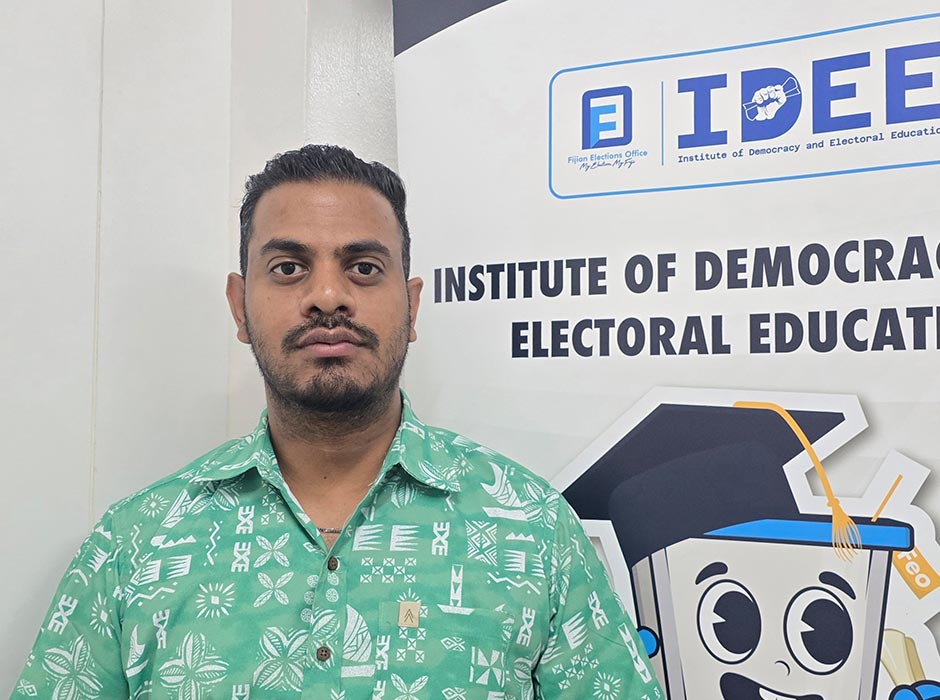
Otago Politics graduate Ravneel Chand’s research examines the psychological factors influencing voter turnout among persons with disabilities in Fiji. He now serves as Manager Learning and Development at the Fijian Elections Office.
While Ravneel Chand was missed at graduation celebrations here in Ōtepoti Dunedin, it seems fitting he celebrated in the homeland he seeks to serve through his research.
Ravneel graduated in absentia on 9 May, with a Master’s in Politics.
He received a Manaaki Scholarship from the New Zealand Government to study with Otago. His advice to students coming to the University from a different country, especially Pacific Island countries, is to stay grounded in who you are.
“You do not need to set aside your identity or experiences. In many ways, your perspective is your strength. Maintaining that authenticity while remaining open to learning from others creates a much richer and more meaningful experience.”
Identifying first and foremost as a Fijian, Ravneel is of Indo-Fijian heritage with roots in the Girmit history. As a Hindu, he says his upbringing has been shaped by values of duty, service and serving with integrity.
“Being a Fijian means being part of a shared identity that is deeply connected to land, people and community. I have a high regard to the vanua, which anchors relationships and responsibility to place. This broader understanding of community and connection is something I carry into my work and how I engage with others.”
Ravneel now serves as Manager Learning and Development at the Fijian Elections Office, where he leads electoral operational training and voter education initiatives. He also contributes to the development of the Institute of Democracy and Electoral Education, which is a registered higher education institute of the Fijian Elections Office.
“What draws me to this work is its direct and lasting impact. Elections are one of the most visible expressions of democracy and the quality of that experience often comes down to how well processes are implemented on the ground and how informed and included voters feel.”
In his master’s research, Ravneel examines the psychological factors influencing voter turnout among persons with disabilities in Fiji.
“Rather than looking only at voter turnout as a number, I explore how motivation is shaped by whether people see voting as meaningful, whether they feel capable of voting, and whether they feel connected to the process.
“Methodologically, I used talanoa, a Pacific research approach centred on open relational dialogue which allowed participants to share their experiences in a more grounded and culturally appropriate way.”
A key insight from Ravneel’s research is that electoral processes are not value-neutral – the way processes are designed and implemented can either enable or discourage participation.
“This means that voter turnout for persons with disabilities is not just about individual choice but also about how inclusive and responsive electoral institutions are in practice.”
His interest in this research was sparked in Suva, Fiji in 2024, when participants at an ‘Introduction to Elections’ workshop for people with disabilities shared their lived experiences.
“In that moment, I realised that voting, often treated as a simple or routine act, can in fact be a powerful expression of dignity and visibility, particularly in a society where exclusion remains a reality for many. I found myself wanting to listen more carefully and to understand more deeply.”
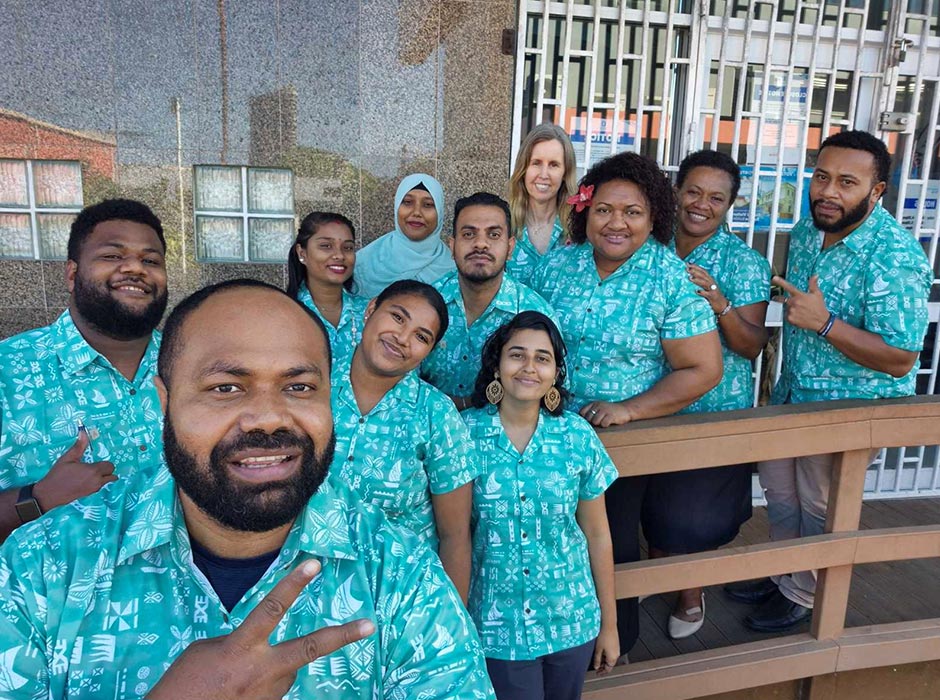
Ravneel Chand (in the centre) with the Learning and Development team at the Fijian Elections Office. “We all are wearing a 'kalavata', a cherished tradition in Fiji of wearing matching, coordinated clothing, literally meaning ‘same colour’ or ‘colour together’," Ravneel says.
Ravneel chose Otago because of its strong reputation and emphasis on critical and independent thinking. He sought out a programme that would allow him to engage deeply with questions directly relevant to his work in electoral management.
“My experience at the University of Otago was both academically rigorous and personally transformative. The politics programme challenged me to think more critically and refine my approach to research in a way that was both structured and meaningful.
“What stood out to me was the supportive and open learning environment. There was a strong emphasis on questioning assumptions and developing independent thought, which pushed me to grow not just as a student but as a practitioner in my field.”
Many friends made along the way have made this a memorable experience.
“Being part of UniFlats events and forming close friendships added a strong sense of belonging.”
He acknowledges his supporters, including International Student Advisor Claire Slocombe.
In the Politics programme, Ravneel is especially grateful to his supervisor Professor Janine Hayward whose mentorship “provided clarity and reassurance at key moments and helped me grow both as a researcher and as a person”.
Politics Senior Lecturer Dr David Jenkins played a significant role in sparking Ravneel’s interest in political theory and challenged him to think more carefully and question his assumptions.
Ravneel also thanks programme kaimahi Associate Professor James Headley, Associate Professor Nicholas Khoo, and Senior Lecturer Dr Lena Tan for sharing their knowledge and insight.
His greatest support has always come from home, where he is celebrating this learning milestone.
“Above all, I thank my wife, Raksha, and my nephew, Harsheel. Raksha was my constant source of strength. Her belief in me and her sacrifices carried me through moments of doubt. This achievement is as much hers as it is mine. Harsheel, with his joy and innocence, reminded me why this research matters, not only for the present, but for the future we are striving to build.”
“Finally, I acknowledge the vanua, the land and the people, which anchors my research in responsibility rather than abstraction. It is a reminder that research is not only about understanding but about serving the community.”
- Kōrero by Antonia Wallace
Study Politics at Otago
If you’ve ever wondered why decisions get made, who decides and how change happens, studying Politics is your chance to step right in.
Explore Politics