
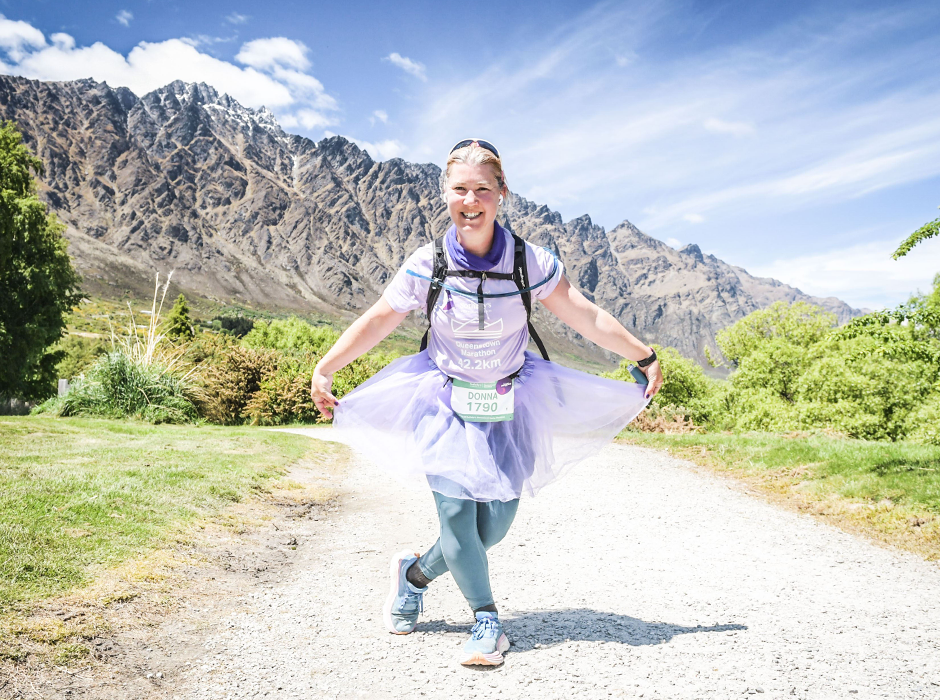
Children’s physiotherapist Donna Smith’s took part in the Queenstown Marathon in 2023 to raise both funds and awareness for the Little Miracles Trust and preterm babies.
Donna Smith has both personal and professional experience navigating the hardship and rewards associated with caring for preterm infants.
A children’s physiotherapist and Otago PhD candidate, Donna started on a path advocating and caring for pēpi and whānau affected by unpredictable birth outcomes after her two sons, Jack and Bennett, were both born pre-term. Her current research explores how bab ywearing – using a sling or carrier to hold a baby close to a person’s body – can benefit the whole whānau following a preterm birth.“It is not a new concept, in fact there is evidence of baby carriers being used from 10,000 years ago, and it is common in many Indigenous cultures, including here in Aotearoa,” Donna says.
“Having a baby born preterm often means being separated from them for a period while they stay in the hospital which can be very painful for parents. I am exploring how baby wearing after this experience might support the whole whānau.
“Cuddles are absolute magic and there is science behind the benefits of close contact, so I’m hoping to add my research to this body of work.”
The benefits of ‘kangaroo care’, which involves prolonged skin-to-skin contact, are well established for babies born preterm or with low birth weight, Donna says. There is also a growing body of research into babywearing, including promising findings around parent–infant responsiveness and attachment. Her research explores what babywearing means for whānau after preterm birth and how they can be supported to navigate it more safely.
Donna’s physiotherapy mahi includes supporting pēpi and whānau through a developmental playgroup with the Little Miracles Trust which supports families of premature and unwell babies. Alongside this work, she has trained and volunteers as a babywearing educator.
Her experience has shown that babywearing often calms these babies and their whānau, with her own children having benefitted from this.
Her first son, Jack,was born at 35 weeks and spent weeks in the neonatal intensive care unit (NICU) in Auckland, while her second son, Bennett, was born at 34 weeks and was cared for at the Dunedin NICU.
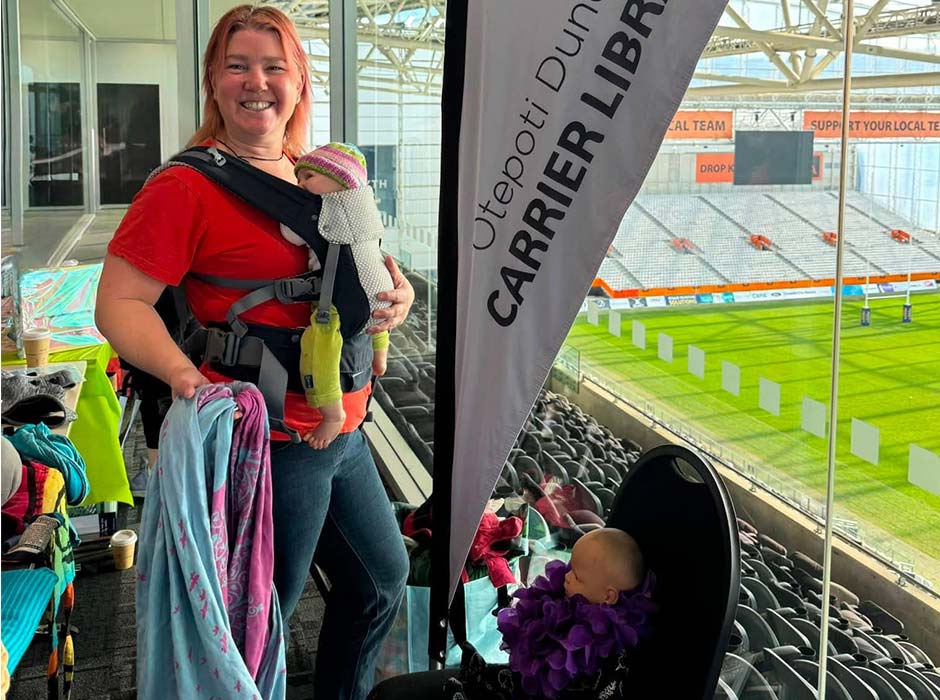
Donna Smith at the Postnatal Me Expo in August where she promoted the Ōtepoti Dunedin Carrier Library for whom she volunteers.
Donna says having lived the experience of needing to leave her boys in hospital and go home without them gave her a deeply personal insight into how traumatic that experience can be for families.
Once her children were discharged, they struggled to sleep anywhere but on her, so babywearing gave her the opportunity to cuddle them while still having her arms available for “things like cups of tea or going for a walk”.
Donna says babywearing was healing and helpful for her and her children, inspiring the PhD journey with the aim of supporting other whānau going through the same experience.
She believes tools that help with regulation, mood and attachment are vital for both the baby and the caregiver. Her research also considers how whānau can receive practical, individualised support to navigate safer babywearing after preterm birth.
“I want to explore how we can empower whānau, perinatal care providers and stakeholders to support safer babywearing, and work in partnership to navigate often complex, real-world contexts.”
Working with whānau across Aotearoa and the United Kingdom has shaped Donna’s understanding of the different circumstances in which families care for their babies. Supporting diverse whānau with high levels of socioeconomic disadvantage had a strong influence on her passion for equitable and practical healthcare that is accessible and culturally responsible.
World Prematurity Day is a global observance held annually on November 15. The University of Otago Clocktower building is lit up purple on the day to help raise awareness of the challenges of preterm birth and to honour the preterm born babies and their families
Kōrero by the Division of Health Sciences Communications Adviser Kelsey Swart