
Research into lagoon bathing, guided by Indigenous knowledge, aims to help underserved communities treat hypertension.
University of Otago – Ōtākou Whakaihu Waka PhD researcher Mary-Ann Rongo Moller is investigating whether naturally warm lagoons could provide an accessible way to lower blood pressure for Cook Islands Māori.
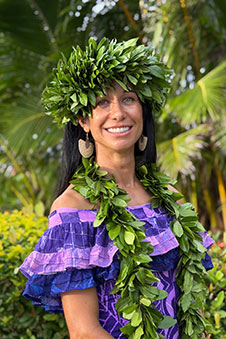
Mary-Ann Rongo Moller
“We're looking at specifically heart health equity. New Zealand Māori and Cook Islands Māori are really overrepresented in the statistics,” she says.
Like New Zealand Māori, Cook Islands Māori view health holistically, recognising the connection between people, kōpū tangata (family) and the natural environment.
She says many of those understandings have been passed down through generations.
“My Mum has always spoken about her grandparents talking to her about how the water can heal. If you're sick or anything's wrong, you go into the lagoon. ‘We didn't have the Papa’ā (Pākehā) medicine, we didn't need it, our natural environment heals us’, she’d say.”
Mary-Ann believes those cultural understandings have strengthened the research.
“When you're in the water, often people talk about feeling like they're like embraced by something greater than themselves.
“There's the vaerua (spiritual connection) to the water, to the natural environment. All of these other aspects could possibly have even greater improvements on your health compared to just sitting in warm water.”
Mary-Ann completed her undergraduate studies at Otago about 15 years ago before completing a master’s degree through Massey University by distance. She later decided, if she was to pursue a PhD, she “really wanted to come back to Otago”.
Her mother is from Rarotonga, though Mary-Ann grew up in Wellington with her father.
“I was actually somewhat removed from my culture, but my Dad tried really hard to take us to Cook Islands dancing classes and things like that.”
Although her previous research focused on menstrual health in female athletes, for her doctoral research, she wanted to do something that could directly benefit her Pacific community.
“Women doing the research for women is really important, and the same applies for Cook Islanders doing research for Cook Islanders.”
As the project developed, Mary-Ann realised it wasn’t enough to simply explain the science to the community.
The community needed to help shape the research itself.
“Eventually I came to the conclusion that I've got to stop trying to make Cook Islands Māori fit my English words.
“They're their own experts, their ancestors knew a lot. And so, why are we trying to make them fit into our world? And doing that actually results in worse health outcomes.”
That shift changed both the way she approached the research and her own understanding of culture.
“Your identity is directly linked to your ability to even do the research.”
Rather than relying solely on academic literature, Mary-Ann chose to lean on her family.
“I made a really clear decision to be guided by family. I have the most incredible aunties and uncles advising me culturally and connecting me with people. As well as my Mum.”
She says relationships are fundamental to earning trust within the community. In Rarotonga, taking time to visit family is just as important as collecting research data.
“The way you interact with people is completely different. For a research trip, if you go around and start ticking off research jobs and somebody says to you, ‘Have you gone to see your uncle yet?’ And if you say, ‘No, I haven't had time’, this would be frowned upon.”
She says the research must, firstly, make sense to the people it is intended for.
“If the people I'm hoping to serve with this don't understand it, then it doesn't matter how many research articles there are that support this, it doesn't work.”
The project has also had an unexpected impact on her own life.
Research has become a pathway back to her culture, strengthening relationships with her kōpū tangata and creating new conversations with her mother.
“I’ve been talking to her so much more, and I think it's changed the dynamic a bit, because now I'm coming to her and asking her questions. She gets really excited that someone's interested in her language, her culture, her family, and so I can actually see that she's also enjoying it.”
“It's like a journey of reconnection.”
The project builds on research by Clinical Exercise Physiology Lecturer Dr Brendon Roxburgh, whose work explores the health benefits of hot and warm water immersion. After reconnecting with her former lecturer and “academic hero” Professor Jim Cotter, Mary-Ann joined the project to help translate those laboratory findings into a real-world setting.
Working alongside her are Va’a O Tautai – Pacific Research Professor Jesse Kokaua and Senior Lecturer for the Department of Surgery and Critical Care Dr Kate Thomas. The project is funded by Pūtahi Manawa.