
Friday 7 August 2020 10:00am
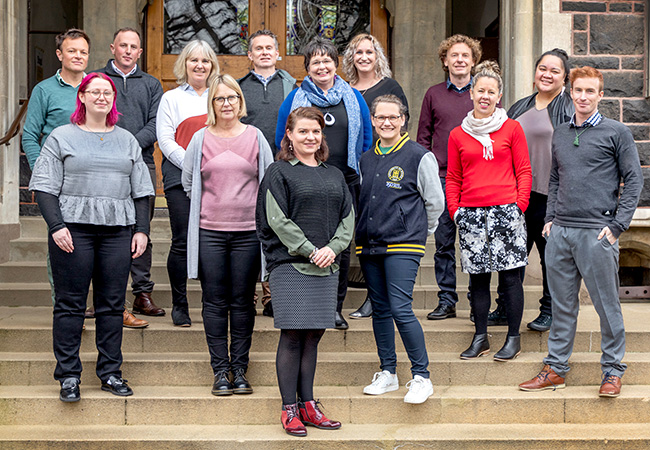
Members of the Otago Communications team.
A key part of any emergency response is good communication. University of Otago Communications Director Megan McPherson is proud of the way her team has stepped up during the COVID-19 emergency.
For a team that deals primarily in words, it’s the numbers that tell the story.
A good figure to start with is the 375,000 page views of the University’s dedicated COVID-19 website.
Since late January the site has been updated more than 600 times with information tailored to the requirements of students, staff and parents.
Some other numbers: 100 TV slots, 1,000 newspaper articles, 3,000 international media hits, 800,000 social media interactions.
It’s little wonder that Communications Director Megan McPherson is more than satisfied with the depth and breadth of pandemic messaging handled by the University’s communications advisers.
"There's just been an ocean of information and our job has been to make sense of that chaos,” Communications Director Megan McPherson.
“The size of the contribution from the whole team cannot be underestimated. There's just been an ocean of information and our job has been to make sense of that chaos.”
Clear, concise communication is a vital strand of any emergency response, according to University Incident Controller Andy Ferguson.
The role of the Communications Office is therefore integral to the University’s emergency planning and the staff already had experience in both real situations and simulations organised by the Incident Management Team (IMT).
When the IMT began its daily pandemic meetings, a communications adviser was in the room to help distil the daily waves of information into University-specific messages.
Student Health advisories, information on self-isolation for returning students, advice for staff on working from home, answers for concerned parents – the list grew every day.
With a need to establish a single source of valid information, the decision was made in the early planning to create the COVID-19 website.
(In January a communications adviser emailed the website team to thank them for setting it up. And he added: “Hopefully we won’t need it!”
That email is now part of the Communications team’s COVID-19 folklore, a story from the early days when the virus was viewed as a distant threat that might never materialise on these shores.)
Communications advisers worked with the Web Design team to keep the site updated and add additional sections as the need arose.
Kim Connelly, Manager, Marketing Content and Publications Unit, says the workload was demanding: “Web update requests often weren’t coming to us until the end of the day or into the evening so much of our work was after-hours.
The website acted as the definitive information repository, feeding a variety of communications channels - emails, texts, social media, the Student App, posters - tailored to each University audience.
“We’ve got an incredible crew of communications advisers here and they all know their audiences, really well,” says Ms McPherson.
“We were really aware from the start of the different vehicles we would use. For example, emails to parents and social media for students.
“The web was our single source of truth, the place you go to get accurate information, and everything we did drives back to that one page.”
Ms McPherson describes communications as “a meeting of your audiences’ needs and what the organisation needs them to know and do.”
In this case the volatile nature of the situation demanded a nimble approach – and some long hours - to keep pace with events. What was true one day was not necessarily true the next. Major changes arrived rapidly and without warning. There was an assumption that the University was getting information in advance from the Government but that was not the case.
“When the Prime Minister announced at five o'clock on a Saturday that the borders were shutting, that's how we found out too. We needed to work quickly that night to get correspondence to all staff overseas.
“It was real seat of the pants stuff. It was our job to work out ‘What does this mean for our staff and students and what can we do to help support them?’.”
The demands on the team expanded. Alongside the regular COVID updates the tasks piled up: producing regular newsletters for the PVCs to keep their informed staff, leading consistent engagement with Alumni, helping launch
the Student Relief Fund Pūtea Tautoko, supporting the Southern District Health Board and delivering the Otago magazine under lockdown conditions.
“Service above self is what you saw. I know people had their own personal challenges but they just keep going until it was finished – and stayed on call as well. Because you might go home and think it's over but there would be a call at nine o'clock at night saying something needed to be updated.”
The University was also fielding a constant stream of media calls and Otago researchers were becoming major figures on the national stage through their media presence.
High-profile Otago academics such as Professors Michael Baker and David Murdoch, both experienced media operators, were prominent in shaping the national discussion with evidence-based calls for a lockdown.
In the background, the communications team was supporting others to step into the spotlight.
One of those was Dr Ayesha Verrall, a Senior Lecturer in the Department of Pathology and Molecular Medicine.
Communications Team Leader Jo Galer has noticed a UK doctor’s live videos were receiving tens of thousands of views, and it was clear there was a real desire for trusted information.
Dr Verrall was approached and, with the help of Communications team members, did her first live broadcast on Facebook a few days later.
An audience quickly developed for her videos, and viewer numbers of 10,000+ were common.
The audience was asking questions, sharing the videos and tagging in friends, with feedback and comments lauding Dr Verrall’s ability to explain in simple terms the evolving elements of the pandemic.
Media organisations started taking note. Dr Verrall was suddenly in high demand in the media and was commissioned by the Ministry of Health to undertake a review of contact tracing.
With the return to Alert Level 1 and a semblance of normality, some of the lessons from the COVID-19 will carry over.
One example is the redesigned “yellow” alert emails which have received positive feedback from students and staff.
“It’s a format that worked really well - we’ve now done 17 staff and 12 student emails - and it’s worked so well we’re going to continue with it,” says Communications Advisory Service Manager Fiona Clarkson.
“The format's consistent and people recognise it so we've built ourselves a tool that will actually be tuned into a business as usual tool.”
The testing circumstances also generated other positives, Ms McPherson says.
“For the team this whole thing provided lots of opportunities for people to learn and grow and develop and they certainly made the most of all of those. There were incredible contributions at crazy hours under pressure and they continually delivered so I could not be more proud of them.”