
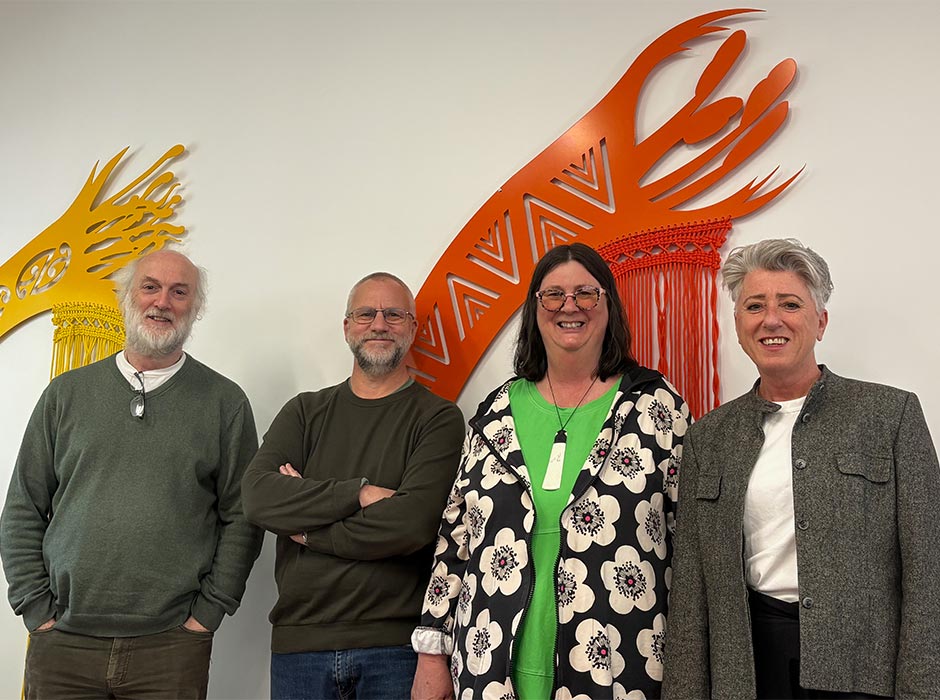
The team on the project ‘Mātai matū – Te Tiriti o Waitangi partnerships in chemistry curriculum, student and staff voices’ are, from left: Dr David Warren, Dr David McMorran, Dr Rachel Martin and Dr Kim Brown.
A mana-enhancing approach to better understand Māori students’ learning journeys in Chemistry has received support from a University of Otago Research Grant.
Over some years, Te Tari Mātauranga Matū – the Department of Chemistry at Otago has identified that most Māori students taking first year chemistry courses do not continue into second year.
Finding out why these students are not continuing their studies is part of the impetus for the project ‘Mātai matū – Te Tiriti o Waitangi partnerships in chemistry curriculum, student and staff voices’.
The Primary Investigator is Dr Kim Brown, Te Kura Ākau Taitoka - College of Education. Associate Investigators are Dr Dave Warren and Dr David McMorran from Chemistry and Dr Rachel Martin (Kāi Tahu, Kāti Māmoe, Waitaha), Māori Curriculum Kaitiaki in the office of DVC Māori.
Kim says the idea for the project started when Chemistry colleagues shared their concerns about this student drop off with her when she was guest lecturing on a 400-level Chemistry paper. She says Otago is not alone in this challenge.
“Research and commentary in Aotearoa Te Waipounamu and globally express concerns regarding disparities in achievement and an absence of belonging in the sciences for many Indigenous students and those from minoritised groups,” Kim says.
This research project is led by the question: how do chemistry students and staff experience undergraduate chemistry education in relation to aspects of decolonisation, the Articles of Te Tiriti o Waitangi, and manawhenuataka?
The project is informed by a Māori methodology creating thought spaces for student and staff perspectives, culminating with a tuakana-teina opportunity (supportive learning relationship between a more and a less knowledgeable person) where students and staff will be able to evaluate the project’s findings and begin processing implications for teaching and learning in undergraduate Chemistry.
Kim, Rachel and Assistant Research Fellow Yasmin Abdul Aziz adopted this approach with undergraduate students in another research project, which Kim says was rewarding.
“The exciting bit is the research methodology. The method creates an environment where students seem to feel safe to express concerns and ideas and the things that matter to them – and our hope is that this space will be equally productive and inclusive for staff.”
This research project places Te Tiriti o Waitangi, partnerships and relationships between students and staff at the heart of any attempt to develop a curriculum in Aotearoa Te Waipounamu that is attentive to decolonisation and Indigenisation, identity, belonging and inclusion.
This mana-enhancing approach could provide ideas for change within the Department of Chemistry and for other areas of the University seeking to work in partnership with students to find more meaningful ways to advance quality education and work towards meeting the Pae Tata strategic direction Whakamana I Te Tiriti o Waitangi domain.
Te Tari Mātauranga Matū
Chemistry is so much a part of our lives, sometimes we don't even notice it. It's at the heart of cooking and eating, breathing and seeing, the clothes we wear and the materials we use to construct our environment. While studying Chemistry at Otago, you'll look at how chemicals interact with each other, with light and with the environment; how to synthesise novel materials and measure trace amounts of pollutants.
Find out more