
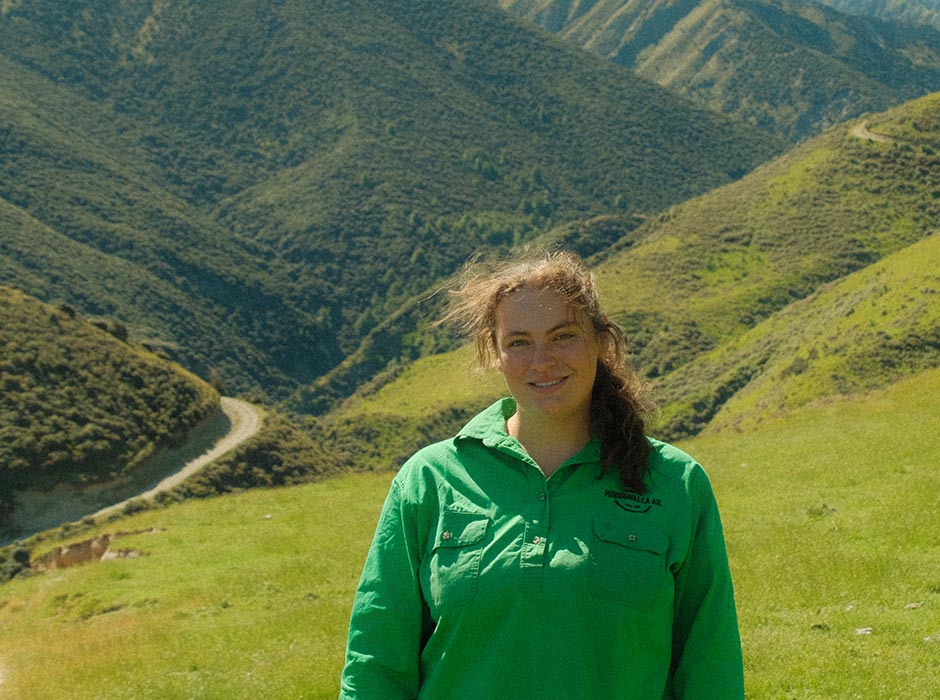
A proud fourth-generation farmer, Georgie Burdon chose the Bachelor of Applied Science at Otago because of the flexibility it gave her to “design my degree the way I wanted, follow my interests and figure out what really motivated me”. Georgie, seen here at the Glen Dene Station, graduates on Saturday.
Georgie Burdon might come from a traditional farming background but there was nothing traditional about the choices she made for her education.
The fourth-generation agriculture enthusiast, from the Lake Hāwea high-country station Glen Dene, chose Otago because it “was not labelled as an agricultural university”.
“At the time, I felt the more traditional agricultural courses around New Zealand weren’t pushing or challenging the rhetoric of sustainability. I wanted to explore that space in my own way.
“Otago contributes hugely to New Zealand’s primary industries, and I knew it had the people and the expertise, so I was willing to take a risk on a new course if it meant accessing that kind of education from a fresh perspective.”
It is a risk that has paid off for Georgie, who graduates today with a Bachelor of Applied Science (BAppSc), majoring in Agricultural Innovation.
Her three years at Otago have seen her receive University and national scholarships, launch a student club, take on advocacy work, a summer internship, an international exchange to the University of Virginia and working for an independent lobbyist in Washington D.C. All this while navigating study with dyslexia.
At the heart of it all is her passion for agriculture. It is one of the things that drew her to doing a BAppSc at Otago.
“Agriculture sits at the core of the three fundamental things people need — food, water, and fibre.
“As a country that markets itself on premium products and a clean, green image, we need to keep improving while navigating growing environmental and social pressures.
“I wanted to be a part of something progressive that would challenge and continue to push New Zealand to be the best it can be.”
Receiving the Otago New Frontiers Sustaining Excellence Scholarship helped kickstart her Otago journey.
“It gave me the confidence to work hard coming out of high school, and I felt like Otago recognised that effort from the moment I arrived.
“Financially, it took pressure off and made a big difference socially too. I didn’t need to get a job immediately in my first year, so I had time to meet people and settle in. With dyslexia, I’ve always had to work harder, so trying to juggle study, work, and settling socially would’ve taken a toll.”
“Even though Otago isn’t branded as an agricultural university, it plays a significant role through its research and teaching across departments like Botany, Pharmacology, Genetics, Business, Geography, and more. I wanted to help break down those barriers and celebrate Otago’s successes in the agricultural space.”
- Georgie Burdon
Dyslexia was a challenge during the transition to University, but Georgie found ways to make it work.
“By using the right tools, working hard, and asking for support, I eventually turned my dyslexia into an advantage.
“When it came to the innovation-focused parts of my degree, I found that my way of thinking helped ideas and connections flow more freely.”
Her way of thinking also fuelled her advocacy work, with one campaign in particular resulting in her being the first Otago recipient of the inaugural Ministry of Primary Industries On-Farm Support Science Scholarships.
The scholarships were initially open to students studying agriculture and horticulture at Massey and Lincoln universities, something Georgie didn’t quite agree with.
With the encouragement of Agricultural Innovation Programme Director Professor Craig Bunt, Georgie wrote to the Ministry for Primary Industries questioning their exclusion of Otago students.
“Even though Otago isn’t branded as an agricultural university, it plays a significant role through its research and teaching across departments like Botany, Pharmacology, Genetics, Business, Geography, and more.
“I wanted to help break down those barriers and celebrate Otago’s successes in the agricultural space.”
Being the first Otago recipient was such an honour, Georgie says.
“I’m proud that other students can now apply and access not just the financial support but also the mentoring the scholarship provides.”
Alongside this, Georgie was a part of Future Farmers – a platform for open discussion and debate about the future of New Zealand farming, and Guardians of Lake Hāwea – a sub-committee of the Hāwea Community Association.
She also helped launch the student club Food and Agriculture Student Association (FASA) in 2023 and was part of the inaugural executive team.
“Launching FASA was really exciting. I knew that coming to Otago as a farm kid, I might struggle to find other rural people, so creating that space mattered.”
In her final semester of study, Georgie went on exchange to the University of Virginia, supported by the Alumni of the University of Otago in America Inc Award.
“It was incredible being part of one of the top public universities, with such strong traditions. Many doors opened for me, and I absolutely encourage anyone to consider pushing themselves to do an exchange.”
While in America, she also had the opportunity to work for an independent lobbyist on Capitol Hill in Washington, D.C., attending committee hearings and meetings with clients and congressional staffers in the in the US House of Representatives.
Her biggest highlight from her time at Otago, though, was “the trust and support from Professor Craig Bunt”.
“Having someone I could question, collaborate with, and be challenged by prepared me so well for life beyond the classroom. Building that relationship was something I really valued.”
After crossing the graduation stage, Georgie is off to a job on a cattle station in Australia “for a bit of fun”.
“It’s like a gap year before I take on more study.
“I want to invest more in the business side of things so I can build a stronger skill set to help tackle the challenges agriculture will face over the next 50 years.”
~ Kōrero by Sandra French, Adviser, Internal Communications
Agricultural Innovation at Otago
Tackle critical food production strategies and build a career in the rapidly growing agricultural sector. With a focus on science and technology, learn how to make food systems more profitable and efficient while reducing environmental impacts.
Find out more