
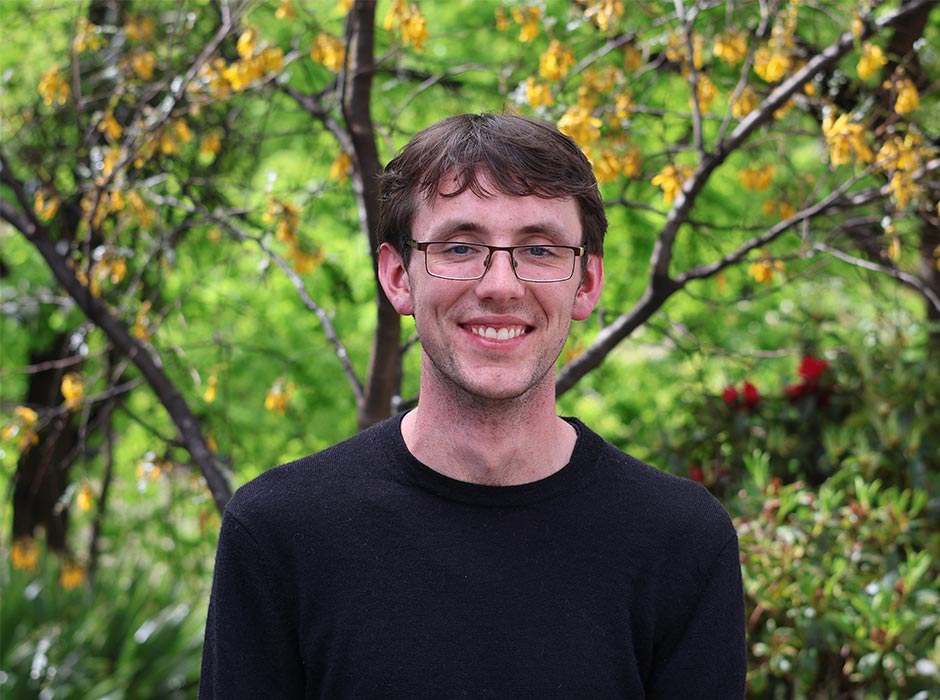
Over the course of their studies, Mathematics and Statistics PhD candidate Carlo Gamble has researched everything from earthquakes to typhoid disease – and now, oral health.
When the dental data of Dunedin Study participants was delivered to the Department of Mathematics and Statistics on a secure USB stick, PhD candidate Carlo Gamble couldn’t have predicted it would impact their own oral health.
“You open the data on your computer and there’s so much of it. It’s a daunting first month, trying to wrangle a seemingly infinite hoard of information. But once you’ve done that, you have your own little playground that you’ve set up,” Carlo says.
“I’m seeing all these ones and zeros in front of me, and tooth decay keeps going up over time for everyone in the study. My awareness of the importance of brushing and flossing has definitely increased!”
Carlo, who moved from Wellington to study at Otago, never thought they’d be studying teeth.
“I came here for Chemistry, but then I moved into Maths and Statistics,” they say.
“If you enjoy mathematics and you like equations and having the beautiful abstract model of reality, in statistics you actually get to use that to help scientists do their work.”
Statisticians need data, and Carlo says The Dunedin Study, a longitudinal research project that’s followed the same 1,037 people since their births in 1970, has produced excellent data sets.
“Each tooth has four or five surfaces, and participants have had every single surface on every tooth measured,” Carlo says.
“I had a tooth scan myself to see what it was like. It was quite fun – you get in the chair, and they use a scanner to create a 3D computer model of your mouth. There are 150 surfaces in each mouth, and each participant has had their adult teeth measured seven times. There’s almost too much data at times.”
Carlo’s analysis will help shape the research of the future in two ways – by providing a statistical model for tooth decay, and by helping us understand the socioeconomic factors that contribute to suboptimal oral health.
“A lot of the models I’m working on can also apply to diseases in populations. My job is to quantify the risk of spread.”
“If one tooth gets decayed the infection will weaken the other teeth. There’s some kind of clustering – the infection spreads out as if it was a disease in a population,” Carlo says.
“A lot of the models I’m working on can also apply to diseases in populations. My job is to quantify the risk of spread.”
Carlo envisages that in the future, their model could help predict the rate at which tooth decay will spread, enabling people to make informed decisions about when to undertake dental treatment.
“Fillings tend to be replaced with larger and larger fillings over time, so predicting the impact of different interventions can help dentists weigh up what the appropriate treatment is.”
Along with supporting the delivery of appropriate treatment options, Carlo’s findings could also impact future policy.
“I’m looking at which teeth are missing, the socioeconomic variables and the demographic data,” Carlo says.
“This may help us understand how often people are going to the dentist, and why certain populations are more disadvantaged. Policymakers can use that data to help people. My lofty goal is to create a statistical model flexible enough that other researchers can use it.”
Carlo makes a compelling case for studying Statistics.
“If you want to work with interesting people and do a lot of different things, if you don’t want to be confined to one area of study, and if you get enjoyment from understanding something complicated and feeling as though you’ve got some control over it, then Statistics feels like the place to be.”
With all those ones and zeros, you might think statistics can render life in black and white. But Carlo says it’s not that simple.
“In statistics we love to have uncertainty. There’s always a margin of error.”
But there’s one thing Carlo is sure about.
“Brush your teeth.”
– Kōrero by Kathryn van Beek, Communications Advisor | Kaiarataki Pārokoroko
Study Maths and Stats at Otago
Understand the fundamentals of mathematics and statistics and solve real world problems.
More about Maths and Stats