
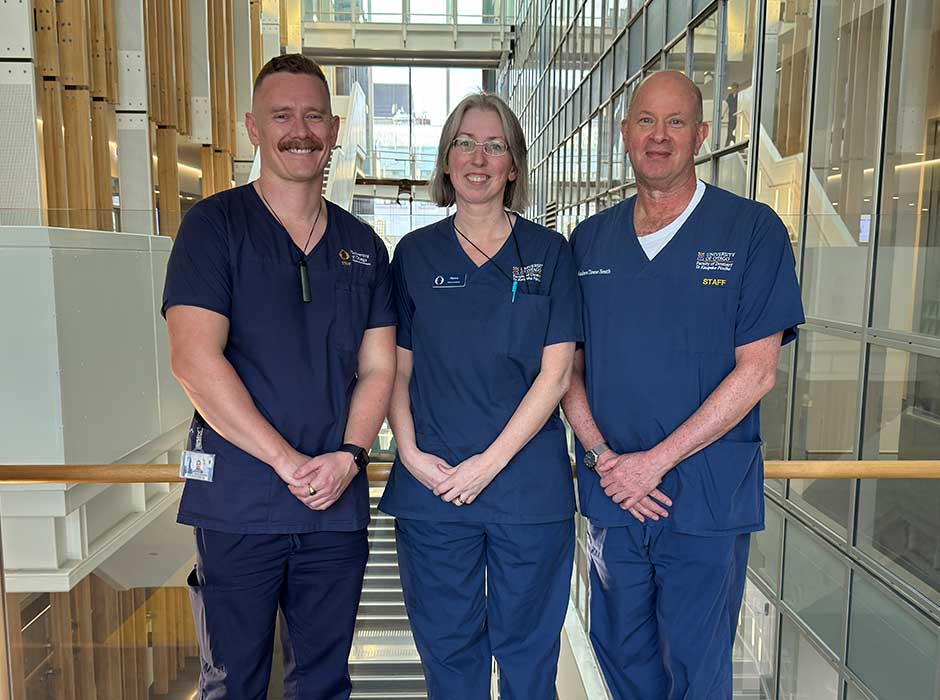
Professor Andrew Tawse-Smith and Senior Lecturers Hanna Olson and Samuel Carrington are elated to receive the University of Otago Research Group Award.
A Faculty of Dentistry research team has won the 2026 University of Otago Research Group award for developing state-of-the-art online teaching resources for both local and international dentistry and oral health students.
Comprised of Professor Andrew Tawse-Smith and Senior Lecturers Hanna Olson and Samuel Carrington (Te Arawa, Ngāti Whakaue, Ngāti Hurungaterangi), the team worked with several world-leading dental schools and educational organisations to develop the e-learning materials which cover foundational dentistry concepts.
This work was done in partnership with Karolinska Institute’s Department of Dental Medicine in Sweden, the University of Leuven’s Oral and Maxillofacial Surgery Centre in Belgium, and Atlas Education in England.
The University of Otago team led the pedagogical design and development of the educational resources for students, while international partners contributed expertise in periodontology, digital imaging, and virtual learning technologies.
Together, the group developed a blended-learning approach which integrates digital simulation, interprofessional education, and emerging artificial intelligence applications into a digital learning tool.
“Our team is elated and grateful to have received this award, as developing an educational tool that supports students from different countries with different learning levels to become internationally competent professionals has been quite the journey,” Andrew says.
“We wouldn’t have been able to do the extensive research and troubleshooting required to achieve this without the help of our partners and so we deeply appreciate their current and continued support.”
Hanna says the most rewarding part of the teams’ efforts has been the success students have experienced from using these tools.
“Early implementation studies showed that, when undergraduate dental and oral health therapy students used the digital resources during their pre-clinical sessions, there was a significant improvement in their knowledge and confidence,” Hanna says.
This teaching method is unlike what has existed before, and has been developed alongside the Dental Council of New Zealand’s standards of professionalism, communication, cultural safety, critical thinking, scientific and clinical knowledge, patient care, and community oral health.
Sam says Hauora Māori has been intentionally embedded throughout the e-learning tool rather than being positioned as an adjunct skill, so the exposure to Māori patients’ contexts, language and values might be normalised for students.
Even beyond the current funding period, the Otago team will keep working with its partners to improve this tool and ensure it’s embedded into the curricula of each partner institution.
Papers and conference proceedings being produced in relation to this work will also continue to be developed as further grant funding is sought to develop this innovation in the long-term and show the credibility and ongoing impact of this tool.
-Kōrero by Kelsey Swart, Division of Health Sciences Communications Adviser
Why study Dentistry?
Dentistry is a challenging profession that combines a high degree of manual dexterity and precision with a thorough understanding of craniofacial biology and pathology, and excellent communication skills.
View